


Japanese Yen trades with mild negative bias against USD; downside seems limited
- The Japanese Yen is undermined by a combination of factors, though it lacks bearish conviction.
- A positive risk tone, tariff jitters, and rebounding US bond yields exert upward pressure on USD/JPY.
- BoJ rate hike bets and the narrowing US-Japan rate differential should continue to underpin the JPY.
The Japanese Yen (JPY) drifted lower during the Asian session on Thursday, though it remains close to a multi-month top touched against its American counterpart earlier this week. Concerns that US President Donald Trump could impose fresh tariffs on Japan, along with a goodish rebound in the US Treasury bond yields and generally positive risk tone, undermine the safe-haven JPY. However, the growing acceptance that the Bank of Japan (BoJ) will hike interest rates further might hold back the JPY bears from placing aggressive bets.
Meanwhile, hawkish BoJ expectations continue to push the Japanese government bond (JGB) yields higher. In contrast, the US Treasury bond yields remain close to the lowest levels of the year amid bets that Trump's trade tariffs could trigger a sharp slowdown in US economic growth and force the Federal Reserve (Fed) to cut interest rates multiple times in 2025. The resultant narrowing of the US-Japan yield differential should further contribute to limiting any further JPY depreciation and cap the USD/JPY pair amid a bearish US Dollar (USD).
Japanese Yen bulls retain control amid rising bets for more rate hikes by BoJ
- US President Donald Trump alleged that Japan and China are guiding their currencies lower, and hinted that he could impose fresh tariffs on imports if this is not halted.
- The White House announced a one-month delay for US automakers to comply with the US–Mexico– Canada Agreement from the tariffs imposed on Mexico and Canada.
- This helps ease fears of a trade war and boosts investors' appetite for riskier assets, which, in turn, undermines the safe-haven Japanese Yen during the Asian session.
- Investors continue to bet on additional rate hikes by the Bank of Japan, pushing the yield on the 10-year Japanese government bond to its highest level since June 2009.
- BoJ Deputy Governor Shinichi Uchida said on Wednesday that the central bank will adjust its policy further if the outlook for economic activity and prices is realized.
- The US Treasury bond yields have been falling for six consecutive weeks amid concerns that Trump's trade barriers could slow economic growth in the long run.
- Moreover, Automatic Data Processing (ADP) reported that private sector employment in the US grew by just 77K in February, falling short of the 140K expected.
- This comes on top of a deterioration in US consumer confidence to a 15-month low and lifted bets that the Federal Reserve will restart cutting interest rates in June.
- The US Dollar bulls seem rather unimpressed by data showing that the economic activity in the US service sector continued to expand at an accelerating pace in February.
- The DXY prolongs its weekly downtrend for the fourth successive day and drops to the lowest level since November 6, which, in turn, should cap the USD/JPY pair.
- Traders now look to the usual Weekly Initial Jobless Claims data from the US for some impetus, though the focus remains on the US Nonfarm Payrolls on Friday.
USD/JPY seems vulnerable to retesting multi-month low, around the 148.00 mark
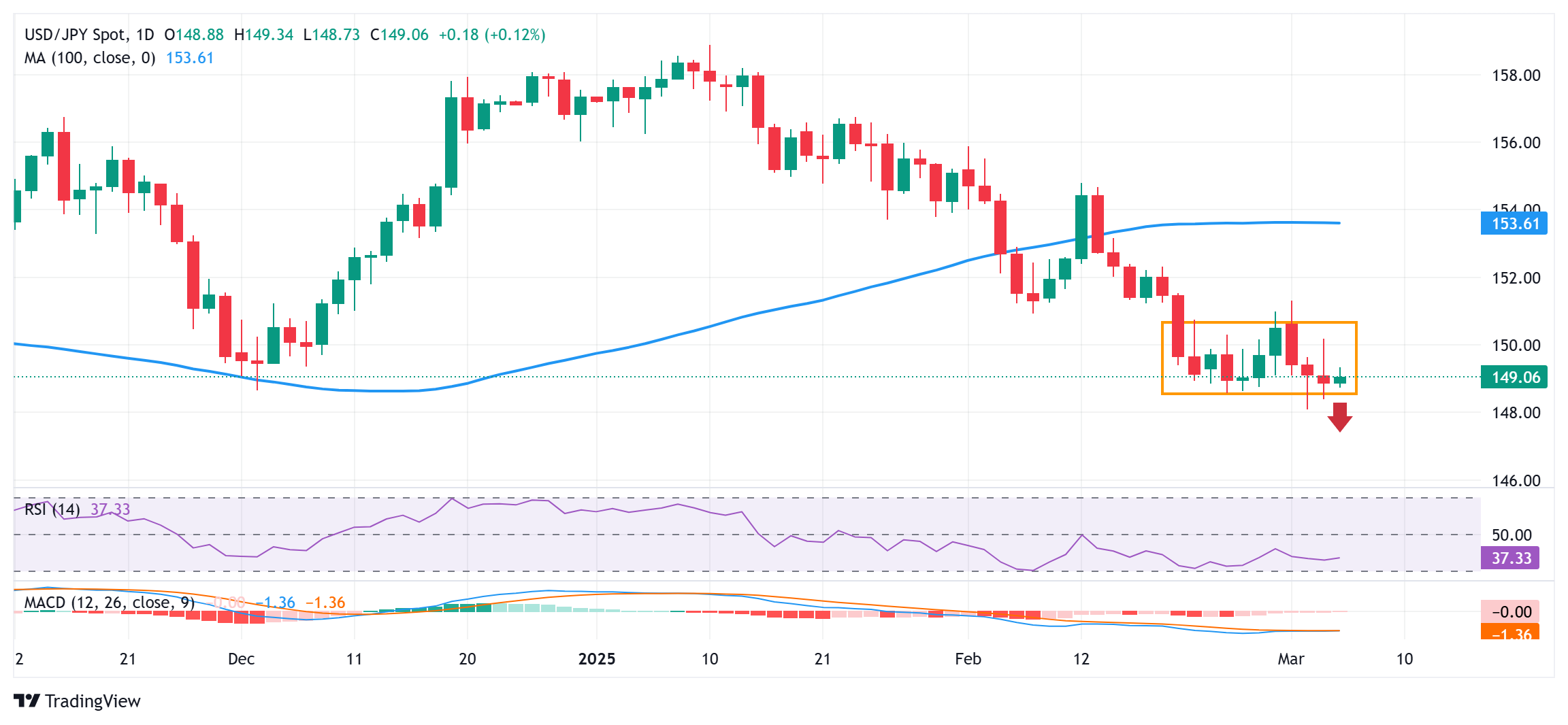
From a technical perspective, the USD/JPY pair has been oscillating in a familiar range over the past two weeks or so. Against the backdrop of the recent sharp fall from the vicinity of the 159.00 mark, or the year-to-date peak touched in January, this might still be categorized as a bearish consolidation phase. Moreover, oscillators on the daily chart are holding deep in negative territory and are still away from being in the oversold zone. This, in turn, suggests that the path of least resistance for spot prices remains to the downside and supports prospects for deeper losses.
Hence, a slide back below the 148.40 intermediate support, en route to the 148.00 neighborhood, or a multi-month low touched on Tuesday, looks like a distinct possibility. Some follow-through selling will be seen as a fresh trigger for bearish traders and make the USD/JPY pair vulnerable to accelerate the downfall towards the 147.35 region en route to the 147.00 round figure.
On the flip side, the 149.45-149.50 zone now seems to act as an immediate hurdle ahead of the 149.75 area and the 150.00 psychological mark. Sustained strength beyond the latter might trigger a short-covering rally and lift the USD/JPY pair to the next relevant hurdle near the 150.55-150.60 region. Any further move, however, could be seen as a selling opportunity near the 151.00 round figure and remain capped near the weekly high, around the 151.30 area.
Japanese Yen FAQs
The Japanese Yen (JPY) is one of the world’s most traded currencies. Its value is broadly determined by the performance of the Japanese economy, but more specifically by the Bank of Japan’s policy, the differential between Japanese and US bond yields, or risk sentiment among traders, among other factors.
One of the Bank of Japan’s mandates is currency control, so its moves are key for the Yen. The BoJ has directly intervened in currency markets sometimes, generally to lower the value of the Yen, although it refrains from doing it often due to political concerns of its main trading partners. The BoJ ultra-loose monetary policy between 2013 and 2024 caused the Yen to depreciate against its main currency peers due to an increasing policy divergence between the Bank of Japan and other main central banks. More recently, the gradually unwinding of this ultra-loose policy has given some support to the Yen.
Over the last decade, the BoJ’s stance of sticking to ultra-loose monetary policy has led to a widening policy divergence with other central banks, particularly with the US Federal Reserve. This supported a widening of the differential between the 10-year US and Japanese bonds, which favored the US Dollar against the Japanese Yen. The BoJ decision in 2024 to gradually abandon the ultra-loose policy, coupled with interest-rate cuts in other major central banks, is narrowing this differential.
The Japanese Yen is often seen as a safe-haven investment. This means that in times of market stress, investors are more likely to put their money in the Japanese currency due to its supposed reliability and stability. Turbulent times are likely to strengthen the Yen’s value against other currencies seen as more risky to invest in.
추천 기사


