


Japanese Yen retreats after hitting over two-month high against USD
- The Japanese Yen climbs to an over two-month top against USD amid BoJ rate hike bets.
- Retreating JGB yields cap the JPY and assists USD/JPY to bounce off sub-149.00 levels.
- The emergence of fresh USD selling should keep a lid on a further recovery for the pair.
The Japanese Yen (JPY) builds on last week's strong gains against its American counterpart and drags the USD/JPY pair below the 149.00 mark, or the lowest level since early December during the Asian session on Monday. Japan's strong Consumer Price Index (CPI) released on Friday comes on top of the upbeat Q4 Gross Domestic Product (GDP) growth report last week. This, along with expectations that sustained wage gains would spur consumer spending, suggests that the Bank of Japan (BoJ) might hike interest rates more aggressively than initially thought and continue to underpin the JPY.
Apart from this, the emergence of fresh US Dollar (USD) selling benefits the JPY and contributes to the USD/JPY pair's slide for the fourth straight day – marking the seventh day of a negative move in the previous eight. Meanwhile, BoJ Governor Kazuo Ueda showed readiness to ramp up government bond buying if long-term interest rates rise sharply. This, in turn, leads to a further pullback in the Japanese government bond (JGB) yields, from a multi-year peak touched last week, which prompts some intraday JPY selling and assists the currency pair in rebounding over 50 pips from the daily low.
Japanese Yen bulls retain control amid hawkish BoJ expectations
- Data released on Friday showed that Japan's core inflation touched a 19-month high in January and reinforced expectations that the Bank of Japan will keep raising interest rates.
- BoJ Governor Kazuo Ueda warned on Friday that the central bank could increase bond buying if abnormal market moves trigger a sharp rise in the government bond yields.
- The yield on the benchmark Japanese government bond (JGB) retreats further from its highest level since November 2009 set last week and caps gains for the Japanese Yen.
- A disappointing sales forecast from Walmart raised doubts about US consumer health and drags the US Dollar to over a two-month low during the Asian session on Monday.
- The flash S&P Global US Composite PMI dropped to 50.4 in February, from 52.7 in January, pointing to a weaker expansion in overall business activity across the private sector.
- Separately, the University of Michigan reported that its US Consumer Sentiment Index dropped more than expected, from 71.7 previous to 64.7 in February, or a 15-month low.
- Moreover, households saw inflation over the next year surging to 4.3% — the highest since November 2023 — and running at 3.5% — the highest since 1995 – over the next five years.
- Federal Reserve officials remain wary of future interest rate cuts amid sticky inflation and the uncertainty over US President Donald Trump's tariff plans and protectionist policies.
USD/JPY seems vulnerable while below 151.00-150.90 support breakpoint
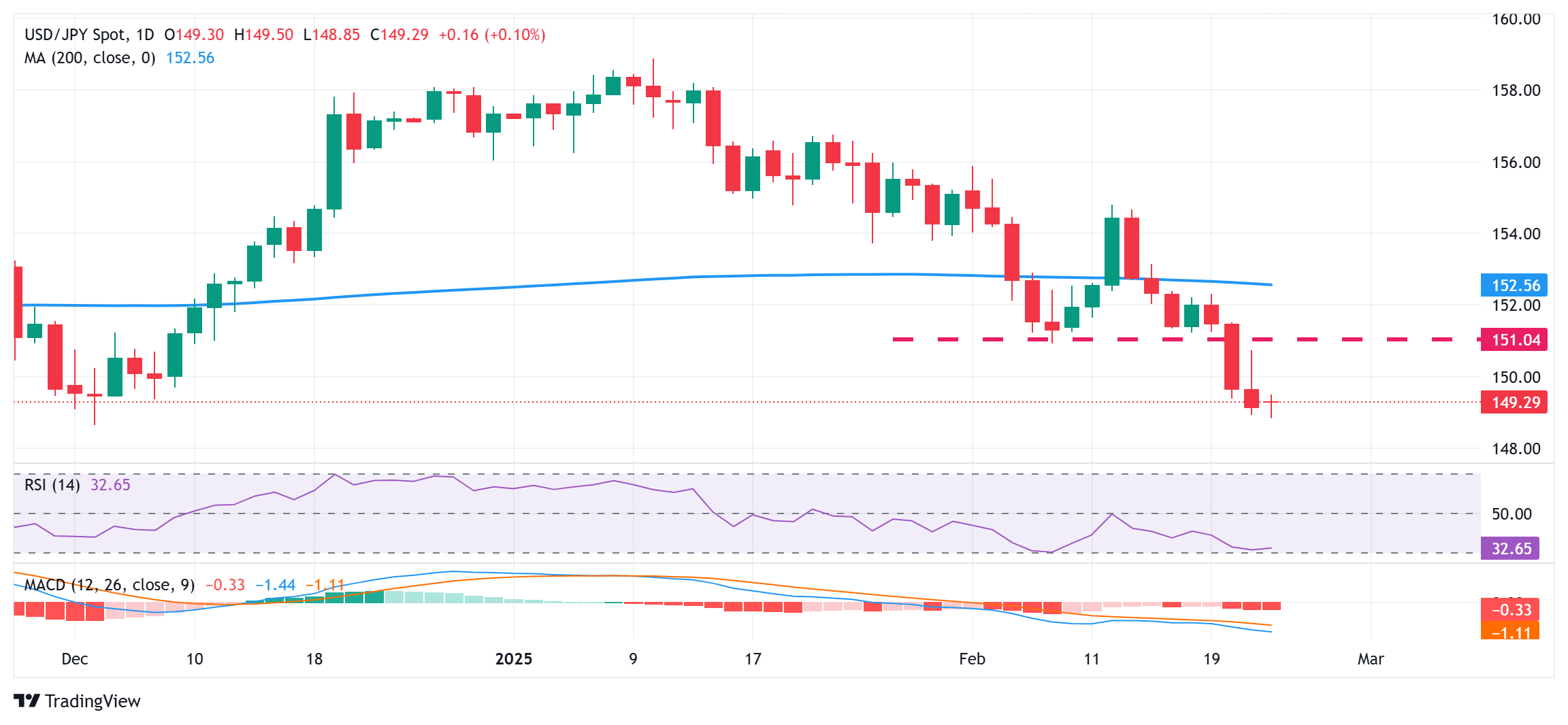
From a technical perspective, any subsequent move up is likely to confront stiff resistance near the 150.00 psychological mark. Some follow-through buying could lift the USD/JPY pair to last Friday's swing high, around the 150.70-150.75 region, en route to the 150.90-151.00 horizontal support breakpoint. The latter should act as a key pivotal point, which if cleared decisively might trigger a short-covering rally and lift spot prices beyond the 151.40 intermediate hurdle, towards the 152.00 mark. The momentum, however, runs the risk of fizzling out rather quickly near the 152.65 area, representing the very important 200-day Simple Moving Average (SMA).
On the flip side, the 149.00 mark, followed by the Asian session low around the 148.85 region, now seems to act as an immediate hurdle ahead of the 148.65 area, or the December 2024 trough. Failure to defend the said support levels would make the USD/JPY pair vulnerable to accelerate the fall further toward the 148.00 round figure. The downward trajectory could extend further towards the next relevant support near the 147.45 region before spot prices eventually drop to the 147.00 mark.
Japanese Yen FAQs
The Japanese Yen (JPY) is one of the world’s most traded currencies. Its value is broadly determined by the performance of the Japanese economy, but more specifically by the Bank of Japan’s policy, the differential between Japanese and US bond yields, or risk sentiment among traders, among other factors.
One of the Bank of Japan’s mandates is currency control, so its moves are key for the Yen. The BoJ has directly intervened in currency markets sometimes, generally to lower the value of the Yen, although it refrains from doing it often due to political concerns of its main trading partners. The BoJ ultra-loose monetary policy between 2013 and 2024 caused the Yen to depreciate against its main currency peers due to an increasing policy divergence between the Bank of Japan and other main central banks. More recently, the gradually unwinding of this ultra-loose policy has given some support to the Yen.
Over the last decade, the BoJ’s stance of sticking to ultra-loose monetary policy has led to a widening policy divergence with other central banks, particularly with the US Federal Reserve. This supported a widening of the differential between the 10-year US and Japanese bonds, which favored the US Dollar against the Japanese Yen. The BoJ decision in 2024 to gradually abandon the ultra-loose policy, coupled with interest-rate cuts in other major central banks, is narrowing this differential.
The Japanese Yen is often seen as a safe-haven investment. This means that in times of market stress, investors are more likely to put their money in the Japanese currency due to its supposed reliability and stability. Turbulent times are likely to strengthen the Yen’s value against other currencies seen as more risky to invest in.
추천 기사


