


USD/INR weakens on RBI’s likely intervention
- The Indian Rupee gains momentum in Tuesday’s Asian session.
- The routine interventions by the RBI support the INR; portfolio outflows and a stronger USD might cap its upside.
- Kansas City Fed President Jeffrey Schmid is set to speak later on Tuesday.
The Indian Rupee (INR) extends the rally on Tuesday, bolstered by the intervention by the Reserve Bank of India (RBI) to prevent the local currency from significant depreciation. Furthermore, the recovery in crude oil prices provides some support to the INR as India is the world's third-largest oil consumer.
Nonetheless, the sustained outflow of foreign funds and the renewed US Dollar (USD) demand might exert some selling pressure on the Indian Rupee. A decline in most Asian currencies also weighs on the local currency for the time being. In the absence of top-tier US economic data releases on Tuesday, the attention will be on risk sentiment and the US Federal Reserve’s (Fed) Jeffrey Schmid speech.
Indian Rupee rebounds as RBI Intervention caps decline
- The Indian equity benchmark indices, the Sensex, declined 0.31% to 77,339.01 points on Monday, closing 10.05% below its record high level hit on September 27. The Nifty fell 0.34%, its longest falling streak in more than 20 months.
- India's foreign exchange reserves fell to $675.65 billion for the sixth week in a row, from a record high of $704 billion in late September.
- DBS Bank estimated India's economic growth will moderate to 6.0% in 2025 and 2026, down from 8.2% in 2024.
- Moody's Ratings projected the Indian economy to grow by 7.2% in 2024, driven by a gradual recovery in household spending and easing inflation pressures.
- The National Association of Home Builders (NAHB) Housing Market Index climbed to 46.0 in November, the highest since April, from 43.0 in October, beating the estimate of 44.0.
USD/INR’s outlook remains positive in the longer term
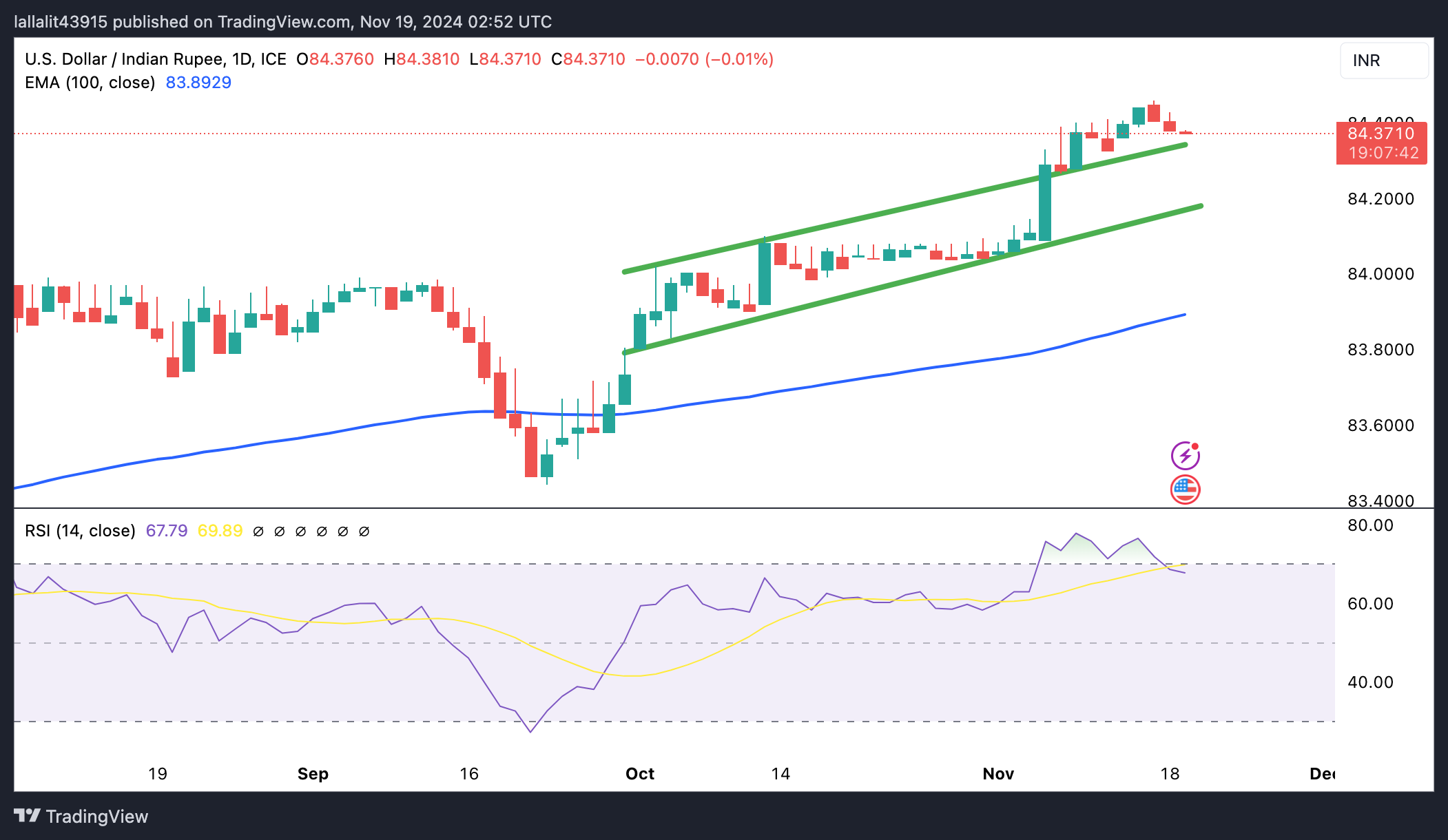
The Indian Rupee trades on a stronger note on the day. The bullish outlook of the USD/INR pair prevails as the pair remains above the key 100-day Exponential Moving Average (EMA) on the daily chart. Additionally, the 14-day Relative Strength Index (RSI) is located above its midline near 67.00, suggesting that the support is likely to hold rather than break.
The first upside barrier to watch is the all-time high of 84.45. A decisive break above this level could clear the way for a move to the 85.00 psychological level.
On the flip side, the resistance-turned-support level at 84.35 acts as an initial support level for USD/INR. A move below the mentioned level could expose 84.00, the round mark. Extended losses could see a drop to 83.89, the 100-day EMA.
Indian Rupee FAQs
The Indian Rupee (INR) is one of the most sensitive currencies to external factors. The price of Crude Oil (the country is highly dependent on imported Oil), the value of the US Dollar – most trade is conducted in USD – and the level of foreign investment, are all influential. Direct intervention by the Reserve Bank of India (RBI) in FX markets to keep the exchange rate stable, as well as the level of interest rates set by the RBI, are further major influencing factors on the Rupee.
The Reserve Bank of India (RBI) actively intervenes in forex markets to maintain a stable exchange rate, to help facilitate trade. In addition, the RBI tries to maintain the inflation rate at its 4% target by adjusting interest rates. Higher interest rates usually strengthen the Rupee. This is due to the role of the ‘carry trade’ in which investors borrow in countries with lower interest rates so as to place their money in countries’ offering relatively higher interest rates and profit from the difference.
Macroeconomic factors that influence the value of the Rupee include inflation, interest rates, the economic growth rate (GDP), the balance of trade, and inflows from foreign investment. A higher growth rate can lead to more overseas investment, pushing up demand for the Rupee. A less negative balance of trade will eventually lead to a stronger Rupee. Higher interest rates, especially real rates (interest rates less inflation) are also positive for the Rupee. A risk-on environment can lead to greater inflows of Foreign Direct and Indirect Investment (FDI and FII), which also benefit the Rupee.
Higher inflation, particularly, if it is comparatively higher than India’s peers, is generally negative for the currency as it reflects devaluation through oversupply. Inflation also increases the cost of exports, leading to more Rupees being sold to purchase foreign imports, which is Rupee-negative. At the same time, higher inflation usually leads to the Reserve Bank of India (RBI) raising interest rates and this can be positive for the Rupee, due to increased demand from international investors. The opposite effect is true of lower inflation.
추천 기사


