


EUR/USD rises ahead of Fed meeting, Trump 2.O keeps downside bias intact
- EUR/USD recovers to near 1.0770 ahead of Fed policy while Trump's victory keeps downside bias intact
- German three-party coalition collapsed, paving the way for snap elections in early 2025.
- The Fed is expected to cut interest rates by 25 bps to 4.50%-4.75%.
EUR/USD rebounds to near 1.0770 in European trading hours on Thursday. The major currency pair bounces back after posting a more than four-month low below 1.0700 on Wednesday. The recovery comes as the US Dollar (USD) corrects ahead of the Federal Reserve’s (Fed) interest rate decision, which will be published at 19:00 GMT.
On Wednesday, the USD Index surged more than 1.6% – the highest single-day gain in almost four years – as United States (US) citizens chose Republican Donald Trump in the presidential elections over Democratic candidate Kamala Harris. The reasoning behind the US Dollar’s rally was Trump’s promise to raise import tariffs and lower corporate taxes. On Thursday, the US Dollar Index (DXY), which tracks the Greenback’s value against six major currencies, drops to near 104.80 after Wednesday’s rally.
Higher tariffs would make imported products more expensive for US citizens and corporations, likely fuelling inflation. Lower taxes could also stimulate spending, contributing to price pressures as well. This scenario would make it more difficult for the Federal Reserve (Fed) to continue with its rate-cutting cycle.
As for the Fed’s monetary policy meeting, traders have priced in a 25 basis points (bps) interest rate cut that will push interest rates lower to 4.50%-4.75%, according to the CME FedWatch tool. As the Fed is widely anticipated to cut interest rates, investors will pay close attention to the monetary policy statement and Fed Chair Jerome Powell’s press conference. Investors would like to know whether the Fed will slow its policy-easing cycle if Trump implements what he promised during the campaign.
Daily digest market movers: EUR/USD rebounds despite multiple headwinds
- EUR/USD recovers sharply to near 1.0770 at the US Dollar’s expense. However, the outlook of the major currency pair remains vulnerable as the Eurozone economy is expected to face a significant burden from Trump’s protectionist policies.
- The blanket 10% tariff on all imported goods advocated by Trump would have a negative impact of 0.1% on the European Union’s (EU) Gross Domestic Product (GDP), according to a recent London School of Economics and Political Science paper.
- At the conference in London on Wednesday, European Central Bank (ECB) Vice President Luis de Guindos warned that tariffs from the US could lead to a vicious cycle of trade war globally. "If you impose a tariff, you have to bear in mind that the other party is going to react, and it’s going to retaliate, and that could give rise to a vicious circle of in terms of inflation, tariffs, which could be the worst possible result and outcome," Guindos said, Reuters reported.
- Meanwhile, the collapse of the German three-party coalition has also added to downside risks of economic growth in the shared continent. On Wednesday, German Chancellor Olaf Scholz fired Federal Minister of Finance Christian Lindner, paving the way for snap elections in early 2025. “It was necessary to prevent harm to our country,” Scholz said, CNN reported.
- On the economic data front, German Industrial Production declined by 2.5%, faster than 1% contraction expected by market participants in September on month.
Technical Analysis: EUR/USD bounces back to near 1.0770
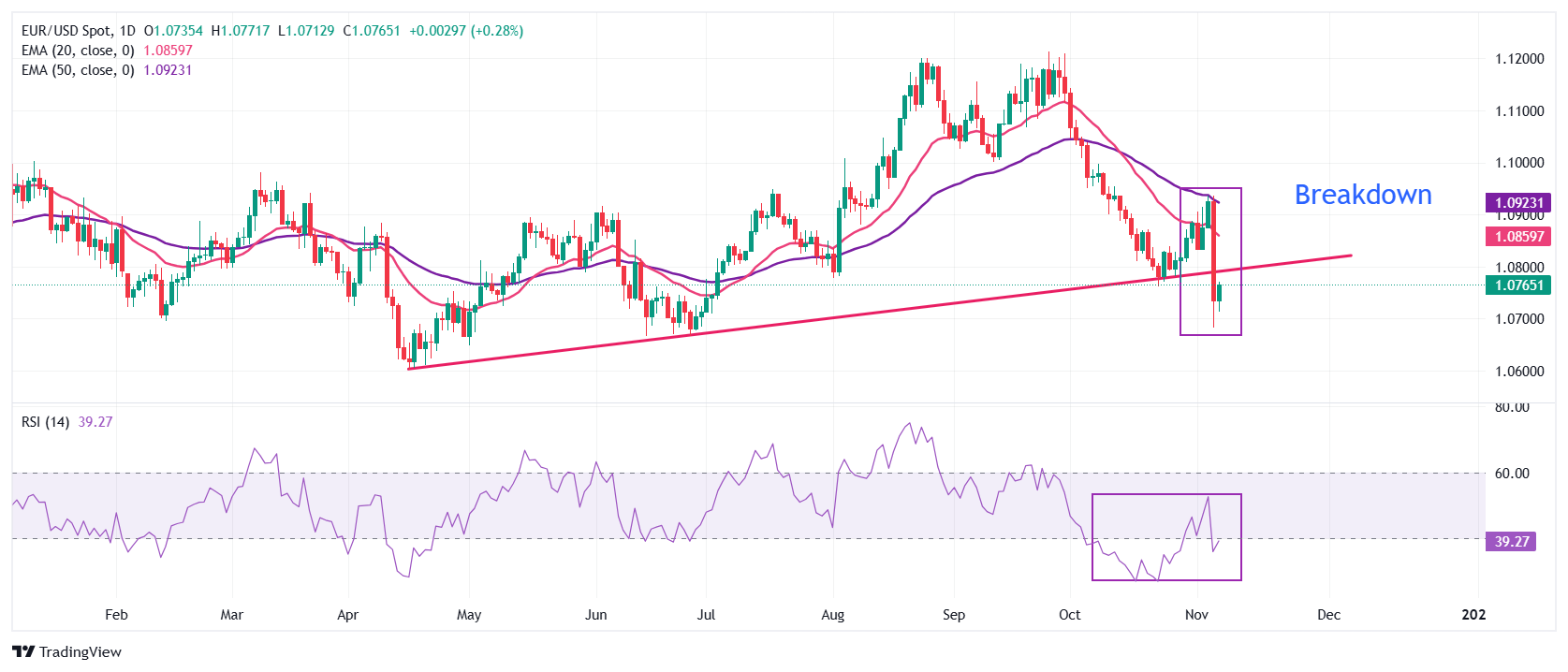
EUR/USD rebounds to near 1.0770 after discovering buying interest below the key support of 1.0700. However, the major currency pair’s recovery appears to be lacking strength as declining 20-day and 50-day Exponential Moving Averages (EMAs) near 1.0860 and 1.0920, respectively, suggest a strong bearish trend.
Additionally, the 14-day Relative Strength Index (RSI) retreats below 40.00, suggesting a resumption of the bearish momentum.
The upward-sloping trendline around 1.0800, which is plotted from the April 16 low at around 1.0600, will act as a key resistance zone for Euro (EUR) bulls. Looking down, the shared currency pair could decline to the year-to-date (YTD) low of 1.0600.
Euro FAQs
The Euro is the currency for the 19 European Union countries that belong to the Eurozone. It is the second most heavily traded currency in the world behind the US Dollar. In 2022, it accounted for 31% of all foreign exchange transactions, with an average daily turnover of over $2.2 trillion a day. EUR/USD is the most heavily traded currency pair in the world, accounting for an estimated 30% off all transactions, followed by EUR/JPY (4%), EUR/GBP (3%) and EUR/AUD (2%).
The European Central Bank (ECB) in Frankfurt, Germany, is the reserve bank for the Eurozone. The ECB sets interest rates and manages monetary policy. The ECB’s primary mandate is to maintain price stability, which means either controlling inflation or stimulating growth. Its primary tool is the raising or lowering of interest rates. Relatively high interest rates – or the expectation of higher rates – will usually benefit the Euro and vice versa. The ECB Governing Council makes monetary policy decisions at meetings held eight times a year. Decisions are made by heads of the Eurozone national banks and six permanent members, including the President of the ECB, Christine Lagarde.
Eurozone inflation data, measured by the Harmonized Index of Consumer Prices (HICP), is an important econometric for the Euro. If inflation rises more than expected, especially if above the ECB’s 2% target, it obliges the ECB to raise interest rates to bring it back under control. Relatively high interest rates compared to its counterparts will usually benefit the Euro, as it makes the region more attractive as a place for global investors to park their money.
Data releases gauge the health of the economy and can impact on the Euro. Indicators such as GDP, Manufacturing and Services PMIs, employment, and consumer sentiment surveys can all influence the direction of the single currency. A strong economy is good for the Euro. Not only does it attract more foreign investment but it may encourage the ECB to put up interest rates, which will directly strengthen the Euro. Otherwise, if economic data is weak, the Euro is likely to fall. Economic data for the four largest economies in the euro area (Germany, France, Italy and Spain) are especially significant, as they account for 75% of the Eurozone’s economy.
Another significant data release for the Euro is the Trade Balance. This indicator measures the difference between what a country earns from its exports and what it spends on imports over a given period. If a country produces highly sought after exports then its currency will gain in value purely from the extra demand created from foreign buyers seeking to purchase these goods. Therefore, a positive net Trade Balance strengthens a currency and vice versa for a negative balance.
추천 기사


