


Mexican Peso rebounds slightly after four-day decline on Trump tariff fears
- The Mexican Peso rebounds slightly, but struggles to recover recent losses despite higher-than-expected economic growth in Q3.
- Technical trend-following and the threat of a Trump victory is probably a factor weighing on the Peso as polls show a close race.
- USD/MXN continues unfolding a bullish ‘abc’ pattern.
The Mexican Peso (MXN) trades mixed in its key pairs – USD/MXN, EUR/MXN and GBP/MXN – on Thursday after weakening for four days running. The continuation lower comes despite a slight improvement in Mexican fundamentals as technical traders ride the Peso’s downtrend.
Mexican Peso struggles as US presidential election draws to a close
The Mexican Peso’s broad weakness could be attributed to the continuing high odds of former President Donald Trump winning the US presidential election on November 5 given his promise to place high tariffs on Mexican imports. In addition, Trump’s preference for lowering taxes despite a rising US debt pile could also potentially lead to higher US Treasury yields and boost the US Dollar (USD), directly impacting USD/MXN.
The election model on polling website FiveThirtyEight gives Trump a 52% chance of winning versus Vice President Kamala Harris’ 48%. Betting website OddsChecker offers fractional odds of 11/18 (or 62.1%) for a Trump win against 28/17 (or 37.8%) for a Kamala Harris victory. The latest opinion polls, however, still place Harris marginally in the lead with 48.1% for the Democrat nominee versus 46.7% for the Republican.
The direct negative impact of a Trump victory on Mexico might be ameliorated, however, by the reality of modern trade between the countries. US, Mexican and Canadian supply chains and economic ecosystems are now intertwined due to three decades of free trade agreements, Mexican imported goods are actually often composed of an amalgam of the three country’s components so tariffs would harm the US as much as Mexico.
Mexican Growth in Q3 beats estimates
The latest macroeconomic figures, meanwhile, offered some relief to the Peso but not enough to push back the tide. Mexican Gross Domestic Product (GDP) growth came out at 1.5% YoY in Q3, beating estimates of 1.2% but below the 2.1% registered in Q2, according to The Instituto Nacional de Estadistica Geografia e Informatica (INEGI). This follows 1.5% growth In Q1.
The Q3 result was exactly in line with the estimates of the International Monetary Fund (IMF), which downgraded its forecasts for Mexican economic growth by 1.5% for 2024.
On a quarterly basis, Mexican GDP rose by 1.0% QoQ, beating estimates of a 0.8% expansion and the previous quarter’s 0.2% increase.
The growth was broad-based and a positive development, however, it would not “preclude another rate cut in November” from the Bank of Mexico (Banxico), according to Kimberley Sperrfechter, Emerging Markets Economist at London-based advisory service Capital Economics. A cut to Mexico’s relatively attractive 10.50% base interest rate would attract less foreign capital inflows, pressuring the Peso lower.
“We still think the conditions are currently in place for Banxico to press ahead with another interest rate cut at its November meeting. But a lot will depend on the outcome of the US election. A Trump victory – and higher US Treasury yields and a stronger Dollar – would probably prompt Banxico to halt,” said Sperrfechter in a note.
Technical Analysis: USD/MXN extends C wave of bullish pattern
USD/MXN continues unfolding a leg higher, probably the “c wave” of a bullish “abc” pattern, which began at the October 14 swing low.
Wave c will probably reach the Fibonacci 61.8% of the length of wave “a”, giving an upside target of 20.29.
USD/MXN Daily Chart
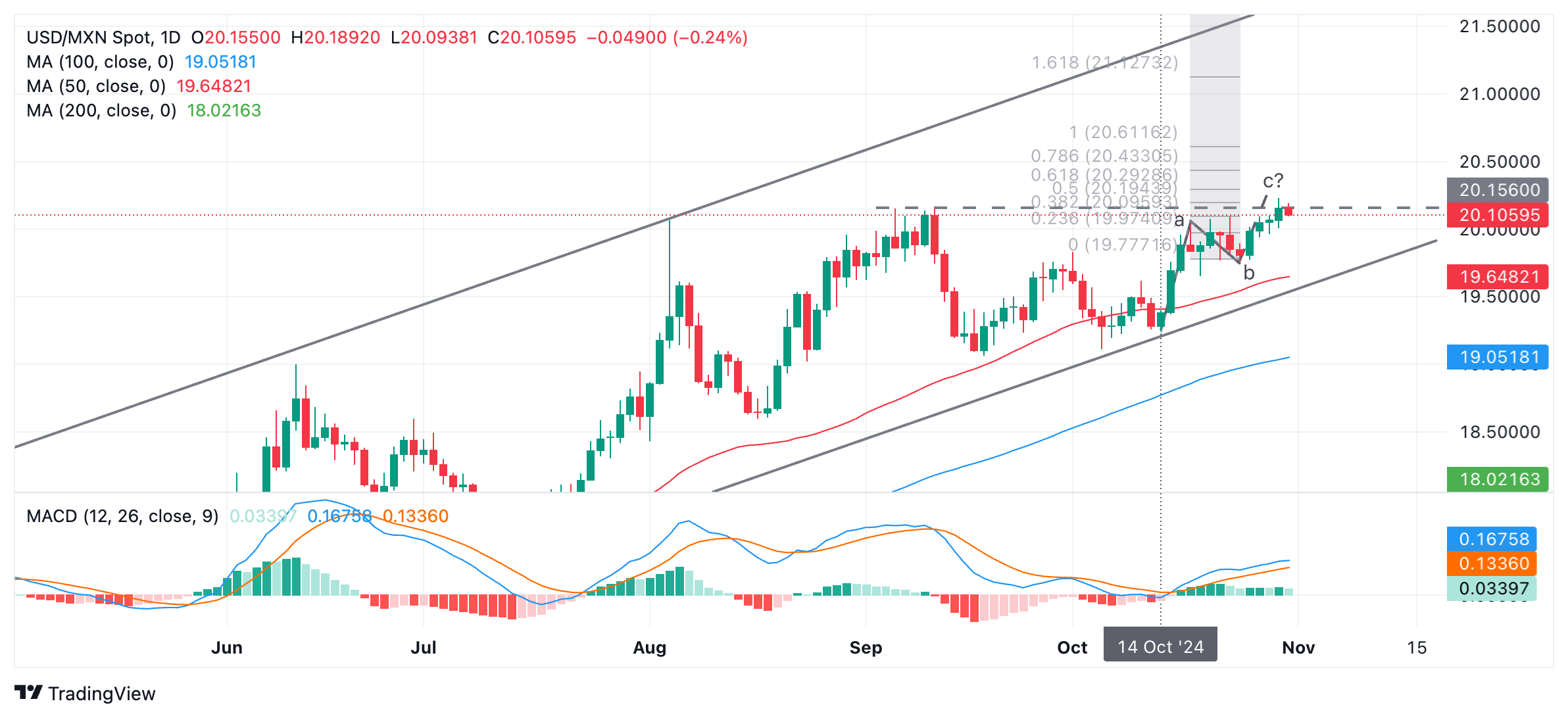
USD/MXN is probably in an uptrend on a short, medium and long-term basis and is trading in a rising channel. Given the technical dictum “the trend is your friend,” the odds favor a continuation higher.
The original break above 19.83 (October 1 high) already confirmed a move up, with a target in the vicinity of the September 10 high at 20.13, which has now been met.
Mexican Peso FAQs
The Mexican Peso (MXN) is the most traded currency among its Latin American peers. Its value is broadly determined by the performance of the Mexican economy, the country’s central bank’s policy, the amount of foreign investment in the country and even the levels of remittances sent by Mexicans who live abroad, particularly in the United States. Geopolitical trends can also move MXN: for example, the process of nearshoring – or the decision by some firms to relocate manufacturing capacity and supply chains closer to their home countries – is also seen as a catalyst for the Mexican currency as the country is considered a key manufacturing hub in the American continent. Another catalyst for MXN is Oil prices as Mexico is a key exporter of the commodity.
The main objective of Mexico’s central bank, also known as Banxico, is to maintain inflation at low and stable levels (at or close to its target of 3%, the midpoint in a tolerance band of between 2% and 4%). To this end, the bank sets an appropriate level of interest rates. When inflation is too high, Banxico will attempt to tame it by raising interest rates, making it more expensive for households and businesses to borrow money, thus cooling demand and the overall economy. Higher interest rates are generally positive for the Mexican Peso (MXN) as they lead to higher yields, making the country a more attractive place for investors. On the contrary, lower interest rates tend to weaken MXN.
Macroeconomic data releases are key to assess the state of the economy and can have an impact on the Mexican Peso (MXN) valuation. A strong Mexican economy, based on high economic growth, low unemployment and high confidence is good for MXN. Not only does it attract more foreign investment but it may encourage the Bank of Mexico (Banxico) to increase interest rates, particularly if this strength comes together with elevated inflation. However, if economic data is weak, MXN is likely to depreciate.
As an emerging-market currency, the Mexican Peso (MXN) tends to strive during risk-on periods, or when investors perceive that broader market risks are low and thus are eager to engage with investments that carry a higher risk. Conversely, MXN tends to weaken at times of market turbulence or economic uncertainty as investors tend to sell higher-risk assets and flee to the more-stable safe havens.
추천 기사


