


Mexican Peso extends losing streak amid risk aversion
- Mexican Peso continues to weaken, recording losses for three consecutive days amid increasing risk aversion.
- Fed Governor Waller supports the recent 50 bps rate cut, pointing to easing inflation and hinting at further cuts if labor conditions deteriorate.
- Banxico anticipated to lower rates by 25 bps next week, potentially sustaining an appealing interest rate differential to support the Peso.
The Mexican Peso extended its losing streak against the Greenback to three consecutive days, with the currency set to sustain weekly losses. Risk aversion hurts the Peso's prospects, which hasn’t been able to capitalize on the Federal Reserve’s (Fed) decision to lower rates for the first time in four years. This exerts pressure on the US Dollar, but the USD/MXN remains firm and trades at 19.38, printing gains of over 0.42%.
Wall Street reversed course on Friday as traders digested the decisions of three major central banks, particularly the Fed. Fed Governor Christopher Waller said on CNBC that cutting 50 basis points was right, justifying its decision based on estimates that the August Personal Consumption Expenditures Price Index (PCE) will be very low.
Waller added that inflation is softening faster than he thought and is concerned about that. He stated that they could do more if the labor market worsens and if the inflation data softens quickly.
South of the border, Mexico’s economic docket is scarce, and traders are eyeing next week with the release of Economic Activity, Retail Sales, inflation data, and the Bank of Mexico (Banxico) monetary policy decision.
Regarding the political turmoil, the week has been calm since the signing into law of the judicial reform.
Meanwhile, traders are eyeing Banxico’s decision. Most analysts estimate a rate cut of at least 25 basis points from 10.75% to 10.50%, which would reduce the interest rate differential slightly. It should, however, will remain attractive to investors and boost the Mexican currency.
Daily digest market movers: Mexican Peso falls, awaiting next week’s data
- According to different banks and rating agencies, the impact of overhauling the judicial system remains far from being felt. The lack of a state of law and transparency could be factors in adjusting Mexico’s creditworthiness over the longer term.
- On Wednesday, the Fed cut rates by 50 bps, justifying its decision on the progress on inflation, which is sustainably moving toward its 2% goal. The US central bank focus shifted onto the labor market.
- The Fed expects inflation to condense to 2.6% in 2024, 2.2% in 2025, and 2% by 2026, according to the Core Personal Consumption Expenditures Price Index.
- Fed officials estimate the US economy will grow at a 2% pace in 2024, with the Unemployment Rate rising to 4.4% by the end of the year.
- December 2024 fed funds rate futures contracting suggests that the Fed might lower rates by at least 53 basis points, implying that in the following two meetings, the market expects two 25 bps rate cuts left in 2024.
USD/MXN technical outlook: Mexican Peso tumbles as USD/MXN rallies above 19.35
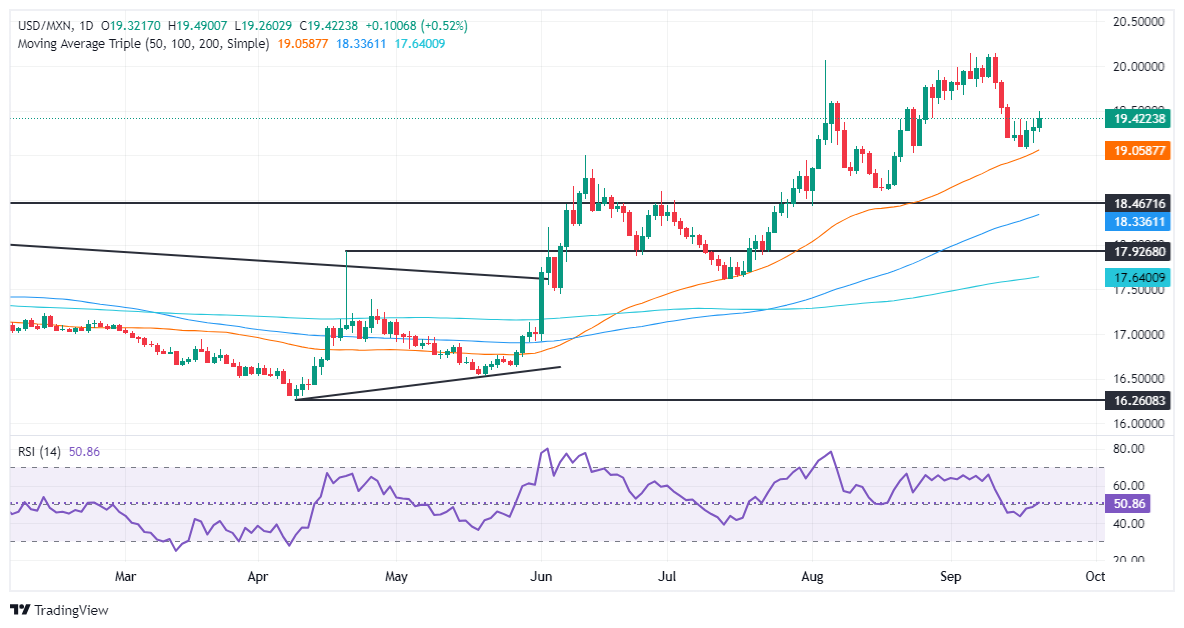
From a technical standpoint, the USD/MXN is upwardly biased despite retreating from around 20.00 toward the September 18 swing low of 19.06. Next week, Banxico is expected to lower rates, which could push the exchange rate out of the 19.00-19.50 range.
Momentum shifted bullishly as the Relative Strength Index (RSI) crossed above its neutral line, while aiming upward.
If the USD/MXN climbs above 19.50, the next resistance would be the 20.00 psychological level. Further upside emerges at the yearly peak at 20.22, followed by the 20.50 mark.
Conversely, if the USD/MXN drops below the September 18 low of 19.06, the psychological 19.00 figure will be exposed. Further losses lie underneath, with buyers' next line of defense being the 50-day Simple Moving Average (SMA) at 18.99, followed by the last cycle low of 18.59, the August 19 daily low.
Mexican Peso FAQs
The Mexican Peso (MXN) is the most traded currency among its Latin American peers. Its value is broadly determined by the performance of the Mexican economy, the country’s central bank’s policy, the amount of foreign investment in the country and even the levels of remittances sent by Mexicans who live abroad, particularly in the United States. Geopolitical trends can also move MXN: for example, the process of nearshoring – or the decision by some firms to relocate manufacturing capacity and supply chains closer to their home countries – is also seen as a catalyst for the Mexican currency as the country is considered a key manufacturing hub in the American continent. Another catalyst for MXN is Oil prices as Mexico is a key exporter of the commodity.
The main objective of Mexico’s central bank, also known as Banxico, is to maintain inflation at low and stable levels (at or close to its target of 3%, the midpoint in a tolerance band of between 2% and 4%). To this end, the bank sets an appropriate level of interest rates. When inflation is too high, Banxico will attempt to tame it by raising interest rates, making it more expensive for households and businesses to borrow money, thus cooling demand and the overall economy. Higher interest rates are generally positive for the Mexican Peso (MXN) as they lead to higher yields, making the country a more attractive place for investors. On the contrary, lower interest rates tend to weaken MXN.
Macroeconomic data releases are key to assess the state of the economy and can have an impact on the Mexican Peso (MXN) valuation. A strong Mexican economy, based on high economic growth, low unemployment and high confidence is good for MXN. Not only does it attract more foreign investment but it may encourage the Bank of Mexico (Banxico) to increase interest rates, particularly if this strength comes together with elevated inflation. However, if economic data is weak, MXN is likely to depreciate.
As an emerging-market currency, the Mexican Peso (MXN) tends to strive during risk-on periods, or when investors perceive that broader market risks are low and thus are eager to engage with investments that carry a higher risk. Conversely, MXN tends to weaken at times of market turbulence or economic uncertainty as investors tend to sell higher-risk assets and flee to the more-stable safe havens.
추천 기사


