

Mexican Peso rallies as USD/MXN falls below 20.00 on cautious Powell statements
- Mexican Peso appreciates 0.58% as USD/MXN dips below 20.00 on sour risk tone, weak US Dollar.
- Powell signals caution on inflation, notes downside risks and solid labor market; Fed seen holding rates steady.
- China’s Q1 GDP beats forecasts, boosting EM currencies; chip export curbs hit US tech sector and NASDAQ.
- Sheinbaum downplays US tomato tariffs, says Mexico remains key supplier amid trade tensions.
The Mexican Peso continues to appreciate against the US Dollar as market appetite remains sour, while Fed Chair Jerome Powell emphasized that he remains slightly focused on inflation as the economy is near maximum employment. At the time of writing, the USD/MXN trades at 19.96, down 0.58%.
The market mood is downbeat as fears about tariffs remain. The US imposing restrictions on chip exports to China weighed on major semiconductor companies, sending the tech-heavy NASDAQ drifting lower. Despite this, China’s reported better-than-expected Gross Domestic Product (GDP) figures in Q1 2025 sponsored a leg-up on emerging market (EM) currencies like the Peso.
Powell said that policy is well-positioned, adding that the economy is “solid” despite uncertainty and downside risks. He stated that growth likely slowed for Q1 2025, engendering the possibility of a stagflationary scenario, after saying, “The Fed's two goals are not yet in tension, but the impulse is for higher unemployment and higher inflation.”
Meanwhile, Mexico’s President, Claudia Sheinbaum, continued negotiating with her US counterpart to avoid Trump's higher tariffs and said that 20.91% tariffs on tomatoes are not going to happen. She added, “This process has been done many times, and Mexico has always won. But even if this sanction were to be applied, Mexican tomatoes would still continue to be exported to the United States because there's no substitute; the main problem would be that tomatoes would be more expensive in the United States.”
Across the northern border, US Retail Sales fared better than expected, while US Industrial Production contracted more than foreseen.
Ahead in the docket, Mexico will feature Retail Sales, mid-month inflation for April, and Economic Activity for February until the next week. In the US, housing and Initial Jobless Claims data will be revealed on Thursday.
Daily digest market movers: Mexican Peso advances amid absent economic docket
- Mexico’s Retail Sales in January were 0.6% MoM and 2.7% YoY. If the data falls below those figures, it would be another signal that the economy is slowing down, as Banco de Mexico (Banxico) Governor Victoria Rodriguez Ceja mentioned.
- Before the Senate, Victoria Rodriguez Ceja said the Governing Board is still unsatisfied with the inflation rate, which stood at 3.8% YoY in March, though far from the 3% target. She added that the disinflation process and the economic slowdown justify Banxico’s dovish approach and hinted that the central bank might continue easing policy.
- A reduction of the interest rate differential between Mexico and the United States, suggests that further upside is seen in the USD/MXN exchange rate. This is because Banxico is expected to reduce rates by 50 basis points (bps) at the May meeting, while the Fed’s first move is projected for July.
- Money market players had priced in 91 bps of easing by the Fed toward the end of 2025. The first cut is expected in July.
- US Retail Sales rose 1.4% MoM in March, beating expectations of 1.3% and were sharply higher than February’s 0.2%, driven by strong auto sales. However, the control group, which feeds into GDP calculations, increased by only 0.4%, down from 1.3% in February and below the 0.6% forecast.
- The Federal Reserve revealed that US Industrial Production fell 0.3% following an increase of 0.8% in February.
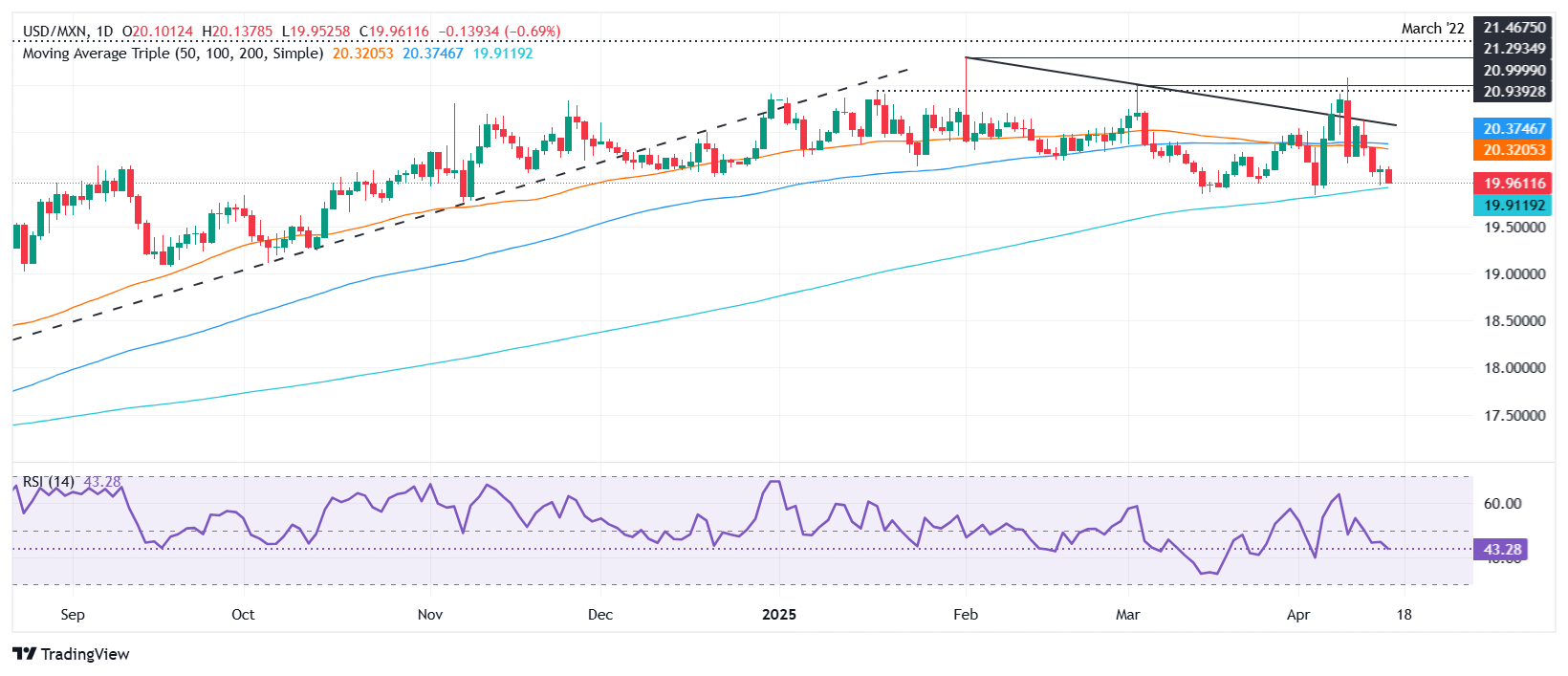
USD/MXN technical outlook: Mexican Peso gains ground as USD/MXN tumbles below 20.00
The USD/MXN uptrend remains intact, although the pair drifts below the 20.00 level. Sellers seem poised to test the 200-day SMA at 19.86, but they will need to clear it on a daily closing, so they could remain hopeful of challenging the 19.50 figure. In that outcome, the next support would be 19.00.
Conversely, if buyers push the USD/MXN exchange rate above 20.00, this could open the door to test the April 14 high of 20.29, which would open the door to the 50-day and 100-day SMA confluence near 20.30–20.36, followed by the 20.50 resistance. Clearing those levels could lead to a retest of the April 9 peak at 21.07.
Mexican Peso FAQs
The Mexican Peso (MXN) is the most traded currency among its Latin American peers. Its value is broadly determined by the performance of the Mexican economy, the country’s central bank’s policy, the amount of foreign investment in the country and even the levels of remittances sent by Mexicans who live abroad, particularly in the United States. Geopolitical trends can also move MXN: for example, the process of nearshoring – or the decision by some firms to relocate manufacturing capacity and supply chains closer to their home countries – is also seen as a catalyst for the Mexican currency as the country is considered a key manufacturing hub in the American continent. Another catalyst for MXN is Oil prices as Mexico is a key exporter of the commodity.
The main objective of Mexico’s central bank, also known as Banxico, is to maintain inflation at low and stable levels (at or close to its target of 3%, the midpoint in a tolerance band of between 2% and 4%). To this end, the bank sets an appropriate level of interest rates. When inflation is too high, Banxico will attempt to tame it by raising interest rates, making it more expensive for households and businesses to borrow money, thus cooling demand and the overall economy. Higher interest rates are generally positive for the Mexican Peso (MXN) as they lead to higher yields, making the country a more attractive place for investors. On the contrary, lower interest rates tend to weaken MXN.
Macroeconomic data releases are key to assess the state of the economy and can have an impact on the Mexican Peso (MXN) valuation. A strong Mexican economy, based on high economic growth, low unemployment and high confidence is good for MXN. Not only does it attract more foreign investment but it may encourage the Bank of Mexico (Banxico) to increase interest rates, particularly if this strength comes together with elevated inflation. However, if economic data is weak, MXN is likely to depreciate.
As an emerging-market currency, the Mexican Peso (MXN) tends to strive during risk-on periods, or when investors perceive that broader market risks are low and thus are eager to engage with investments that carry a higher risk. Conversely, MXN tends to weaken at times of market turbulence or economic uncertainty as investors tend to sell higher-risk assets and flee to the more-stable safe havens.
Artigos Recomendados


