


US Dollar set to post third consecutive week in red as dust from Fed meeting settles
- The US Dollar consolidates on Friday after weakening further on Thursday..
- Traders have repriced the US Dollar amidst the Bank of Japan and Bank of England’s decisions to keep rates on hold.
- The US Dollar Index falls outside its tight bandwidth, a sign that could dive lower next week.
The US Dollar (USD) trades broadly steady on Friday after Thursday’s sharp decline, when traders revalued the Greenback after the US Federal Reserve (Fed) joined the European Central Bank (ECB) and several others by starting its interest-rate cutting cycle. Quite a different picture comes from the Bank of England (BoE) and the Bank of Japan (BoJ), which decided to keep interest rates steady, causing the US Dollar to struggle against the British Pound (GBP) and the Japanese Yen (JPY).
On the economic data front, the US economic calendar is quite empty, which is ideal for traders to let the dust settle after a volatile week. Next week, a lot of US data is set to be released. The main elements include the final US Gross Domestic Product (GDP) data for Q2 and the Personal Consumption Expenditures (PCE) Price Index, the Fed’s preferred inflation gauge.
Daily digest market movers: You can’t always get what you want
- The Bank of Japan (BoJ) has kept its interest rate stable at 0.25%. BoJ Governor Kazuo Ueda mentioned that inflation came in a little softer than anticipated, that the BoJ is keeping a close eye on the economic data, and that it is ready to hike at any moment when needed.
- Federal Reserve Bank of Philadelphia President Patrick Harker delivers a speech titled "The Federal Reserve: it's more than just interest rates" at the Tulane University Freeman School of Business Lecture in New Orleans at around 18:00 GMT.
- Equity markets are facing some profit taking after the steep rallies that took place in the aftermath of the Fed rate decision. Both European equities and US Futures are in red numbers. Still, losses are rather contained, by no more than 0.5% on average.
- The CME Fedwatch Tool shows a 59.3% chance of a 25-basis-point rate cut at the next Fed meeting on November 7. The remaining 40.7% is pricing in another 50-basis-point rate cut.
- The US 10-year benchmark rate trades at 3.71%, rather in the middle of this week’s range between 3.60% and 3.76%.
US Dollar Index Technical Analysis: Where do we close this week?
The US Dollar Index (DXY) is in a precarious situation. A weekly close below that line in the sand of 100.62 could point to further weakness ahead. A further depreciation could take place next week if US data eases further, opening the door to another big rate cut in November.
The upper level of the recent range remains 101.90, with the DXY still possible to recover above 100.62 first. Further up, the index could go to 103.18, with the 55-day Simple Moving Average (SMA) at 102.66 on the way. The next tranche up is very misty, with the 200-day SMA and the 100-day SMA at 103.76, just ahead of the big 104.00 round level.
On the downside, 100.62 (the low from December 28, 2023) is being broken again and could point to more weakness ahead. Should that take place next week, the low from July 14, 2023, at 99.58, will be the next level to look out for. If that level gives way, early levels from 2023 are coming in near 97.73.
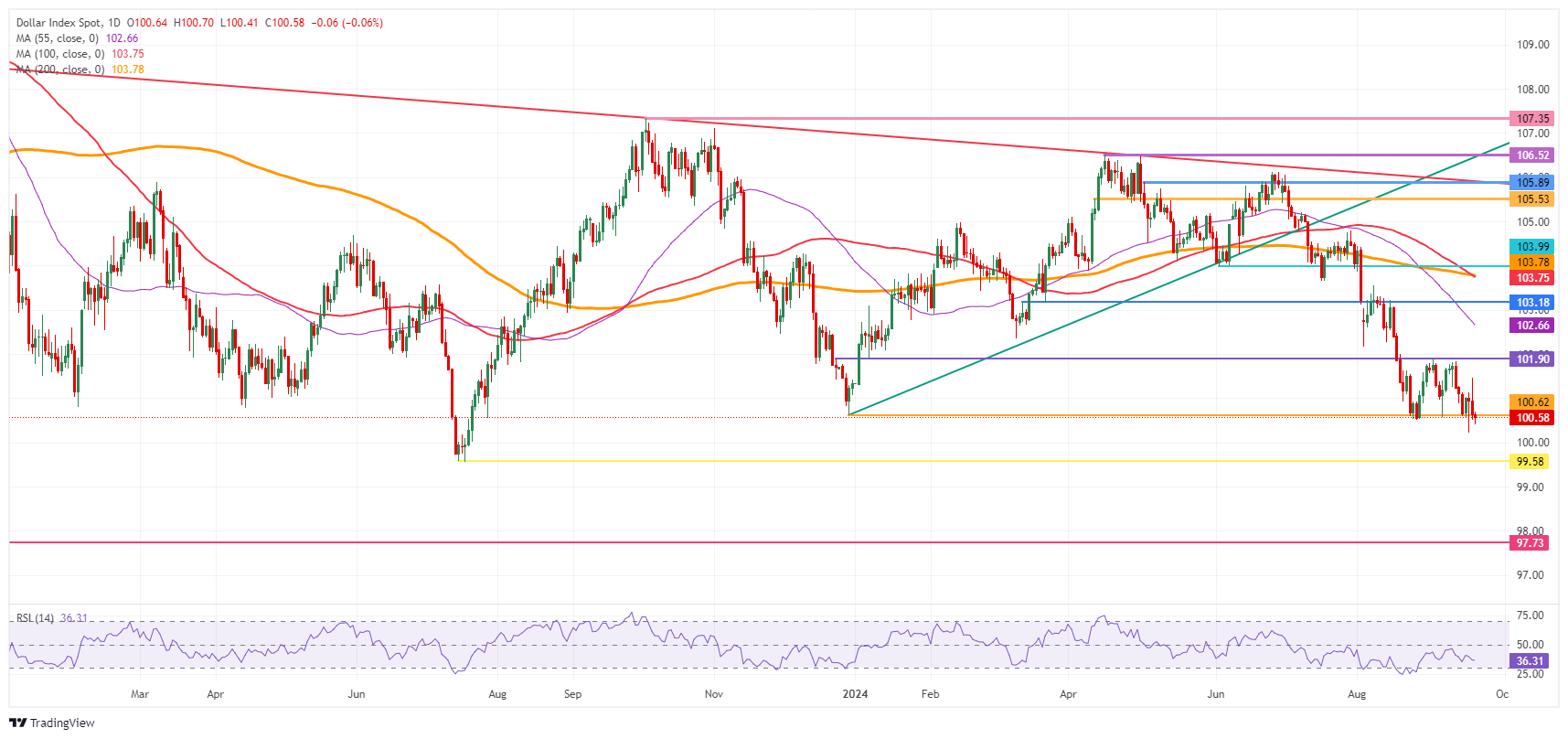
US Dollar Index: Daily Chart
US Dollar FAQs
The US Dollar (USD) is the official currency of the United States of America, and the ‘de facto’ currency of a significant number of other countries where it is found in circulation alongside local notes. It is the most heavily traded currency in the world, accounting for over 88% of all global foreign exchange turnover, or an average of $6.6 trillion in transactions per day, according to data from 2022. Following the second world war, the USD took over from the British Pound as the world’s reserve currency. For most of its history, the US Dollar was backed by Gold, until the Bretton Woods Agreement in 1971 when the Gold Standard went away.
The most important single factor impacting on the value of the US Dollar is monetary policy, which is shaped by the Federal Reserve (Fed). The Fed has two mandates: to achieve price stability (control inflation) and foster full employment. Its primary tool to achieve these two goals is by adjusting interest rates. When prices are rising too quickly and inflation is above the Fed’s 2% target, the Fed will raise rates, which helps the USD value. When inflation falls below 2% or the Unemployment Rate is too high, the Fed may lower interest rates, which weighs on the Greenback.
In extreme situations, the Federal Reserve can also print more Dollars and enact quantitative easing (QE). QE is the process by which the Fed substantially increases the flow of credit in a stuck financial system. It is a non-standard policy measure used when credit has dried up because banks will not lend to each other (out of the fear of counterparty default). It is a last resort when simply lowering interest rates is unlikely to achieve the necessary result. It was the Fed’s weapon of choice to combat the credit crunch that occurred during the Great Financial Crisis in 2008. It involves the Fed printing more Dollars and using them to buy US government bonds predominantly from financial institutions. QE usually leads to a weaker US Dollar.
Quantitative tightening (QT) is the reverse process whereby the Federal Reserve stops buying bonds from financial institutions and does not reinvest the principal from the bonds it holds maturing in new purchases. It is usually positive for the US Dollar.
Artigos Recomendados


