


WTI Price Analysis: Consolidates above mid-$82.00s, bullish potential seems intact
- WTI struggles to gain any meaningful traction, though the bias seems tilted in favor of bulls.
- Escalating geopolitical tensions fuels supply concerns and acts as a tailwind for the commodity.
- The technical setup also suggests that the path of least resistance for Oil prices is to the upside.
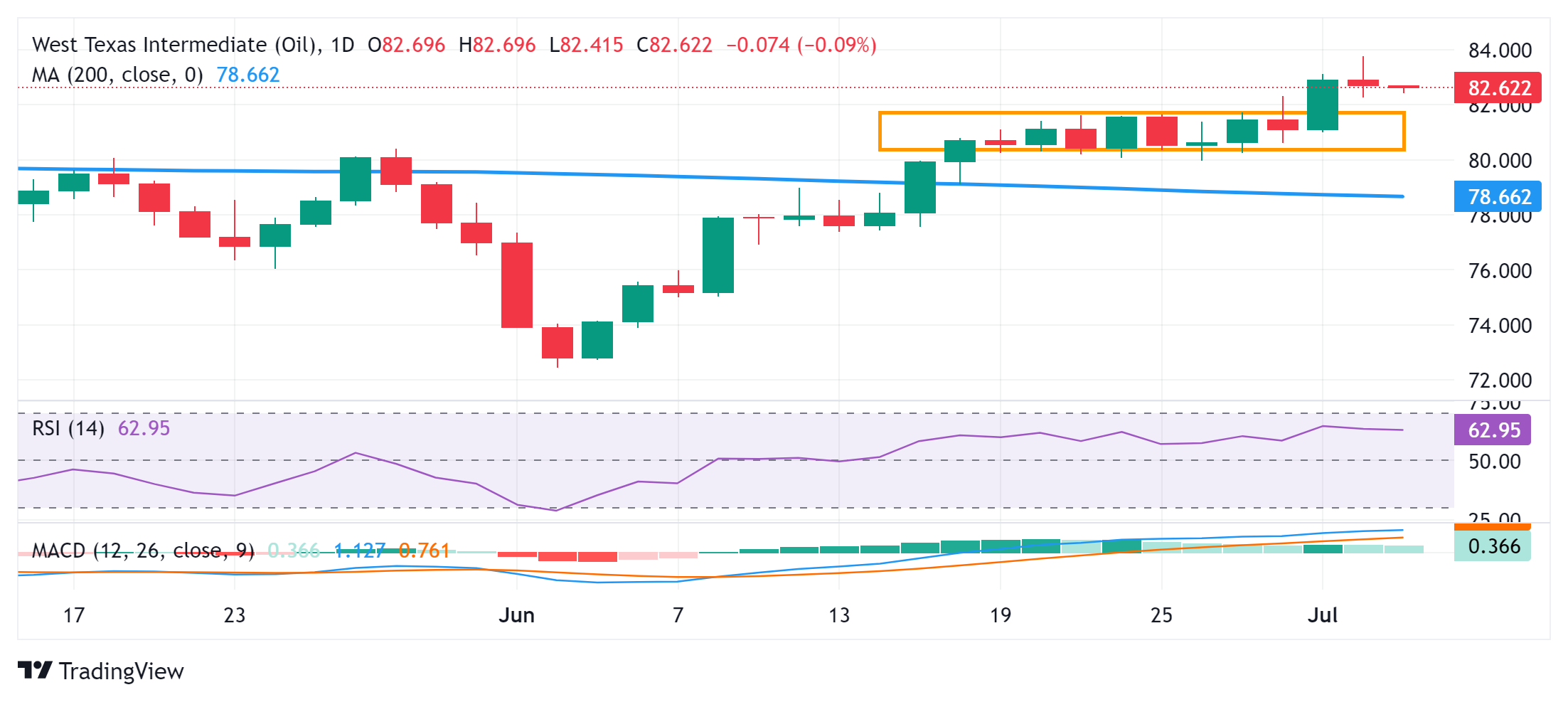
West Texas Intermediate (WTI) US crude Oil prices lack any firm intraday direction on Wednesday and oscillate in a narrow band during the Asian session. The commodity currently trades around the $82.65-$82.70 region, nearly unchanged for the day and remains well within striking distance of its highest level since April 26 touched the previous day.
Investors remain concerned that a wider conflict in the Middle East could disrupt supplies from the key Oil-producing countries. This, along with A very strong start to the hurricane season in the US, turn out to be a key factor acting as a tailwind for the black liquid. That said, concerns over a slowdown in global economic growth might hold back bulls from placing fresh bets and cap the upside for Crude Oil prices.
From a technical perspective, this week's breakout through a short-term trading range comes on the back of the recent strength and acceptance above the very important 200-day Simple Moving Average (SMA). Moreover, oscillators on the daily chart are holding in positive territory and are still away from being in the overbought zone, suggesting that the path of least resistance for Crude Oil prices is to the upside.
Hence, any subsequent weakness below the overnight swing low, around the $82.25 region, is likely to find decent support near the $82.00 mark. This is followed by the aforementioned trading range breakpoint point, now turned support near the $81.55 area, which if broken might prompt some technical selling. Crude Oil prices might then slide to the $81.00/barrel mark en route to the $80.40-$80.35 horizontal support.
On the flip side, momentum back above the $83.00 mark is likely to confront some resistance near the $83.75-$83.80 region, or over a two-month peak set on Tuesday. Some follow-through buying, leading to a move beyond the $84.00 mark, will be seen as a fresh trigger for bulls and allow Crude Oil prices to accelerate the positive move towards the next relevant barrier, just ahead of the $85.00 psychological mark.
WTI Oil FAQs
WTI Oil is a type of Crude Oil sold on international markets. The WTI stands for West Texas Intermediate, one of three major types including Brent and Dubai Crude. WTI is also referred to as “light” and “sweet” because of its relatively low gravity and sulfur content respectively. It is considered a high quality Oil that is easily refined. It is sourced in the United States and distributed via the Cushing hub, which is considered “The Pipeline Crossroads of the World”. It is a benchmark for the Oil market and WTI price is frequently quoted in the media.
Like all assets, supply and demand are the key drivers of WTI Oil price. As such, global growth can be a driver of increased demand and vice versa for weak global growth. Political instability, wars, and sanctions can disrupt supply and impact prices. The decisions of OPEC, a group of major Oil-producing countries, is another key driver of price. The value of the US Dollar influences the price of WTI Crude Oil, since Oil is predominantly traded in US Dollars, thus a weaker US Dollar can make Oil more affordable and vice versa.
The weekly Oil inventory reports published by the American Petroleum Institute (API) and the Energy Information Agency (EIA) impact the price of WTI Oil. Changes in inventories reflect fluctuating supply and demand. If the data shows a drop in inventories it can indicate increased demand, pushing up Oil price. Higher inventories can reflect increased supply, pushing down prices. API’s report is published every Tuesday and EIA’s the day after. Their results are usually similar, falling within 1% of each other 75% of the time. The EIA data is considered more reliable, since it is a government agency.
OPEC (Organization of the Petroleum Exporting Countries) is a group of 13 Oil-producing nations who collectively decide production quotas for member countries at twice-yearly meetings. Their decisions often impact WTI Oil prices. When OPEC decides to lower quotas, it can tighten supply, pushing up Oil prices. When OPEC increases production, it has the opposite effect. OPEC refers to an expanded group that includes ten extra non-OPEC members, the most notable of which is Russia.
Artigos Recomendados


