


Canadian Dollar churns as markets grapple with tariff uncertainty
- The Canadian Dollar cycled near key moving averages on Thursday.
- Market participants are chewing on unclear tariff policy from the Trump administration.
- Canadian jobs data and US NFP net payrolls numbers are due on Friday.
The Canadian Dollar (CAD) explored the high end on Thursday as market confidence in the US Dollar (USD) waivered in the face of ongoing tariff ambiguity from Unites States (US) President Donald Trump. The Loonie pared early gains, but still remains up on the day against the Greenback, keeping USD/CAD hung up on the 50-day Exponential Moving Average (EMA) at the 1.4300 handle.
Canada’s Ivey Purchasing Managers Index (PMI) came in stronger than expected, climbing to a seven-month high in February. On the US side, Challenger Job Cuts rose to multi-year highs, sparking some trepidation ahead of Friday’s US Nonfarm Payrolls (NFP) net jobs additions report.
Daily digest market movers: Canadian Dollar recovers some ground on Thursday
- The Canadian Dollar briefly gained seven-tenths of one percent against the Greenback, before falling back to a more moderate 0.2%.
- Seasonally-adjusted Canadian Ivey PMI figures rose to 55.3 in February, a seven-month high. The headline figure beat the forecast of 50.9, and rose strongly from January’s 47.1.
- Market confidence in Canadian economic activity may be misplaced, as US trade tariffs still pose a threat to growth, despite the Trump administration’s wavering tariff policies.
- President Donald Trump granted a 30-day extension on import tariffs for the US automotive industry, and Trump staffers are announcing that further exemptions and extensions will be on the way, declawing their own trade policies.
- Despite the Trump team’s regular pivoting on its own tariff implementation, markets are growing increasingly tired of the headline froth.
Canadian Dollar price forecast
The Canadian Dollar’s (CAD) Thursday push was enough to force the Loonie higher against the Greenback, but not by much. USD/CAD dropped into the 50-day EMA at the 1.4300 major price handle, a common congestion point for the Loonie-Dollar pairing in recent months.
Momentum is still on the middling side, with frequent dips into multi-year lows for the Canadian Dollar. Until key fundamentals like trade tariffs, or a more solidified economic outlook develop a clearer picture, USD/CAD can be expected to continue muddling through in a rough range.
USD/CAD daily chart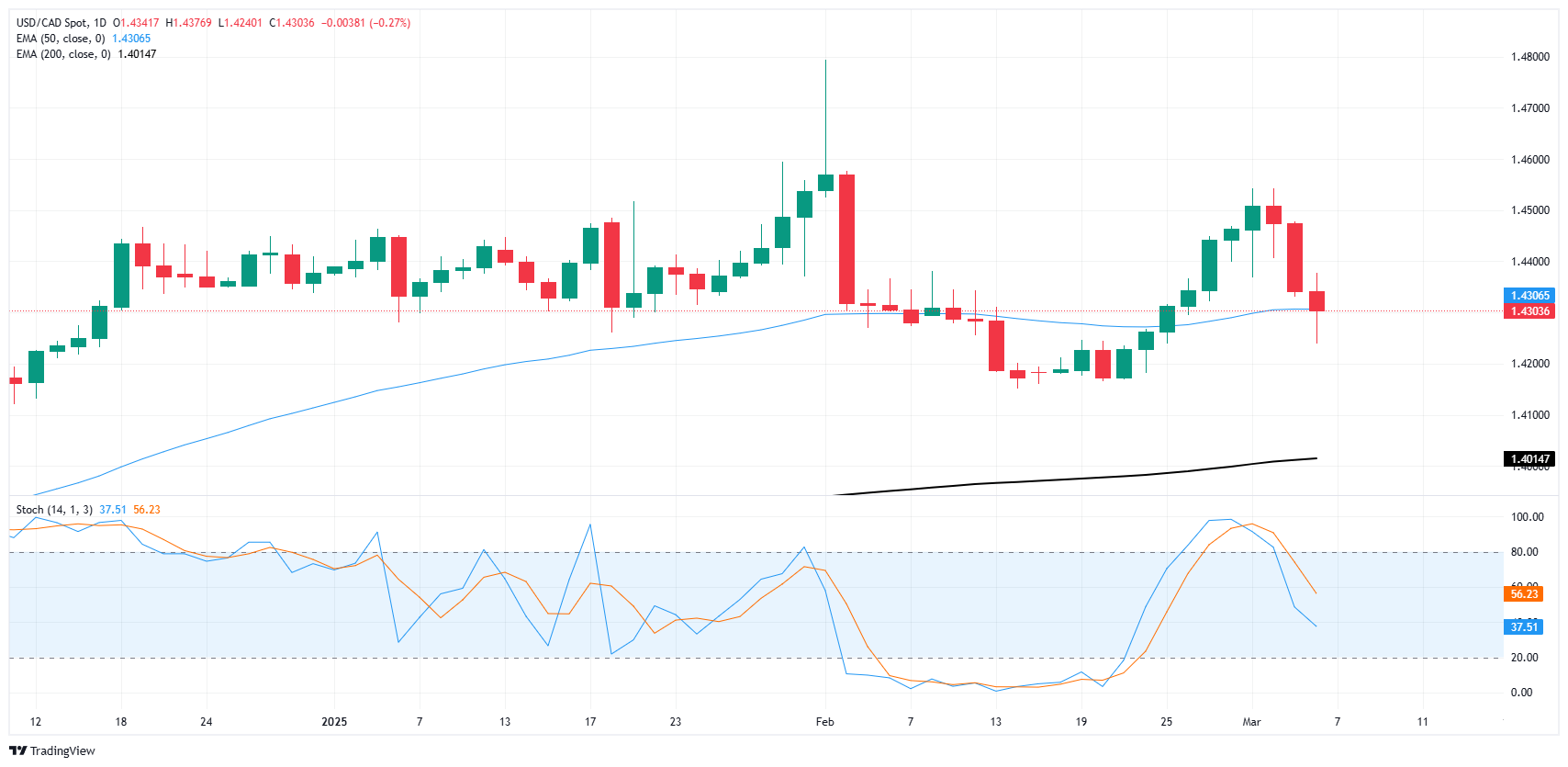
Canadian Dollar FAQs
The key factors driving the Canadian Dollar (CAD) are the level of interest rates set by the Bank of Canada (BoC), the price of Oil, Canada’s largest export, the health of its economy, inflation and the Trade Balance, which is the difference between the value of Canada’s exports versus its imports. Other factors include market sentiment – whether investors are taking on more risky assets (risk-on) or seeking safe-havens (risk-off) – with risk-on being CAD-positive. As its largest trading partner, the health of the US economy is also a key factor influencing the Canadian Dollar.
The Bank of Canada (BoC) has a significant influence on the Canadian Dollar by setting the level of interest rates that banks can lend to one another. This influences the level of interest rates for everyone. The main goal of the BoC is to maintain inflation at 1-3% by adjusting interest rates up or down. Relatively higher interest rates tend to be positive for the CAD. The Bank of Canada can also use quantitative easing and tightening to influence credit conditions, with the former CAD-negative and the latter CAD-positive.
The price of Oil is a key factor impacting the value of the Canadian Dollar. Petroleum is Canada’s biggest export, so Oil price tends to have an immediate impact on the CAD value. Generally, if Oil price rises CAD also goes up, as aggregate demand for the currency increases. The opposite is the case if the price of Oil falls. Higher Oil prices also tend to result in a greater likelihood of a positive Trade Balance, which is also supportive of the CAD.
While inflation had always traditionally been thought of as a negative factor for a currency since it lowers the value of money, the opposite has actually been the case in modern times with the relaxation of cross-border capital controls. Higher inflation tends to lead central banks to put up interest rates which attracts more capital inflows from global investors seeking a lucrative place to keep their money. This increases demand for the local currency, which in Canada’s case is the Canadian Dollar.
Macroeconomic data releases gauge the health of the economy and can have an impact on the Canadian Dollar. Indicators such as GDP, Manufacturing and Services PMIs, employment, and consumer sentiment surveys can all influence the direction of the CAD. A strong economy is good for the Canadian Dollar. Not only does it attract more foreign investment but it may encourage the Bank of Canada to put up interest rates, leading to a stronger currency. If economic data is weak, however, the CAD is likely to fall.
Artigos Recomendados


