


Mexican Peso struggles in early December as US Dollar holds firm
- Mexican Peso drops 0.37% as November Business Confidence in Mexico worsens, signaling economic slowdown.
- A Banxico survey shows inflation likely to stay below 4%, but the economy will miss expectations of growth above 2% in 2024.
- US Dollar supported by stronger ISM Manufacturing PMI and Trump’s tariff threats, overshadowing weak economic data.
The Mexican Peso begins December on the back foot against the Greenback. The Peso is down by 0.37% amid a busy economic calendar on both sides of the border. Mexico’s economic docket featured Business Confidence for November, while the US schedule showed that business activity continued to improve despite remaining in contractionary territory. The USD/MXN trades at 20.44.
The Instituto Nacional de Estadistica Geografia e Informatica revealed the Business Confidence Index in the manufacturing sector, which dipped and posted its worst reading since September 2024. Following that data release, the Bank of Mexico (Banxico) revealed its latest monthly survey of economists, including forecasts from 40 analysts.
Most economists suggest that headline inflation will remain below 4%, while core inflation is expected to continue its downtrend and stall in 2025. The economy is expected to slow further, with the Gross Domestic Product (GDP) forecasted to end the year below 2.00%, as foreseen in Q2 2024. The USD/MXN exchange rate is expected to remain above the 20.00 figure by the end of the year.
In the US, the ISM Manufacturing PMI in November improved compared to October, exceeding estimates. In the same tenure was the S&P Global index, revealed earlier, yet both readings, despite showing improvement, remained in contractionary territory.
Despite this, the US Dollar remained also underpinned by Donald Trump’s warning to BRICS countries that creating a new currency or moving away from the US Dollar as a means of payment could face 100% tariffs, “and should expect to say goodbye to selling into the wonderful U.S. Economy,” he added.
Ahead this week, Mexico’s schedule will feature the release of jobs data, gross fixed investment, and automobile production. In the US, the docket will feature Fed speakers, the JOLTs Job Openings for October, S&P and ISM Services PMI surveys, and Nonfarm Payroll figures.
Daily digest market movers: Mexican Peso undermined by dovish Banxico stance
- Banxico’s November survey shows that analysts estimate inflation at 4.42% in 2024 and 3.84% in 2025. Underlying inflation figures will remain at 3.69% in 2024 and 2025. GDP is forecasted at 1.55% and 1.23% for 2024 and 2025, respectively, and the USD/MXN exchange rate at 20.22 for the rest of the year and 20.71 in 2025.
- Last week, according to November's meeting minutes, Banxico hinted they’re willing to consider bigger rate cuts. One member noted, “Considering the current levels of core inflation and the expectation that it will continue declining, a larger rate adjustment could be considered at the next monetary policy meeting.”
- The latest Citi Mexico survey showed that most economists estimate Banxico will cut rates by 25 basis points at the December meeting. Analysts project the economy will grow 1.5% in 2024 and 1% in 2025.
- The ISM Manufacturing PMI in November rose from 46.5 to 48.4, exceeding forecasts of 47.5. The S&P Global Manufacturing PMI for the same period increased from 48.5 to 49.7, above the 48.8 expected by the consensus.
- The CME FedWatch Tool suggests that investors see a 64% chance of a 25-basis-point (bps) rate cut at the Federal Reserve’s December meeting, down from 66% last Friday.
- Data from the Chicago Board of Trade, via the December Fed funds rate futures contract, shows investors estimate 16 bps of Fed easing by the end of 2024.
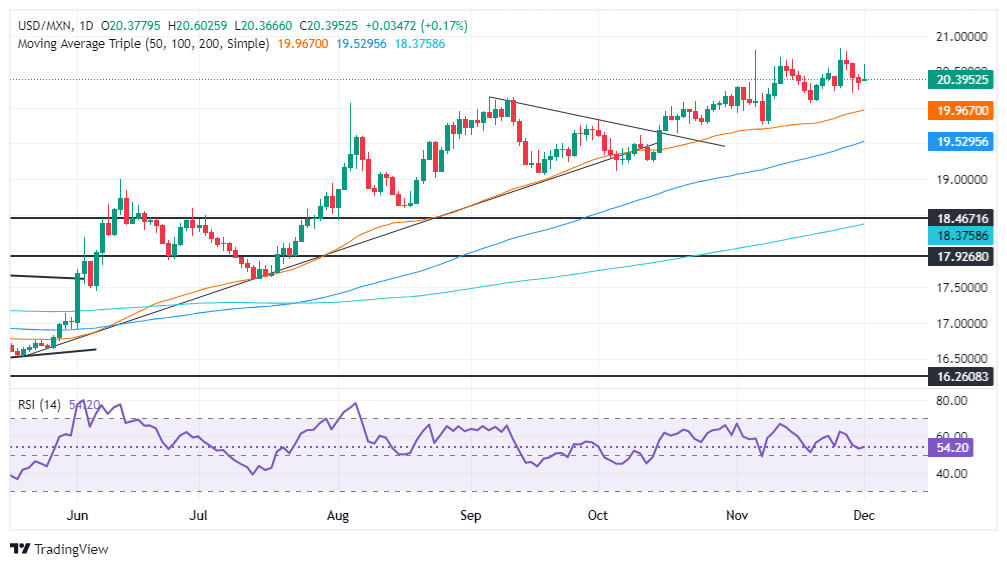
Mexican Peso technical outlook: USD/MXN rallies past 20.35 as Peso weakens
The USD/MXN uptrend remains intact despite consolidating at around 20.20 for the last eight consecutive trading days. Although the pair has carved a series of higher highs and higher lows, buyers must clear the 20.50 psychological figure to target the year-to-date (YTD) peak at 20.82. If surpassed, the next stop would be 21.00, ahead of March 8, 2022, peak at 21.46, followed by the November 26, 2021, high at 22.15.
On the other hand, sellers pushing the USD/MXN below 20.00 could pave the way to test the 50-day Simple Moving Average (SMA) at 19.95, with key support levels exposed, like the 100-day SMA at 19.61, before the psychological 19.00 figure.
Mexican Peso FAQs
The Mexican Peso (MXN) is the most traded currency among its Latin American peers. Its value is broadly determined by the performance of the Mexican economy, the country’s central bank’s policy, the amount of foreign investment in the country and even the levels of remittances sent by Mexicans who live abroad, particularly in the United States. Geopolitical trends can also move MXN: for example, the process of nearshoring – or the decision by some firms to relocate manufacturing capacity and supply chains closer to their home countries – is also seen as a catalyst for the Mexican currency as the country is considered a key manufacturing hub in the American continent. Another catalyst for MXN is Oil prices as Mexico is a key exporter of the commodity.
The main objective of Mexico’s central bank, also known as Banxico, is to maintain inflation at low and stable levels (at or close to its target of 3%, the midpoint in a tolerance band of between 2% and 4%). To this end, the bank sets an appropriate level of interest rates. When inflation is too high, Banxico will attempt to tame it by raising interest rates, making it more expensive for households and businesses to borrow money, thus cooling demand and the overall economy. Higher interest rates are generally positive for the Mexican Peso (MXN) as they lead to higher yields, making the country a more attractive place for investors. On the contrary, lower interest rates tend to weaken MXN.
Macroeconomic data releases are key to assess the state of the economy and can have an impact on the Mexican Peso (MXN) valuation. A strong Mexican economy, based on high economic growth, low unemployment and high confidence is good for MXN. Not only does it attract more foreign investment but it may encourage the Bank of Mexico (Banxico) to increase interest rates, particularly if this strength comes together with elevated inflation. However, if economic data is weak, MXN is likely to depreciate.
As an emerging-market currency, the Mexican Peso (MXN) tends to strive during risk-on periods, or when investors perceive that broader market risks are low and thus are eager to engage with investments that carry a higher risk. Conversely, MXN tends to weaken at times of market turbulence or economic uncertainty as investors tend to sell higher-risk assets and flee to the more-stable safe havens.
Artigos Recomendados


