


GBP/JPY takes a breather at the top end of 13-day win streak
- GBP/JPY is middling on Thursday, pausing after a 13-day climb.
- Data for both currencies remains limited, but UK elections could spark volatility.
- Japanese Yen likely to continue deflating as BOJ remains stubbornly easy on policy.
GBP/JPY is taking a breather after stellar 13-consecutive-trading-day win streak, holding close to the high end of a 3.5% bottom-to-top near-term rally. Meaningful economic data is absent from the economic calendar on Thursday. Still, upcoming UK Parliamentary Election results could spark moves in either direction as traders tend to reward political upheaval with an overall uptick in volatility.
A 14-year run for the UK’s Conservative Tory party is set to end on Thursday, as early entry polls heading into the election noted an extreme likelihood of a sweeping victory for the UK’s Labour Party. Labour’s Keir Starmer is set to replace incumbent UK Prime Minister Rishi Sunak as the British populace looks set to pivot away from the party that has struggled since strongarming Brexit across the finish line.
Japanese economic data is firmly low-tier for the remainder of the trading week, and the Yen is doomed to continue spiraling lower as the still-wide interest rate differential between the JPY and most other major currencies is an unavoidable hurdle to Japanese policymakers that have been attempting to intervene in market flows with threats of direct intervention for weeks. Effects of verbal intervention have fully decayed as the Yen sinks to multi-year, and in some cases, multi-decade lows across the board.
GBP/JPY technical outlook
Topside technical barriers have all evaporated as GBP/JPY continues to grind into fresh 16-year highs regularly, and the pair is sticking close to the high end after cracking above the 206.00 handle this week.
The Guppy is buried deep in bull country in a long-term one-sided trend. The pair has traded almost exclusively north of the 200-day Exponential Moving Average (EMA) currently rising through 190.80 since climbing above the long-term moving average in the first quarter of 2023.
It would take an 8% decline to drag GBP/JPY black into bearish territory below the key moving average, and the pair has closed in the green on a week-on-week basis for all but five of the last 26 trading weeks, and is on pace to chalk in a 26th.
GBP/JPY daily chart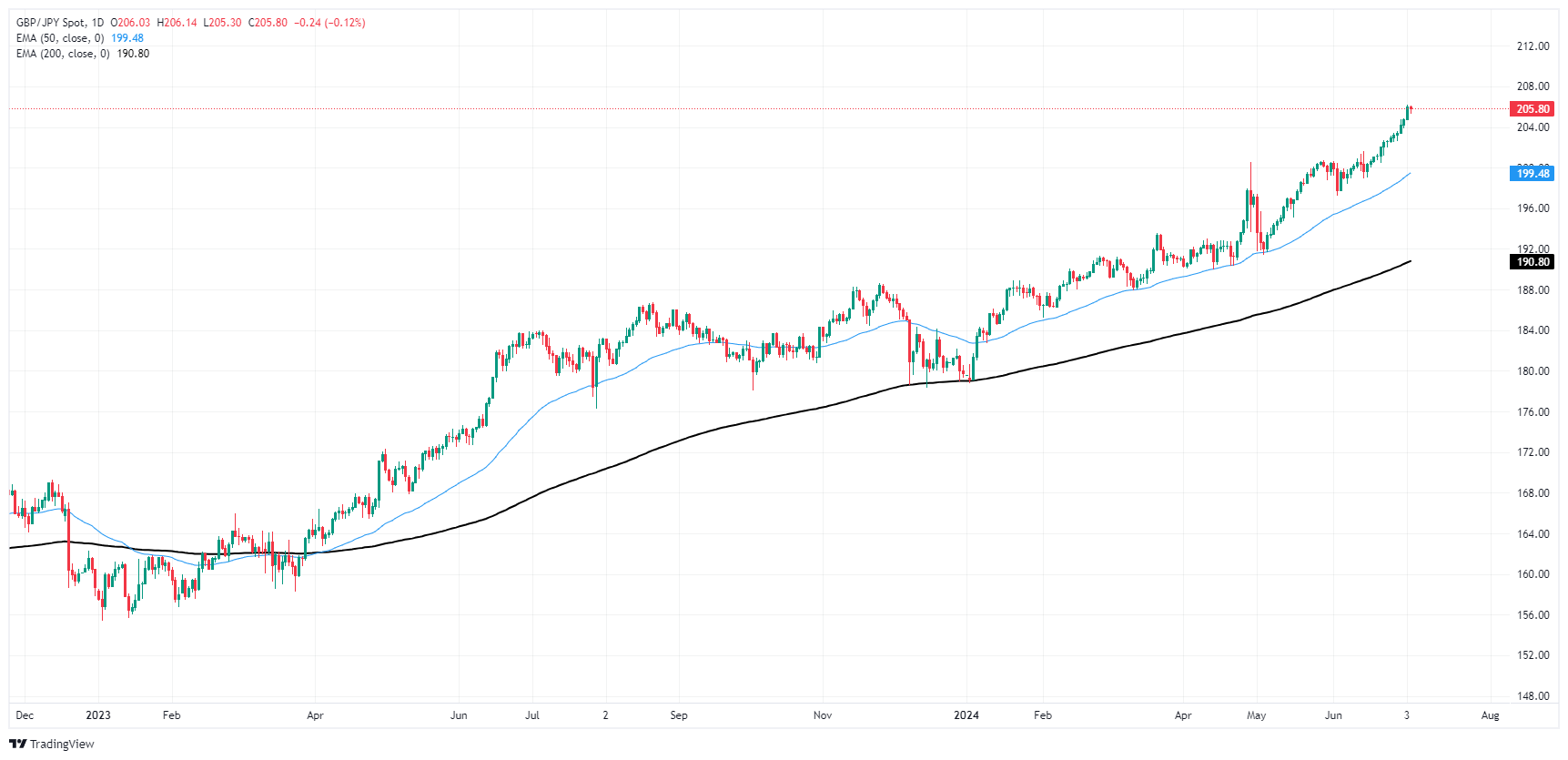
Pound Sterling FAQs
The Pound Sterling (GBP) is the oldest currency in the world (886 AD) and the official currency of the United Kingdom. It is the fourth most traded unit for foreign exchange (FX) in the world, accounting for 12% of all transactions, averaging $630 billion a day, according to 2022 data. Its key trading pairs are GBP/USD, aka ‘Cable’, which accounts for 11% of FX, GBP/JPY, or the ‘Dragon’ as it is known by traders (3%), and EUR/GBP (2%). The Pound Sterling is issued by the Bank of England (BoE).
The single most important factor influencing the value of the Pound Sterling is monetary policy decided by the Bank of England. The BoE bases its decisions on whether it has achieved its primary goal of “price stability” – a steady inflation rate of around 2%. Its primary tool for achieving this is the adjustment of interest rates. When inflation is too high, the BoE will try to rein it in by raising interest rates, making it more expensive for people and businesses to access credit. This is generally positive for GBP, as higher interest rates make the UK a more attractive place for global investors to park their money. When inflation falls too low it is a sign economic growth is slowing. In this scenario, the BoE will consider lowering interest rates to cheapen credit so businesses will borrow more to invest in growth-generating projects.
Data releases gauge the health of the economy and can impact the value of the Pound Sterling. Indicators such as GDP, Manufacturing and Services PMIs, and employment can all influence the direction of the GBP. A strong economy is good for Sterling. Not only does it attract more foreign investment but it may encourage the BoE to put up interest rates, which will directly strengthen GBP. Otherwise, if economic data is weak, the Pound Sterling is likely to fall.
Another significant data release for the Pound Sterling is the Trade Balance. This indicator measures the difference between what a country earns from its exports and what it spends on imports over a given period. If a country produces highly sought-after exports, its currency will benefit purely from the extra demand created from foreign buyers seeking to purchase these goods. Therefore, a positive net Trade Balance strengthens a currency and vice versa for a negative balance.
Artigos Recomendados


