


Is the Schwab U.S. Dividend Equity ETF a Millionaire Maker?
Virtually every investor wants to build wealth, but there are countless roads to this destination. When discussing potential millionaire-making investments, it often boils down to how likely they are to get you where you want to go and how long it will take.
Naturally, individual stocks usually represent the home-run investment. On the other hand, exchange-traded funds (ETFs) are generally about the underlying strategy because they represent many stocks (sometimes hundreds) lumped together and traded under one ticker symbol.
Where to invest $1,000 right now? Our analyst team just revealed what they believe are the 10 best stocks to buy right now. See the 10 stocks »
The Schwab U.S. Dividend Equity ETF (NYSEMKT: SCHD) is a popular dividend stock ETF. However, investors frequently debate whether it has enough growth and upside for wealth-seeking long-term investors. I investigated the ETF's long-term potential and the best way for investors to maximize it.
Here is what you need to know.
Here is what investing in the Schwab U.S. Dividend Equity ETF gets you
The Schwab U.S. Dividend Equity ETF includes 103 dividend stocks, so buying a share of the ETF gives investors a sliver of ownership in over a hundred companies. Therefore, investors are highly diversified out of the gate. The fund follows the Dow Jones U.S. Dividend 100 index.
At the current share price, investors receive a 3.3% distribution (dividend) yield, far exceeding the S&P 500's 1.3%.
Now, let's talk strategy. The ETF features mature, blue chip companies with a track record of paying and increasing dividends. The Schwab U.S. Dividend Equity ETF's top 10 positions are:
- Pfizer: 14 years of consecutive annual dividend increases
- BlackRock: 15 years
- AbbVie: 52 years (including as part of Abbott Labs)
- Cisco Systems: 14 years
- Coca-Cola: 62 years
- Bristol Myers Squibb: 18 years
- Texas Instruments: 21 years
- PepsiCo: 52 years
- Lockheed Martin: 22 years
- Amgen: 13 years
People focus on dividends as earnings a company could have retained and reinvested but instead gave to shareholders. That's technically true, and it's also true these mature companies aren't among the market's fastest growers.
However, dividends also represent a litmus test. Only a high-quality and growing company can pay a dividend (a cash expense for the business) and raise it yearly. Building substantial stock market wealth requires time in most cases, and high-quality dividend stocks offer consistency for what they lack in growth.
The Schwab U.S. Dividend Equity ETF has generated nearly 400% in total returns since late 2011. That makes the ETF a multibagger. This blue chip dividend stock strategy can enrich investors when you give it sufficient time for compounding to work its magic.
The ETF has lagged the S&P 500, but there's more to the story
In my experience, the most common argument against the Schwab U.S. Dividend Equity ETF is that it lags the S&P 500, so people would be better off simply buying and holding an S&P 500 index fund.
I'll never dismiss investing in the S&P 500, but it's not as strong an argument as it seems. If you look at the historical performance of the two below, you can see they were pretty close until the past five years:
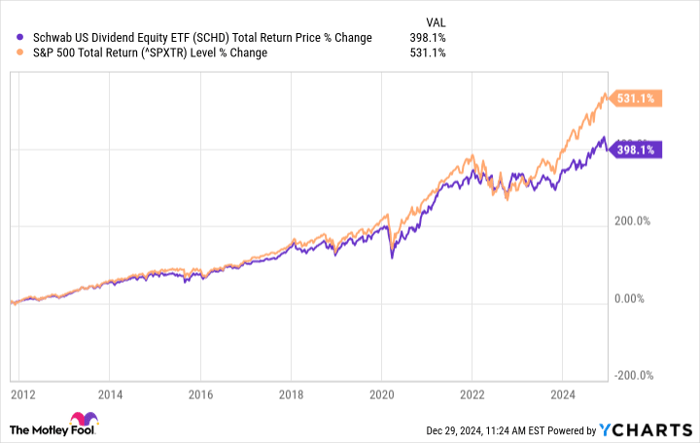
SCHD Total Return Price data by YCharts
The S&P 500 has become increasingly technology-weighted (33%) due to the "Magnificent Seven" stocks, which currently represent 32% of its value. In other words, the S&P 500 isn't as diversified as its name implies. One could argue that a downturn in the technology sector would hurt the S&P 500 more than the Schwab U.S. Dividend Equity ETF, which only has 8.8% exposure to technology.
Here's the bottom line: Don't let recency bias and a technology stock boom prevent you from appreciating how effectively the Schwab U.S. Dividend Equity ETF has generated wealth for investors over the past 14 years.
How to get the most out of the Schwab U.S. Dividend Equity ETF
Want to invest in the Schwab U.S. Dividend Equity ETF? Reinvest your dividends.
The companies in the ETF are generally growing, but they aren't growth stocks. Reinvesting the dividends means your dividends buy more ETF shares, which also pay dividends. It's an additional layer of compounding that helps supercharge your investment returns.
You're also building a dividend snowball that pays you more income as it grows. The cool part is that you can eventually keep your dividends instead of reinvesting them, meaning you're getting cash flow from your investment without selling shares. Theoretically, your portfolio could pay you forever, whereas someone who must sell their stocks for cash could run into trouble if they sell too much or the market crashes.
After all, becoming a millionaire isn't just about labels -- it's about lifetime wealth.
Don’t miss this second chance at a potentially lucrative opportunity
Ever feel like you missed the boat in buying the most successful stocks? Then you’ll want to hear this.
On rare occasions, our expert team of analysts issues a “Double Down” stock recommendation for companies that they think are about to pop. If you’re worried you’ve already missed your chance to invest, now is the best time to buy before it’s too late. And the numbers speak for themselves:
- Nvidia: if you invested $1,000 when we doubled down in 2009, you’d have $356,514!*
- Apple: if you invested $1,000 when we doubled down in 2008, you’d have $47,762!*
- Netflix: if you invested $1,000 when we doubled down in 2004, you’d have $485,594!*
Right now, we’re issuing “Double Down” alerts for three incredible companies, and there may not be another chance like this anytime soon.
See 3 “Double Down” stocks »
*Stock Advisor returns as of December 30, 2024
Justin Pope has positions in Coca-Cola and PepsiCo. The Motley Fool has positions in and recommends AbbVie, Abbott Laboratories, Bristol Myers Squibb, Cisco Systems, Pfizer, and Texas Instruments. The Motley Fool recommends Amgen and Lockheed Martin. The Motley Fool has a disclosure policy.
Recommended Articles


