


Best Stock to Buy Right Now: Amazon vs. Shopify
Amazon (NASDAQ: AMZN) has famously been a huge winner for long-term shareholders, and so has its increasingly intense competitor Shopify (NYSE: SHOP). Both stocks have crushed the returns of the S&P 500 over the last decade as they rode the tailwind of e-commerce growth around the world, but the two companies have entirely different market strategies.
Amazon has vertically integrated e-commerce to make it the most efficient experience for shoppers. Shopify wants to be the best software and payment layer to power third-party e-commerce brands.
As investors head into the last month of 2024, which stock is the best buy right now? Time to take a deeper look into these two e-commerce stocks.
Shopify: Focusing on core competencies
Shopify's business was supercharged by the COVID-19 pandemic. Revenue started to grow 100% year over year in 2020, which caused the company's stock price to rocket higher.
With all that success, management decided to invest heavily in new services outside of e-commerce software and payments. These included logistics networks, robotics, and even cryptocurrencies. Name any service relatively attached to the e-commerce and payments landscape, and Shopify was trying to build out products for its customers.
In 2022 and 2023, the company realized it had spread itself too thin and was getting away from its core competencies. Amazon is the expert in e-commerce logistics, as are UPS and FedEx. It would take years and tens of billions of dollars that Shopify didn't have to catch these competitors. After this realization, Shopify decided to cut most of these new business segments and focus on its core software/payments offerings to help refocus the business and improve profitability.
The strategy has worked wonderfully. Revenue growth stabilized, while profits and free cash flow are soaring. Last quarter, revenue grew 26% year over year to more than $2 billion. Free-cash-flow margin was 19%, compared to a negative margin less than two years ago. Revenue growth in the mid-20% range is expected to continue in the fourth quarter, as well.
As the dominant player in e-commerce software, Shopify can ride the global e-commerce tailwind to new heights over the next decade. I wouldn't expect 26% revenue growth to continue forever, but it looks like the company has found its groove and hit the sweet spot of investing, while also maintaining a level of profitability that will please shareholders.
Amazon: Winning through efficiencies
These days, you may hear a lot of e-commerce merchants complain about Amazon. Too many sponsored listings, too many competing brands on the platform.
While some of this may be true, e-commerce brands return to selling on Amazon time and time again. Why? Because it has the most efficient warehouse and logistics network, as well as the largest group of e-commerce customers to sell to.
Last quarter, Amazon's North American retail sales grew 9% year over year to $95.5 billion. International revenue was growing even faster at a 12% annual clip.
Within these sales, advertising revenue grew 19% year over year, which is a higher margin than most of Amazon's business segments. Despite competing platforms such as Shopify popping up around the world, Amazon has been able to retain its lead in the e-commerce landscape with an estimated 40% market share in the United States.
Like Shopify, Amazon has gotten much more efficient with its spending and started expanding its profit margins. Over the last 12 months, Amazon's operating margin was close to 10%, and free cash flow was $43 billion. As the company keeps growing high-margin segments such as advertising, investors should expect profit margins to keep expanding.
It may seem like an old stodgy business, compared to Shopify, but Amazon's financials show no signs of slowing. It won't grow as quickly as Shopify due to its massive $620 billion revenue base, but there's still plenty of room for Amazon to expand in the coming years, while also improving its profitability.
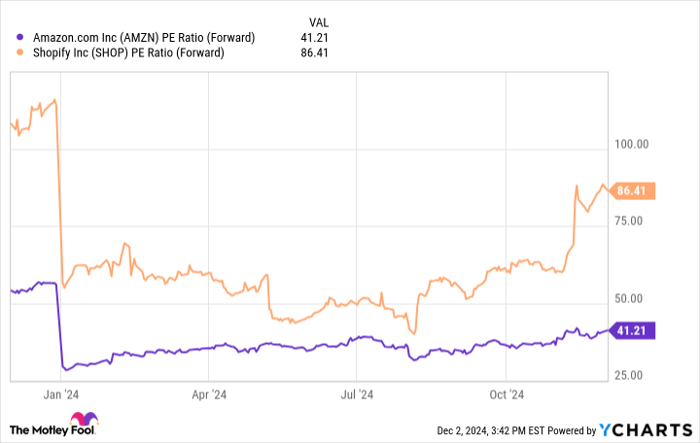
AMZN Price-to-Earnings Ratio (P/E) (Forward) data by YCharts.
Which stock is the better buy?
Comparing Amazon and Shopify is difficult. In some sense, they're both going through similar financial trajectories by trimming costs, but also proving they can still grow and simultaneously generate a profit. Shopify is a much smaller business, but that's because it only targets a few points in the e-commerce supply chain.
Looking at total spending from its e-commerce merchants, Shopify is estimated to have more than 10% market share of e-commerce sales in the United States, while Amazon's is around 40%. Let's not forget Amazon's cloud computing division, which generates close to $100 billion in annual revenue and tens of billions in profits.
When it comes to which stock is a better buy, the simple thing to do is look at their respective valuations. Shopify trades at a market cap of $142 billion and a forward price-to-earnings ratio (P/E) of 86. Amazon's forward P/E is significantly lower at just 41.
While Shopify should grow slightly faster than Amazon over the next five years, I don't think it warrants a forward P/E of more than double its competitor. For this reason, I think Amazon is the better buy for investors at today's prices.
Don’t miss this second chance at a potentially lucrative opportunity
Ever feel like you missed the boat in buying the most successful stocks? Then you’ll want to hear this.
On rare occasions, our expert team of analysts issues a “Double Down” stock recommendation for companies that they think are about to pop. If you’re worried you’ve already missed your chance to invest, now is the best time to buy before it’s too late. And the numbers speak for themselves:
- Nvidia: if you invested $1,000 when we doubled down in 2009, you’d have $359,445!*
- Apple: if you invested $1,000 when we doubled down in 2008, you’d have $45,374!*
- Netflix: if you invested $1,000 when we doubled down in 2004, you’d have $484,143!*
Right now, we’re issuing “Double Down” alerts for three incredible companies, and there may not be another chance like this anytime soon.
See 3 “Double Down” stocks »
*Stock Advisor returns as of December 2, 2024
John Mackey, former CEO of Whole Foods Market, an Amazon subsidiary, is a member of The Motley Fool's board of directors. Brett Schafer has positions in Amazon. The Motley Fool has positions in and recommends Amazon, FedEx, and Shopify. The Motley Fool recommends United Parcel Service. The Motley Fool has a disclosure policy.
Recommended Articles


