


5 Reasons to Buy This Index Fund and Hold for a Lifetime
You've probably heard people say, "Nothing is forever." That's true for almost all aspects of life. I think it's really close to being accurate in investing too, but not quite. If there's such a thing as a timeless investment, it is probably an index fund. After all, anything can happen to any given company, but indexes represent groups of stocks picked as a sampling of the broader market.
One potential timeless index fund you can buy and hold forever is the Vanguard S&P 500 ETF (NYSEMKT: VOO). This exchange-traded fund (ETF) is my favorite index fund to gain exposure to the S&P 500 index, arguably the most extraordinary market index in the world.
Here are five reasons the Vanguard S&P 500 ETF should permanently reside in your investment portfolio.
1. It's an easy way to gain portfolio diversification
Diversification is one of the most important parts of investing responsibly. Has anyone ever told you not to put all your eggs in one basket?
It's the same idea with an index fund. You can do all your homework, but sometimes things go wrong for companies that nobody can predict. Spreading your money across various investments ensures that one mistake or bad break doesn't have catastrophic consequences for your portfolio.
The Vanguard S&P 500 ETF tracks the S&P 500, an index of 500 of America's most prominent companies. In other words, one share of the index technically means you own a tiny sliver of hundreds of individual companies. Buying an S&P 500 index fund like this is the easiest way to diversify your portfolio.
2. It offers exposure to the S&P 500
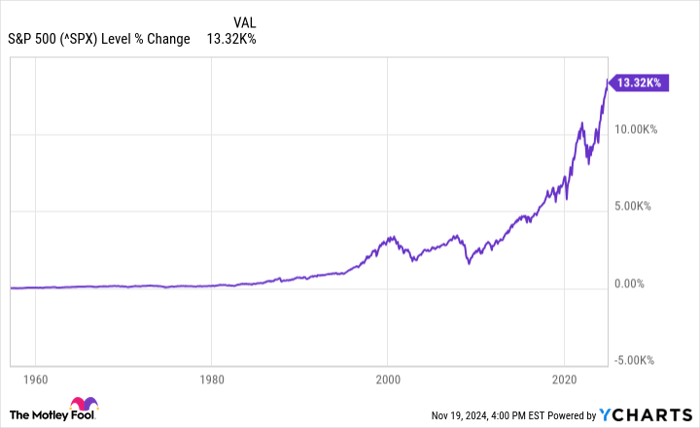
If there's an index you want to follow, it's the S&P 500. Since expanding to 500 companies in 1957, it has created staggering wealth for investors:
^SPX data by YCharts.
The methodology is simple but effective. A committee selects from among prominent U.S. companies that fit specific criteria.
The index is weighted by market cap, so a company that thrives and grows larger will earn a higher weighting. In doing so, it essentially leans into winning stocks. If a company doesn't perform, it can be dropped from the index and replaced.
It has worked so well that most professional investors underperform the S&P 500 over the long term.
3. It charges low fees
The cool thing about the Vanguard S&P 500 ETF is that it costs almost nothing to own it. Most exchange-traded funds charge an expense ratio, a fee for the fund's managers. The Vanguard S&P 500 ETF's expense ratio is just 0.03%. That means you'll pay $0.30 annually for every $1,000 you invest.
This fund's low fees are a sneaky good feature. Fees can vary, but generally speaking, the more actively managed a fund is, the higher the fees. And while you often get what you pay for in life, that's not always the case with investment funds. High fees don't guarantee high returns (again, most professionals lag the S&P 500).
Ironically, high fees can do more harm than good over time because they add up. Remember: The fees are based on your total amount invested, not your gains.
4. You can trust Vanguard
You can feel safe putting your money into Vanguard's funds. The company's history goes back to the 1970s. Today, it has over $9 trillion in assets under management. It's the world's largest mutual fund company and the second-largest ETF company behind BlackRock.
Importantly, those who invest in Vanguard funds own the company, not individual shareholders in the company itself. Since the same people who put their money into Vanguard's funds own the company, it helps align interests and reduces the chances of conflict. The company's size and structure should give investors the confidence to buy and hold.

Data by YCharts.
5. It's a compounding machine, making it great for all investment strategies
Lastly, the S&P 500 offers a little bit of everything, which makes the Vanguard S&P 500 ETF a fit for almost any portfolio. You have already seen the index's staggering appreciation over the years. Are you into dividends? The index pays one that currently yields 1.3%. In all, the S&P 500 has historically generated total annualized returns of about 8%.
If you invest in the S&P 500 and historical trends hold up, your money will double about every nine years. So, $10,000 turns into $160,000 over 36 years, which underlines the impact compounding can have when it has enough time to work its magic.
Whether you're young and just getting started or a retiree trying to stretch your nest egg, the Vanguard S&P 500 ETF deserves at least a spot in your portfolio. It could be, dollar for dollar, the best long-term investment you can make.
Don’t miss this second chance at a potentially lucrative opportunity
Ever feel like you missed the boat in buying the most successful stocks? Then you’ll want to hear this.
On rare occasions, our expert team of analysts issues a “Double Down” stock recommendation for companies that they think are about to pop. If you’re worried you’ve already missed your chance to invest, now is the best time to buy before it’s too late. And the numbers speak for themselves:
- Nvidia: if you invested $1,000 when we doubled down in 2009, you’d have $378,269!*
- Apple: if you invested $1,000 when we doubled down in 2008, you’d have $43,369!*
- Netflix: if you invested $1,000 when we doubled down in 2004, you’d have $476,653!*
Right now, we’re issuing “Double Down” alerts for three incredible companies, and there may not be another chance like this anytime soon.
See 3 “Double Down” stocks »
*Stock Advisor returns as of November 18, 2024
Justin Pope has no position in any of the stocks mentioned. The Motley Fool has positions in and recommends the Vanguard S&P 500 ETF. The Motley Fool has a disclosure policy.
Recommended Articles


