

Stock-Split Watch: Is ASML Holding Next?
Key Points
Forward stock splits decrease a company's share price and proportionally increase shares outstanding, while reverse stock splits do the opposite.
Forward stock splits tend to happen because a stock has recently gone on a strong run.
ASML makes a critical machine needed by companies that create semiconductor chips.
- 10 stocks we like better than ASML ›
Investors tend to show outsized interest in companies that conduct stock splits. While a stock split does not change the market cap of a company or an investor's equity position in that company, it does indicate something about a company that can be useful in evaluating its position in the market. Typically, stock splits occur after a stock has recently made a big price move over a relatively short period of time, whether up or down.
The Netherlands-based ASML Holding (NASDAQ: ASML) plays a critical role in the blazing hot semiconductor space, which creates the chips that power large language models. Its stock price has generally reflected the company's performance and is up about 1,050% in the past decade. It hasn't executed a forward stock split since October 2007, and is trading up 2,280% since then.
Where to invest $1,000 right now? Our analyst team just revealed what they believe are the 10 best stocks to buy right now. Continue »
Could this be the next company to conduct a stock split?
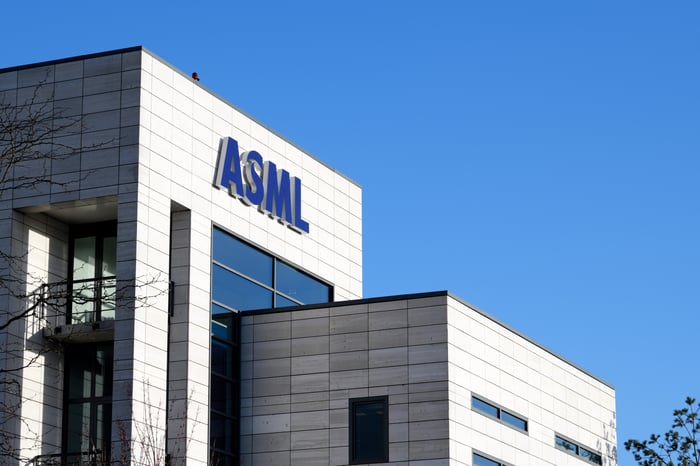
Image source: ASML Holding.
How stock splits work and why companies do them
It's important for investors to remember that while a stock split does change the share price and outstanding share count, the market cap -- and therefore an investor's equity position -- remains the same.
For example, let's say an investor purchased 250 shares of a company trading at $800 per share for a total equity position of $200,000. If the company then conducts a 4-for-1 forward stock split, the investor would exchange one of their shares for four new ones, giving the investor 1,000 shares. The share price would decline to $200 per share ($200,000/1,000).
There tend to be specific reasons companies conduct stock splits. One common reason is if a company's stock performed extremely well and rose to a high level per share. If shares of peers trade well below that level, management may want to make the stock trade at a comparable price so it feels more attainable to retail investors. Because traditional stock splits increase the outstanding share count, splits can also help boost liquidity.
Reverse stock splits tend to be viewed as more problematic by the market because they can indicate that management doesn't believe it can increase the stock price through pure execution. One of the most common reasons for a reverse split is to help a stock remain compliant with share price minimums set by the Nasdaq exchange or the New York Stock Exchange. Both exchanges will send companies deficiency notices if a stock trades for less than $1 per share for 30 consecutive trading days, which can eventually lead to delisting if the company can't get its stock price back above $1 per share. A reverse stock split can give management time to fix issues at the company while being able to stay on one of the most liquid stock exchanges in the world.
Will ASML Holding conduct a stock split?
ASML Holding is viewed as a key player in the artificial intelligence trade because the company makes lithography machines that chipmakers use to etch transistors onto silicon wafers, which the semiconductors need to operate.
While ASML is not the only company that makes lithography machines, it is the only one that makes extreme ultraviolet lithography machines, which companies like Nvidia need to create extremely small and intricate designs on their powerful chips. Such machines are not cheap (ASML's newest lithography machine is expected to cost around $400 million).
Given that the company's machines play such a critical role in chip design, ASML's stock has performed well, up nearly 48% this year and close to 174% over the past five years. Interestingly, the stock now trades at a very high share price of roughly $1,036 per share. ASML did conduct one other stock split in 2012, executing a reverse split as part of a synthetic buyback (it's a way for a company to return capital to its shareholders by combining a direct cash payment to shareholders with a reverse stock split. The reverse split adjusts the number of shares to prevent dilution of earnings per share (EPS) that can occur from the buyback).
Meanwhile, as of this writing, competitors like Lam Research and Applied Materials trade at roughly $148 and $228 per share, respectively. One competitor, KLA Research, also trades high at $1,159 per share.
ASML doesn't necessarily need to conduct a stock split, but it certainly could if it wanted to. The stock has done well; the company has not conducted a forward split since 2007, and there are competitors that trade at much lower share prices. So while I am not sure if ASML will conduct a stock split, it wouldn't surprise me if it happens.
Should you invest $1,000 in ASML right now?
Before you buy stock in ASML, consider this:
The Motley Fool Stock Advisor analyst team just identified what they believe are the 10 best stocks for investors to buy now… and ASML wasn’t one of them. The 10 stocks that made the cut could produce monster returns in the coming years.
Consider when Netflix made this list on December 17, 2004... if you invested $1,000 at the time of our recommendation, you’d have $590,287!* Or when Nvidia made this list on April 15, 2005... if you invested $1,000 at the time of our recommendation, you’d have $1,173,807!*
Now, it’s worth noting Stock Advisor’s total average return is 1,047% — a market-crushing outperformance compared to 195% for the S&P 500. Don’t miss out on the latest top 10 list, available when you join Stock Advisor.
See the 10 stocks »
*Stock Advisor returns as of October 27, 2025
Bram Berkowitz has no position in any of the stocks mentioned. The Motley Fool has positions in and recommends ASML, Applied Materials, and Lam Research. The Motley Fool has a disclosure policy.
Recommended Articles


