


US Dollar edges higher as markets brace for geopolitical, tariff uncertainty
- The US Dollar trades stronger amidst geopolitical concerns.
- The US Dollar appreciates despite a drop in US yields and the Fed’s commitment to cut rates.
- The US Dollar Index tries to break out of its lower March range.
The US Dollar Index (DXY), which tracks the performance of the US Dollar (USD) against six major currencies, extends recovery and trades around 104.00 at the time of writing on Friday, trying to break out higher. The move away from the 2025 low at 103.20 reached on Tuesday comes after the Financial Times reported European countries are drawing up plans to take on responsibilities for the continent’s defence from the United States (US), including a pitch to the Trump administration for a managed transfer over the next five to 10 years, which would reshape the North Atlantic Treaty Organisation (NATO). The European bloc wants to avoid a disorganised exit from the US in the treaty.
Meanwhile, pressure is mounting with April 2 as the deadline for the US to impose reciprocal tariffs. Several traders and analysts are trying to grasp the impact the tariffs might have on markets, though for now, this remains unclear. US Federal Reserve (Fed) Chairman Jerome Powell said in the press conference following the latest Fed meeting on Wednesday that levies should have a transitory effect on inflation.
Markets seem to believe those words, however, traders remain doubtful. The last time Powell said effects were transitory, the Fed had to hike from 0.25% to 5.5% its policy rate in the post-covid era when inflation appeared to be sticky, not transitory. It took the central bank more than a year to confirm that.
Daily digest market movers: Very quiet ahead
- This Friday will be marked as Quadruple Witching day. Quadruple Witching is an event in financial markets when four different sets of futures and options expire on the same day, and investors need to decide whether to sell and buy back their positions or just sell them.
- At 13:05, Federal Reserve Bank of New York President John Williams delivers keynote remarks at the 2nd Biennial Macroeconometric Caribbean Conference in Nassau, Bahamas.
- At 15:00 GMT, US President Donald Trump will give a speech from the Oval Office.
- Equities are dropping lower on Friday. In China, the Hang Seng and the Shanghai Shenzhen indexes both dropped over 1.50%. This fueled another rout in European equities and in US futures. Concerns are mounting as US corporate profit earnings look bleak, and several central banks – including the Federal Reserve, the Bank of Japan and the Bank of England – have expressed uncertainty about the economy due to tariffs, affecting their policy-making.
- According to the CME Fedwatch Tool, the probability of interest rates remaining at the current range of 4.25%-4.50% in May’s meeting is at 83.1%. For June, the odds for borrowing costs being lower stand at 70.0%.
- The US 10-year yield trades around 4.22%, heading back to its five-month low of 4.10% printed on March 4.
US Dollar Index Technical Analysis: Contradictions and correlations
The US Dollar Index (DXY) is ticking up for a third day in a row and is already trading positive for this week’s performance. The seismic shift that materialised at the start of March is still present. With the US reciprocal tariff deadline on April 2 approaching, either a full swing trade back to 106.82 or another leg lower towards 101.90 or even 100.62 could occur as markets are having a hard time reading and understanding the possible effects of these tariffs on the global economy.
Should the DXY close above 104.00 this week, a large sprint higher towards the 105.00 round level could happen, with the 200-day Simple Moving Average (SMA) converging at that point and reinforcing this area as a strong resistance. Once broken through that zone, a string of pivotal levels, such as 105.53 and 105.89, could limit the upward momentum.
On the downside, the 103.00 round level could be considered a bearish target in case US yields roll off further on deteriorating US data, with even 101.90 on the table if markets further capitulate on their long-term US Dollar holdings.
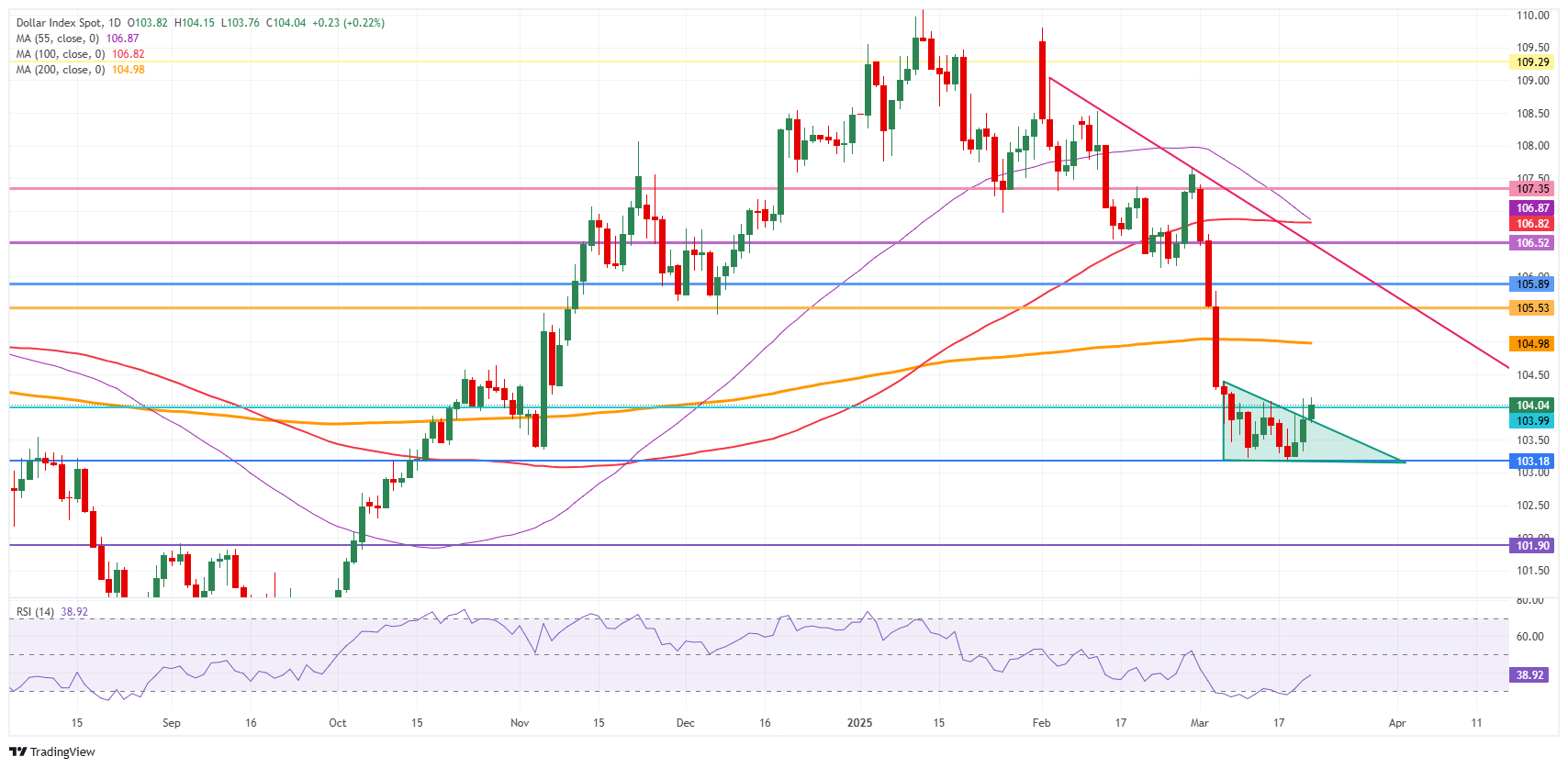
US Dollar Index: Daily Chart
US Dollar FAQs
The US Dollar (USD) is the official currency of the United States of America, and the ‘de facto’ currency of a significant number of other countries where it is found in circulation alongside local notes. It is the most heavily traded currency in the world, accounting for over 88% of all global foreign exchange turnover, or an average of $6.6 trillion in transactions per day, according to data from 2022. Following the second world war, the USD took over from the British Pound as the world’s reserve currency. For most of its history, the US Dollar was backed by Gold, until the Bretton Woods Agreement in 1971 when the Gold Standard went away.
The most important single factor impacting on the value of the US Dollar is monetary policy, which is shaped by the Federal Reserve (Fed). The Fed has two mandates: to achieve price stability (control inflation) and foster full employment. Its primary tool to achieve these two goals is by adjusting interest rates. When prices are rising too quickly and inflation is above the Fed’s 2% target, the Fed will raise rates, which helps the USD value. When inflation falls below 2% or the Unemployment Rate is too high, the Fed may lower interest rates, which weighs on the Greenback.
In extreme situations, the Federal Reserve can also print more Dollars and enact quantitative easing (QE). QE is the process by which the Fed substantially increases the flow of credit in a stuck financial system. It is a non-standard policy measure used when credit has dried up because banks will not lend to each other (out of the fear of counterparty default). It is a last resort when simply lowering interest rates is unlikely to achieve the necessary result. It was the Fed’s weapon of choice to combat the credit crunch that occurred during the Great Financial Crisis in 2008. It involves the Fed printing more Dollars and using them to buy US government bonds predominantly from financial institutions. QE usually leads to a weaker US Dollar.
Quantitative tightening (QT) is the reverse process whereby the Federal Reserve stops buying bonds from financial institutions and does not reinvest the principal from the bonds it holds maturing in new purchases. It is usually positive for the US Dollar.
Recommended Articles


