


Degrossing Now, Bitcoin Moonshot Next? Here’s The Case, Says Analyst
Bitcoin may be trapped beneath the gravitational pull of forced deleveraging, but macro strategist and Forward Guidance host Felix Jauvin insists that the clearing of risk books is no more than “the prelude to an incredible trade once the degrossing is over.” In a thread on X, Jauvin stitches together fiscal arithmetic, global liquidity metrics and the geopolitics of trade to argue that the next great impulse for BTC will arrive when capital flows that have underpinned US asset dominance reverse and re‑seed risk appetite abroad.
Bitcoin Amid The Trump Chaos
Jauvin begins by borrowing the empirical backbone of Michael Howell’s work. “Bitcoin is primarily driven by global liquidity,” he writes, citing Howell’s Granger‑causality tests that give liquidity an eleven‑week statistical lead on spot prices. Equity‑style beta “is a spurious correlation,” Jauvin argues, because US equities have merely been the channel through which global dollar liquidity has expressed itself since pandemic‑era deficits swelled Treasury issuance and household incomes at once.
Putting numbers to the claim, he notes that the United States has “run a substantially higher fiscal deficit as % of GDP than any other country,” a gap that “mechanically leads to higher inflation, higher nominal GDP, and therefore higher top‑line revenue for corporations.” By extension, the S&P 500—and increasingly Bitcoin—have monopolised incremental risk capital. “Because of this dynamic, US equity markets have been the dominant marginal driver of risky asset growth, wealth effect, global liquidity, and therefore a vacuum for global capital to go where it’s treated best: the USA.”
Jauvin’s inflection point is the Trump campaign’s declared ambition to compress the trade deficit and prod allies into heavier fiscal outlays for defence and infrastructure. “The Trump administration wants to lower trade deficits with other countries, which mechanically implies a decrease of US dollars flowing to foreign countries that will not be reinvested into US assets,” he writes. A paired objective is “a weaker dollar and stronger foreign currencies,” achieved as foreign central banks lift rates and investors repatriate funds to harvest that carry.
He sees the genie already inching out of the bottle: “Trump’s shoot‑first, ask‑questions‑after approach to trade negotiations is leading the rest of the world to unshackle themselves from their meagre fiscal deficits … I believe nations will continue with this pursuit regardless.”
If foreign governments embark on deficit‑financed rearmament and industrial policy, the marginal growth in global liquidity would migrate out of Washington and into Europe and Asia. “As the US continues to pivot from a global capital partner to a more protectionist one, holders of US‑dollar assets will begin to have to increase the risk premium associated with these previously pristine assets and have to mark them with a wider margin of safety.”
Why Bitcoin, And Why After The Sell‑Off
Jauvin frames the present turmoil as the necessary purgation of crowded positions: “The first trade is to sell US‑dollar assets that the entire world is overweight and avoid the degrossing that is ongoing.” Margin exhaustion forces funds to raise cash indiscriminately, pinning Bitcoin to tech beta for now. But, he insists, the second phase will favour assets unburdened by national accounts or tariff risk. “During rotational market days and non‑margin‑call days, we’ve started to see this dynamic take shape. DXY down, US equities underperforming ROW, gold soaring, and Bitcoin holding up surprisingly well.”
Gold has already responded, he notes. Bitcoin, by contrast, “hasn’t kept up with gold’s outperformance” because its high‑beta reputation keeps systematic traders on the sidelines. That sets up the asymmetry: “For me, a risk‑seeking macro trader, Bitcoin feels like the cleanest trade after the trade here. You can’t tariff bitcoin, it doesn’t care about what border it resides in … and provides a clean exposure to global liquidity, not just American liquidity.”
Crucially, Jauvin anticipates a visible break in the co‑movement with US tech once non‑US fiscal stimulus becomes the leading source of incremental liquidity. “I’m seeing the potential for the first time … for Bitcoin to decouple from US tech equities,” he writes, conceding that the idea has hurt many before but arguing that this time “we are seeing the potential for a meaningful change in capital flows that would make it durable.”
If the thread’s logic holds, the present stress is the mandatory downstroke before a secular re‑rating. “This market regime is what Bitcoin was built for,” Jauvin concludes. “Once the degrossing dust settles, it will be the fastest horse out of the gate. Accelerate.”
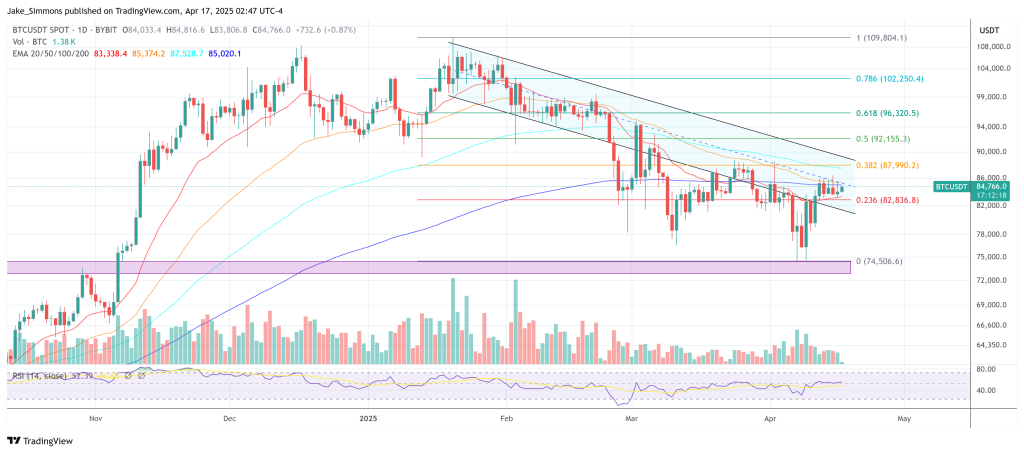
At press time, BTC traded at $84,766.
Recommended Articles


