


Gold price pulls back after historic surge past $3,000 on Trump trade woes
- Gold briefly hits unprecedented high at $3,004 per ounce before settling lower at $2,982 amid US Dollar volatility.
- Geopolitical tensions rise as Russia-Ukraine ceasefire falters; China's central bank extends bullion buying streak, boosts Gold.
- US recession fears escalate following dismal consumer sentiment report, raising bets the Fed could ease policy further in 2025.
Gold prices retreat after hitting a record high, surpassing $3,000, as traders remain uncertain about US President Donald Trump's trade policies. This and the weakness of the US Dollar drove the precious metal to reach an all-time high of $3,004 a troy ounce before retreating to $2,982, losing 0.21% in the day.
Geopolitics are also impacting Gold’s demand. The Ukraine—Russia ceasefire is at a crossroads, with the latter seeming reluctant to adhere to the 30-day truce.
In the meantime, the People’s Bank of China (PBoC) increased its Bullion reserves for the fourth straight month in February, according to the World Gold Council (WGC).
Recession fears surrounding the economy of the United States (US) sent the Greenback on a tailspin, spurring demand for the non-yielding metal. This increased the odds that the Federal Reserve (Fed) would ease policy by 66 basis points (bps) in 2025, down from 74 bps a day ago.
Traders are focused on next week’s Federal Reserve (Fed) policy decision.Last Friday, Fed Chair Jerome Powell noted that "market measures of inflation expectations have moved up, driven by tariffs," signaling concerns that trade policies could contribute to renewed price pressures.
Data-wise, the University of Michigan (UoM) Consumer Sentiment Index registered a dismal print, while inflation expectations aimed higher due to US President Trump’s tariffs.
Next week, the US economic schedule will feature Retail Sales, housing data, the Fed’s monetary policy decisions, and economic projections.
Daily digest market movers: Gold price treads water amid soft US Dollar
- The US 10-year Treasury bond yield has recovered some ground and climbed five basis points up at 4.320%.
- US real yields, as measured by the US 10-year Treasury Inflation-Protected Securities (TIPS) yield that correlates inversely to Gold prices surges four and a half bps up at 2.013% via Reuters.
- The US Dollar Index (DXY), which tracks the Greenback’s value against six currencies, falls 0.14% to 103.71.
- The University of Michigan (UoM) Consumer Sentiment survey for March revealed a sharp decline in sentiment, falling to 57.9 from 64.7, well below the 63.1 forecast.
- Inflation expectations surged, with Americans projecting 12-month inflation to rise from 4.3% to 4.9%. Over a five-year period, consumers expect inflation to increase to 3.9%, up from the previous 3.5% estimate.
- Despite recent cooler-than-expected inflation data, economists caution that tariffs on US imports could lead to a renewed inflationary uptick in the coming months.
- On Wednesday, 25% US tariffs on steel and aluminum took effect at midnight as US President Donald Trump is battling to reduce the trade deficit by applying duties on imports.
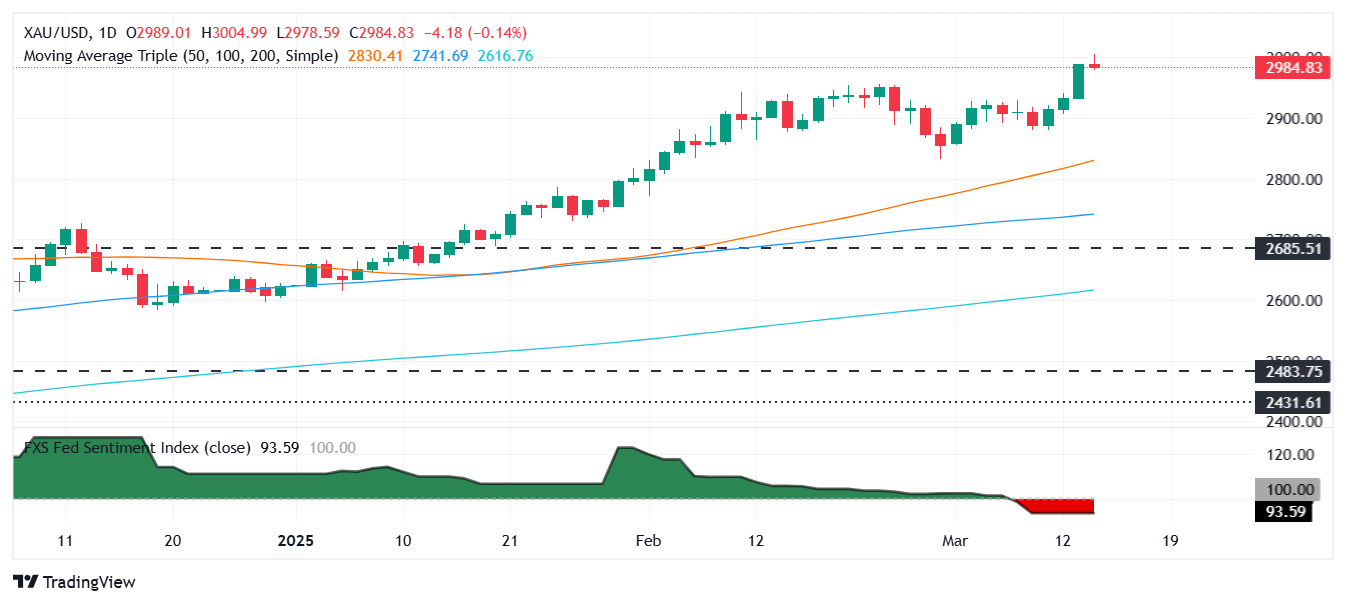
XAU/USD technical outlook: Gold price struggles to hold above $3,000
Gold price retreats after finally reaching the $3,000 milestone. The pullback is seen as bulls taking a breather before launching a second attack to achieve a daily close above the all-time high of $3,004. The following key resistance levels seen are $3,050 and $3,100.
On the flipside, the first support is the $2,950, which, if cleared, could pave the way to test $2,900 ahead of $2,850. The following support will be a February 28 low of $2,832.
Gold FAQs
Gold has played a key role in human’s history as it has been widely used as a store of value and medium of exchange. Currently, apart from its shine and usage for jewelry, the precious metal is widely seen as a safe-haven asset, meaning that it is considered a good investment during turbulent times. Gold is also widely seen as a hedge against inflation and against depreciating currencies as it doesn’t rely on any specific issuer or government.
Central banks are the biggest Gold holders. In their aim to support their currencies in turbulent times, central banks tend to diversify their reserves and buy Gold to improve the perceived strength of the economy and the currency. High Gold reserves can be a source of trust for a country’s solvency. Central banks added 1,136 tonnes of Gold worth around $70 billion to their reserves in 2022, according to data from the World Gold Council. This is the highest yearly purchase since records began. Central banks from emerging economies such as China, India and Turkey are quickly increasing their Gold reserves.
Gold has an inverse correlation with the US Dollar and US Treasuries, which are both major reserve and safe-haven assets. When the Dollar depreciates, Gold tends to rise, enabling investors and central banks to diversify their assets in turbulent times. Gold is also inversely correlated with risk assets. A rally in the stock market tends to weaken Gold price, while sell-offs in riskier markets tend to favor the precious metal.
The price can move due to a wide range of factors. Geopolitical instability or fears of a deep recession can quickly make Gold price escalate due to its safe-haven status. As a yield-less asset, Gold tends to rise with lower interest rates, while higher cost of money usually weighs down on the yellow metal. Still, most moves depend on how the US Dollar (USD) behaves as the asset is priced in dollars (XAU/USD). A strong Dollar tends to keep the price of Gold controlled, whereas a weaker Dollar is likely to push Gold prices up.
Recommended Articles


