


Gold extends losses with the Dollar supported by higher yields
- Gold rally fails at around $2,720 and pares previous gains amid higher US yields.
- The divergence between the Federal Reserve and the rest of the major central banks is supporting the USD.
- XAU/USD is under growing negative pressure, aiming for $2,660.
Gold (XAU/USD) has given away earlier gains and is trading lower for the second consecutive day during Friday’s European session. The US Dollar (USD) maintains its bullish tone, supported by rising US Treasury yields, which keeps the precious metal under pressure.
Recent US data is showing a resilient US economy with inflation picking up. Donald Trump’s high tariffs for imports and restricted immigration are expected to lift consumer prices, forcing the Federal Reserve (Fed) to approach cautiously with monetary easing next year.
Most of the major central banks, in contrast, are expected to cut rates aggressively, as shown by the European Central Bank (ECB), the Bank of Canada (BoC), and the Swiss National Bank (SNB) this week. This provides a competitive advantage for the Dollar, which has rallied more than 1% so far this week, to the detriment of Gold prices.
Daily digest market movers: Gold pares weekly gains amid a strong US Dollar
- Gold is on track to a moderate advance this week. The uncertainty in the Middle East has provided support to the safe-haven commodity, but the positive momentum faded as markets calmed and the focus shifted to the US economy.
- Data from Thursday showed that US Jobless Claims increased by 242K against expectations of a slight decline to 220K from the previous week’s 225K.
- US Producer Prices were mixed, with the headline PPI accelerating at a 0.4% pace, twice as much as the 0.2% expected, from 0.3% in October. The core PPI eased to 0.2% from 0.3% last month.
- These data cemented hopes of Fed cuts next week and favoured a shallow bounce in Gold prices. However, the US Dollar resumed its bullish trend as the dust settled with investors coming to terms with the view of only gradual Fed cuts in 2025.
- In Europe, the ECB cut rates by 0.25% to 3% against the will of some doves, who wanted more aggressive cuts. The SNB took markets by surprise with a large cut and hinted at more easing.
- These decisions highlighted the divergence in the forward guidance of the Fed and the rest of the major central banks and provided important support for the US Dollar.
- Earlier this week, US consumer prices grew at their fastest pace in seven months, which adds to evidence that the cooling inflationary trend has faded.
Technical analysis: XAU/USD under growing bearish pressure
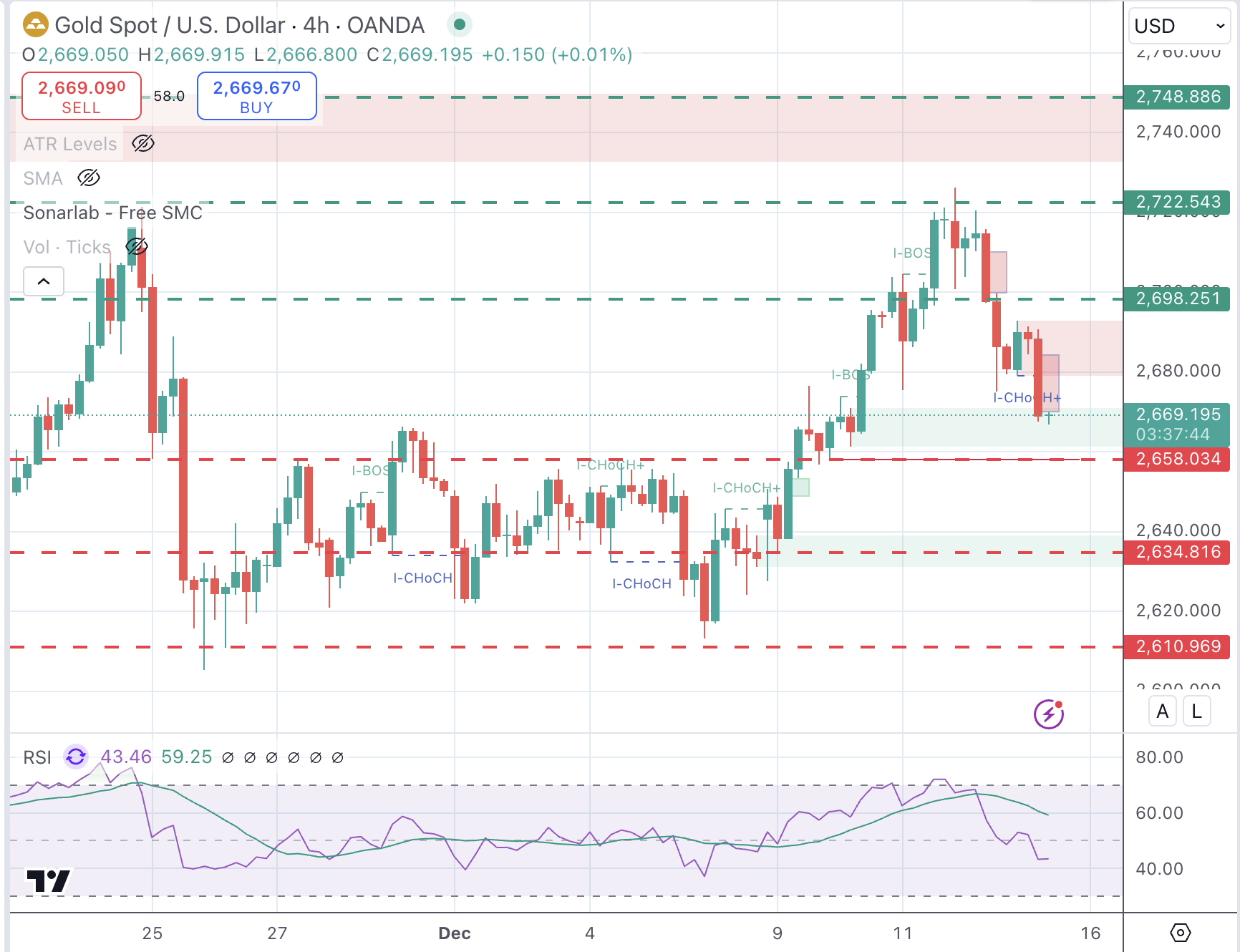
Gold’s rally was capped again at the $2,720 resistance area earlier this week, and the precious metal is trading lower. Bears appear to be taking control, aiming for a retest of the previous week’s range top between $2,660 and $2,665.
Below here, the pair might find support at the December 9 low at around $2,630 ahead of the channel bottom and the November 25, 26 and December 5 lows at around $2,610.
Upside attempts are likely to find resistance at the $2,700 psychological level and the mentioned $2,730 (November 22 and December 11 highs).
XAU/USD 4-Hour Chart
Gold FAQs
Gold has played a key role in human’s history as it has been widely used as a store of value and medium of exchange. Currently, apart from its shine and usage for jewelry, the precious metal is widely seen as a safe-haven asset, meaning that it is considered a good investment during turbulent times. Gold is also widely seen as a hedge against inflation and against depreciating currencies as it doesn’t rely on any specific issuer or government.
Central banks are the biggest Gold holders. In their aim to support their currencies in turbulent times, central banks tend to diversify their reserves and buy Gold to improve the perceived strength of the economy and the currency. High Gold reserves can be a source of trust for a country’s solvency. Central banks added 1,136 tonnes of Gold worth around $70 billion to their reserves in 2022, according to data from the World Gold Council. This is the highest yearly purchase since records began. Central banks from emerging economies such as China, India and Turkey are quickly increasing their Gold reserves.
Gold has an inverse correlation with the US Dollar and US Treasuries, which are both major reserve and safe-haven assets. When the Dollar depreciates, Gold tends to rise, enabling investors and central banks to diversify their assets in turbulent times. Gold is also inversely correlated with risk assets. A rally in the stock market tends to weaken Gold price, while sell-offs in riskier markets tend to favor the precious metal.
The price can move due to a wide range of factors. Geopolitical instability or fears of a deep recession can quickly make Gold price escalate due to its safe-haven status. As a yield-less asset, Gold tends to rise with lower interest rates, while higher cost of money usually weighs down on the yellow metal. Still, most moves depend on how the US Dollar (USD) behaves as the asset is priced in dollars (XAU/USD). A strong Dollar tends to keep the price of Gold controlled, whereas a weaker Dollar is likely to push Gold prices up.
Recommended Articles


