


Gold eases slightly below fresh monthly highs at $2,720
- The Gold rally halts right below a one-month high at $2,720, but downside attempts are limited.
- Higher Treasury yields are acting as support for the US Dollar and weighing on the recent Gold rally.
- XAU/USD broader technical picture remains positive, with price action printing higher highs and higher lows.
Gold (XAU/USD) is hesitating below a one-month high at $2,720 on Thursday’s European session following a sharp rally over the last three days. The rebound on US Treasury yields, with the benchmark 10-year yield more than 15 pips above last week’s lows, is weighing on the precious metal’s rally.
However, downside attempts remain limited, with investors nearly fully pricing a 25 basis points (bps) interest-rate cut by the Federal Reserve (Fed) next week. The hot US Consumer Price Index (CPI) report did not scratch investors’ hopes of further monetary easing, although the outlook of a shallower easing cycle in 2025 underpins the US Dollar (USD).
Daily digest market movers: Gold rally stalls with the Dollar steady near two-week highs
- US consumer prices grew at their fastest pace in seven months, 0.3% up in November compared with the previous month and 2.6% year-on-year, from 0.2% and 2.6%, respectively. The core CPI remained steady at 0.3% monthly and 3.3% from November last year.
- Market expectations of a 25 bps Fed rate cut on December 18 increased to 98% from 85% before the CPI release and around 75% last week, as shown by the CME Group’s Fed Watch Tool.
- Futures markets are increasingly pricing the chance of two additional rate cuts in 2025, instead of three as previously thought.
- Strong US macroeconomic data and expectations of higher inflation stemming from Donald Trump’s policies are forcing investors to scale back Fed easing prospects, and pushing US yields higher.
- The yield of the benchmark 1-year Treasury note has reached 4.30% from 4.12% lows last week after having rallied for four consecutive days. This provides important support to the Greenback.
- The Swiss National Bank (SNB) cut interest rates by 50 basis points against market expectations of a 25 bps cut. The European Central Bank (ECB) is next with the market consensus anticipating a quarter-point interest-rate cut. Another jumbo cut would rattle markets and send the US Dollar higher.
Technical analysis: XAU/USD consolidates with $2,720 resistance in focus
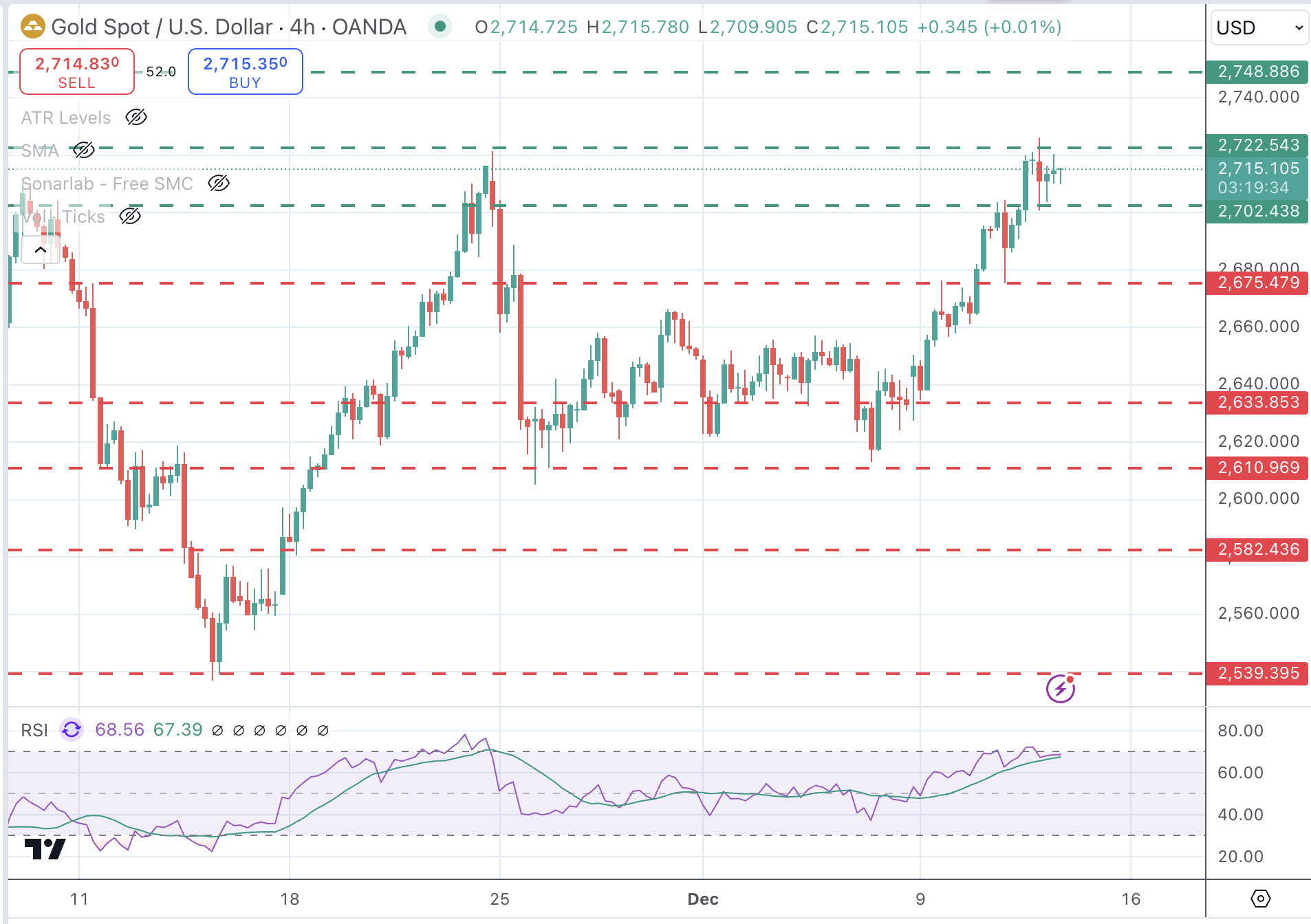
Gold’s rally has lost some steam, with US Treasury yields bouncing up and the US Dollar appreciating on the back of strong US inflation data. However, the broader trend remains positive, with bearish attempts contained above $2,700.
On the upside, the November 24 high at $2,720 emerges as the first resistance. The next upside target is the November 4, 5 and 6 highs at around $2,750.
On the downside, previous resistance at around $2,700 (December 10 high) is acting now as support ahead of the $2,675 intra-day level and the December 9 low at $2,630.
XAU/USD 4-Hour Chart
Inflation FAQs
Inflation measures the rise in the price of a representative basket of goods and services. Headline inflation is usually expressed as a percentage change on a month-on-month (MoM) and year-on-year (YoY) basis. Core inflation excludes more volatile elements such as food and fuel which can fluctuate because of geopolitical and seasonal factors. Core inflation is the figure economists focus on and is the level targeted by central banks, which are mandated to keep inflation at a manageable level, usually around 2%.
The Consumer Price Index (CPI) measures the change in prices of a basket of goods and services over a period of time. It is usually expressed as a percentage change on a month-on-month (MoM) and year-on-year (YoY) basis. Core CPI is the figure targeted by central banks as it excludes volatile food and fuel inputs. When Core CPI rises above 2% it usually results in higher interest rates and vice versa when it falls below 2%. Since higher interest rates are positive for a currency, higher inflation usually results in a stronger currency. The opposite is true when inflation falls.
Although it may seem counter-intuitive, high inflation in a country pushes up the value of its currency and vice versa for lower inflation. This is because the central bank will normally raise interest rates to combat the higher inflation, which attract more global capital inflows from investors looking for a lucrative place to park their money.
Formerly, Gold was the asset investors turned to in times of high inflation because it preserved its value, and whilst investors will often still buy Gold for its safe-haven properties in times of extreme market turmoil, this is not the case most of the time. This is because when inflation is high, central banks will put up interest rates to combat it. Higher interest rates are negative for Gold because they increase the opportunity-cost of holding Gold vis-a-vis an interest-bearing asset or placing the money in a cash deposit account. On the flipside, lower inflation tends to be positive for Gold as it brings interest rates down, making the bright metal a more viable investment alternative.
Recommended Articles


