


Gold bounces off 50-day SMA after US GDP-inspired decline
- Gold is bouncing off support from a major Moving Average after an over 1.0% fall.
- Traders now await the Federal Reserve’s preferred inflation gauge for more guidance on Friday.
- A lower-than-expected result could see Gold rebound; the opposite for a higher-than-forecast reading.
Gold trades in the $2,360s per ounce on Friday after recovering from the 50-day Simple Moving Average (SMA), as technical traders scalp the bounce after the steep drop of the previous day. Gold sold off by over 1.0% on Thursday as it ran with the commodity pack lower, which declined as a group on global growth fears.
Gold accelerates sell-off after US GDP surprise
Gold bears were further emboldened on Thursday after the release of preliminary US Gross Domestic Product (GDP) growth data showed the American economy grew at an annualized rate of 2.8% in the second quarter, exceeding market expectations of 2.0% and doubling the 1.4% pace of growth in the prior period.
The data indicated the US economy is doing better than expected and that the Federal Reserve (Fed) may need to keep interest rates higher for longer to keep inflation under control. This, in turn, makes Gold, which is a non-interest-bearing asset, less attractive to investors.
Despite the GDP surprise, expectations for rate cuts remain intact. Markets continue to fully price in an interest reduction in the Federal Reserve’s September meeting and anticipate two more cuts by the end of the year.
Gold may be moved by Fed’s favorite inflation gauge
Gold could see more volatility on Friday after the release of June’s core Personal Consumption Expenditures (PCE) Price Index in the US, the Federal Reserve's preferred gauge of inflation. The data could further tone the outlook for interest rates in the US, which could impact the yellow metal.
The Fed is currently expected to cut interest rates by 0.25% in September, reducing them from an upper band of 5.50% to 5.25%. Two more 0.25% cuts are also seen as more than 50% likely before the end of the year, according to the CME FedWatch tool. The core PCE's last reading was 2.6% year-over-year in May, now economists expect it to fall to 2.5% in June as it edges ever closer to the Fed’s 2.0% target level. A deeper-than-expected decline would increase the probability of the Fed making further cuts to interest rates after September; the opposite is true of a higher-than-forecast result.
Technical Analysis: Gold finds support at 50-day SMA
Gold continues unfolding a new down leg within the widening range it has formed since May. It is in a sideways rather than directional market trend, which, given “the trend is your friend,” is likely to continue.
The down leg has met support at the 50-day SMA at $2,360 and bounced slightly. If it closes below the SMA, it will probably extend its decline to the next support level at the base of the widening range and the 100-day SMA at circa $2,320.
XAU/USD Daily Chart
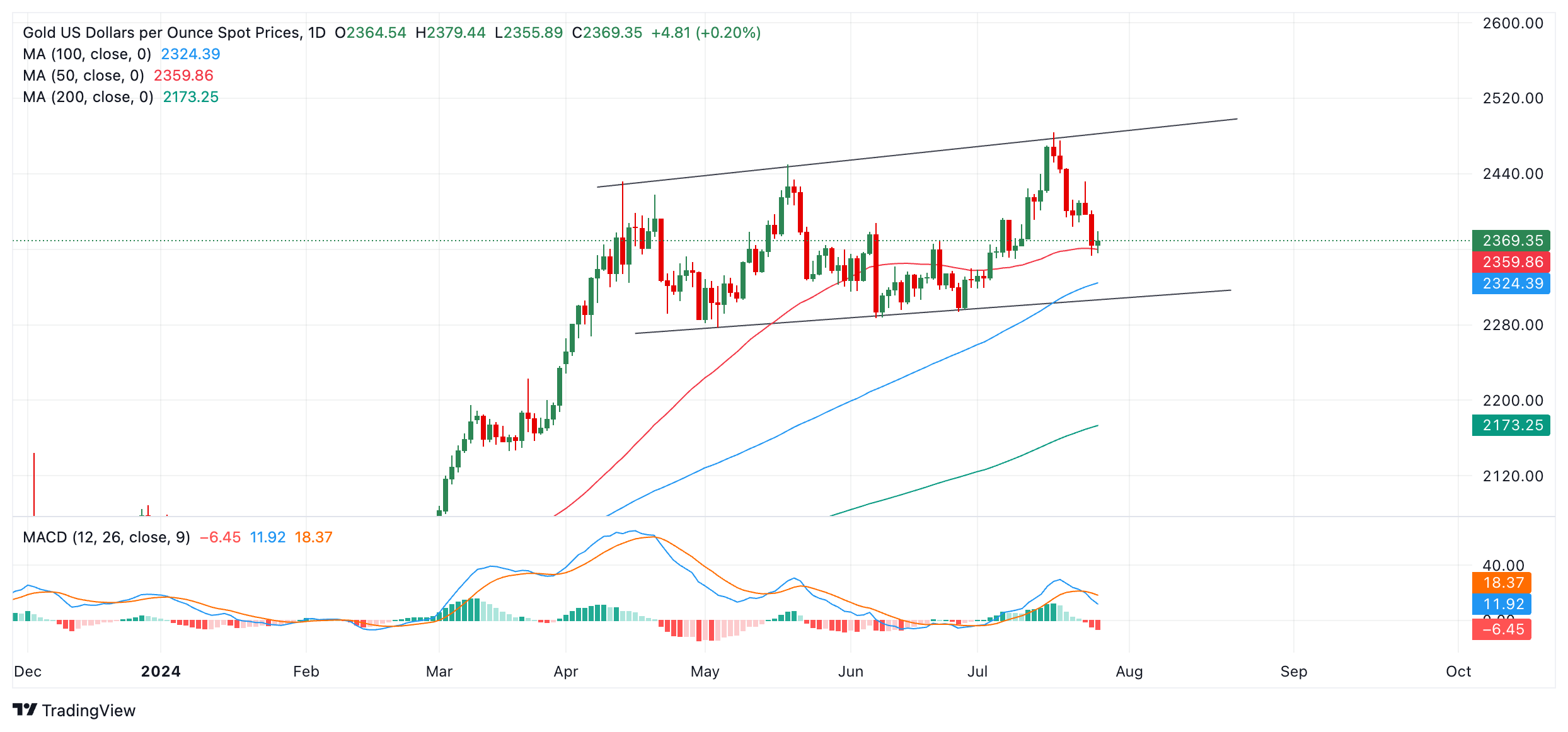
The fact that the Moving Average Convergence Divergence (MACD) indicator has crossed below its signal line adds further bearish confirmation to the downward move currently unfolding. MACD tends to work particularly well at signaling price turns in sideways markets.
A break above the $2,483 all-time high would indicate the establishment of a higher high and suggest the possibility of a breakout to the upside and an extension of the longer-term uptrend.
Such a move might unlock Gold’s next upside target at roughly $2,555-$2,560, calculated by extrapolating the 0.618 Fibonacci ratio of the height of the range higher.
Economic Indicator
Core Personal Consumption Expenditures - Price Index (YoY)
The Core Personal Consumption Expenditures (PCE), released by the US Bureau of Economic Analysis on a monthly basis, measures the changes in the prices of goods and services purchased by consumers in the United States (US). The PCE Price Index is also the Federal Reserve’s (Fed) preferred gauge of inflation. The YoY reading compares the prices of goods in the reference month to the same month a year earlier. The core reading excludes the so-called more volatile food and energy components to give a more accurate measurement of price pressures." Generally, a high reading is bullish for the US Dollar (USD), while a low reading is bearish.
Read more.Next release: Fri Jul 26, 2024 12:30
Frequency: Monthly
Consensus: 2.5%
Previous: 2.6%
Source: US Bureau of Economic Analysis
After publishing the GDP report, the US Bureau of Economic Analysis releases the Personal Consumption Expenditures (PCE) Price Index data alongside the monthly changes in Personal Spending and Personal Income. FOMC policymakers use the annual Core PCE Price Index, which excludes volatile food and energy prices, as their primary gauge of inflation. A stronger-than-expected reading could help the USD outperform its rivals as it would hint at a possible hawkish shift in the Fed’s forward guidance and vice versa.
Recommended Articles


