


Mexican Peso rises amid delayed Trump tariffs
- Mexican Peso strengthens on news of a postponed tariff plan by the incoming Trump administration.
- The upcoming US-Mexico border emergency declaration could reintroduce tension, impacting Peso's trajectory.
- Banxico's Deputy Governor Heath suggests a dovish inflation stance, manageable without excessive tightening.
The Mexican Peso (MXN) rallied against the US Dollar (USD) on Monday ahead of United States (US) President Donald Trump's inauguration. An article in The Wall Street Journal suggested that tariffs would not be imposed immediately after Trump’s oath as the 47th President of the US. The USD/MXN trades at 20.53, down over 1.20% after reaching a daily peak of 20.89.
The market mood remains slightly positive as investors prepare for Trump's inauguration. The WSJ article mentioned that Trump directed federal agencies to “investigate and remedy persistent trade deficits and address unfair trade and currency policies by other nations.” Moreover, the presidential memo suggests that Trump’s administration would focus directly on China, Canada and Mexico.
In the meantime, once President Trump takes office, he is expected to declare a national emergency on the US-Mexico border, which could weigh on the Mexican Peso as tensions arise in both countries.
Aside from this, Banco de Mexico (Banxico) Deputy Governor Jonathan Heath was dovish, saying that headline and core inflation figures may hit 4% in January, adding that the Central Bank “does not need to exaggerate a restrictive posture.”
In a post in X, Heath noted that the December inflation report was “good news since it is the first time (inflation) comes below the 4.26% logged in October 2023.”
This week, Mexico’s economic docket will feature Retail Sales, mid-month Inflation and a proxy for November's Gross Domestic Product (GDP) Economic Activity.
Daily digest market movers: Mexican Peso climbs ahead of inflation data
- The Mexican Peso could take a breather if Trump does not impose tariffs immediately on Mexican imports.
- However, the Mexican currency is not out of the woods. The divergence between the Banco de Mexico (Banxico) and the Federal Reserve (Fed) hints that further upside in USD/MXN lies ahead.
- Mexico’s Retail Sales in November plunged to 0.3% MoM and 1.2% YoY.
- Mid-month inflation in January is foreseen to drop from 4.44% to 3.93%. Underlying inflation is expected to rise modestly from 3.62% to 3.69%.
- Economists polled by Reuters revealed that GDP will grow 1.2% in 2025, compared to 1.6% last year. Additionally, they foresee Banco de Mexico (Banxico) cutting interest rates by at least 150 basis points to 8.50% by the end of the year.
- In the Fed’s latest Summary of Economic Projections (SEP), officials estimate they will cut interest rates by 50 basis points.
- Money market futures had priced in 42.5 bps of Fed rate cuts in 2025, according to CME FedWatch Tool data.
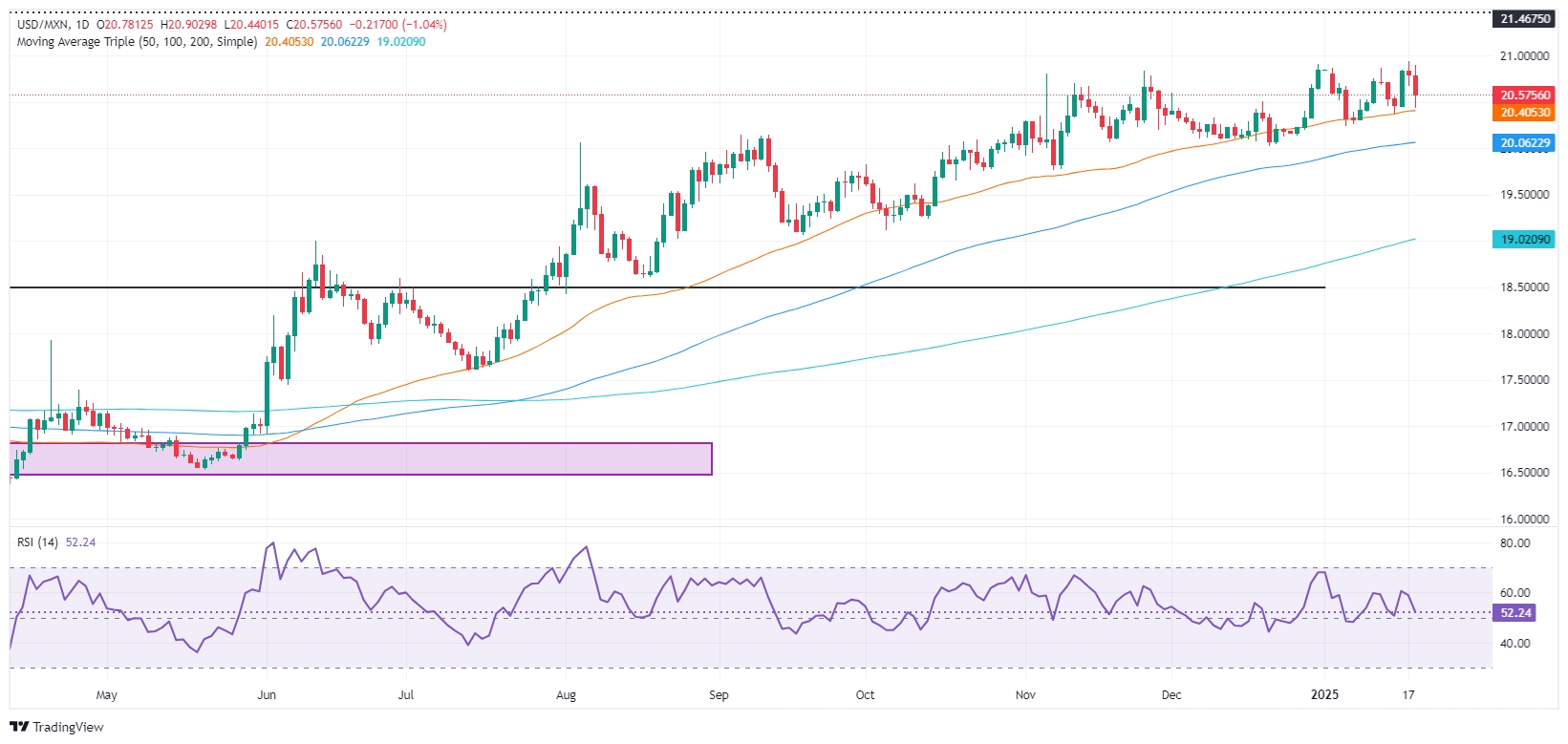
USD/MXN technical outlook: Mexican Peso rises as USD/MXN dips below 20.80
The USD/MXN uptrend remains intact despite the ongoing pullback, which saw the exotic pair reach a daily low of 20.43 near the 50-day Simple Moving Average (SMA) at 20.38 before recovering some ground.
If USD/MXN climbs above the year-to-date (YTD) high of 20.94, it will clear the path to challenge the 21.00 psychological barrier. Once surpassed, the next resistance will be the March 8, 2022 peak at 21.46, followed by 21.50 and the 22.00 psychological level.
Conversely, if the pair tumbles below the 50-day SMA, the next support would be the 100-day SMA at 20.04, which is ahead of the 20.00 mark.
Mexican Peso FAQs
The Mexican Peso (MXN) is the most traded currency among its Latin American peers. Its value is broadly determined by the performance of the Mexican economy, the country’s central bank’s policy, the amount of foreign investment in the country and even the levels of remittances sent by Mexicans who live abroad, particularly in the United States. Geopolitical trends can also move MXN: for example, the process of nearshoring – or the decision by some firms to relocate manufacturing capacity and supply chains closer to their home countries – is also seen as a catalyst for the Mexican currency as the country is considered a key manufacturing hub in the American continent. Another catalyst for MXN is Oil prices as Mexico is a key exporter of the commodity.
The main objective of Mexico’s central bank, also known as Banxico, is to maintain inflation at low and stable levels (at or close to its target of 3%, the midpoint in a tolerance band of between 2% and 4%). To this end, the bank sets an appropriate level of interest rates. When inflation is too high, Banxico will attempt to tame it by raising interest rates, making it more expensive for households and businesses to borrow money, thus cooling demand and the overall economy. Higher interest rates are generally positive for the Mexican Peso (MXN) as they lead to higher yields, making the country a more attractive place for investors. On the contrary, lower interest rates tend to weaken MXN.
Macroeconomic data releases are key to assess the state of the economy and can have an impact on the Mexican Peso (MXN) valuation. A strong Mexican economy, based on high economic growth, low unemployment and high confidence is good for MXN. Not only does it attract more foreign investment but it may encourage the Bank of Mexico (Banxico) to increase interest rates, particularly if this strength comes together with elevated inflation. However, if economic data is weak, MXN is likely to depreciate.
As an emerging-market currency, the Mexican Peso (MXN) tends to strive during risk-on periods, or when investors perceive that broader market risks are low and thus are eager to engage with investments that carry a higher risk. Conversely, MXN tends to weaken at times of market turbulence or economic uncertainty as investors tend to sell higher-risk assets and flee to the more-stable safe havens.
Recommended Articles


