


EUR/USD rises above 1.0800 as US Dollar edges down
- EUR/USD finds cushion near 1.0800 amid improvement in the Eurozone’s economic outlook.
- The ECB is set to start reducing interest rates from the June meeting.
- The US Dollar drops even though traders pare back Fed rate-cut bets.
EUR/USD seems well-supported near the round-level support of 1.0800 in Friday’s European session. The strength in the major currency pair is majorly driven by strong Eurozone preliminary Purchasing Managers Index (PMI) data for May. The strong Composite PMI has improved the Eurozone’s economic outlook, but the likelihood of the European Central Bank (ECB) lowering interest rates in the short term remains firm.
S&P Global reported on Thursday that the Composite PMI jumped to 52.3, beating the consensus of 52.0 and the former release of 51.7. The PMI data rose for the third consecutive month even though the ECB is maintaining a restrictive policy framework.
Dr. Cyrus de la Rubia, Chief Economist at Hamburg Commercial Bank (HCOB) – which also publishes the PMI data in collaboration with S&P Global – said: “This time, there is also some good news for the ECB as the rates of inflation for input and output prices in the services sector have softened compared to the month before. This will be supportive of the apparent stance of the ECB to cut rates at the meeting on June 6. However, the better inflation outlook will most probably not be enough for the central bank to announce that further rate cuts will follow suit.”
Daily digest market movers: EUR/USD rebounds as US Dollar recovery stalls
- EUR/USD holds the crucial support of 1.0800 as the US Dollar declines despite upbeat data from the United States and deepening uncertainty about when the Federal Reserve (Fed) will start reducing interest rates. The early PMI print by S&P Global for May showed that the Composite PMI also beat expectations in the US, exceeding the prior reading due to robust growth in both manufacturing and service activities.
- The US preliminary PMI numbers suggested that business activity rose at the fastest pace in just over two years after two months of slower growth, indicating that the economy is on track to post solid Gross Domestic Product (GDP) gain in the second quarter. Strong US PMI data has weakened market speculation that the Fed will start reducing interest rates from the September meeting.
- The CME FedWatch tool shows that the probability for rate cuts from their current levels in September has been reduced to 53% from 64% recorded a week ago. Meanwhile, hawkish guidance on interest rates by Fed policymakers has also weighed on rate-cut bets for September.
- On Thursday, Atlanta Fed Bank President Raphael Bostic said the central bank may need to wait for the rate-cut consideration amid upside risks to inflation despite a slowdown in price pressures in April’s Consumer Price Index (CPI) report, Reuters reported. In a virtual class session with Stanford University business school students, Bostic said prices of a few goods are increasing at a faster pace than what is required to bring inflation down to the 2% target. Bostic added that a strong job market gives him comfort in maintaining a restrictive stance on interest rates.
- In Friday’s session, investors will focus on the US Durable Goods Orders data for April, which will be published at 12:30 GMT. Fresh orders for Durable Goods are estimated to have declined by 0.8% after expanding 2.6% in March.
Technical Analysis: EUR/USD holds 1.0800
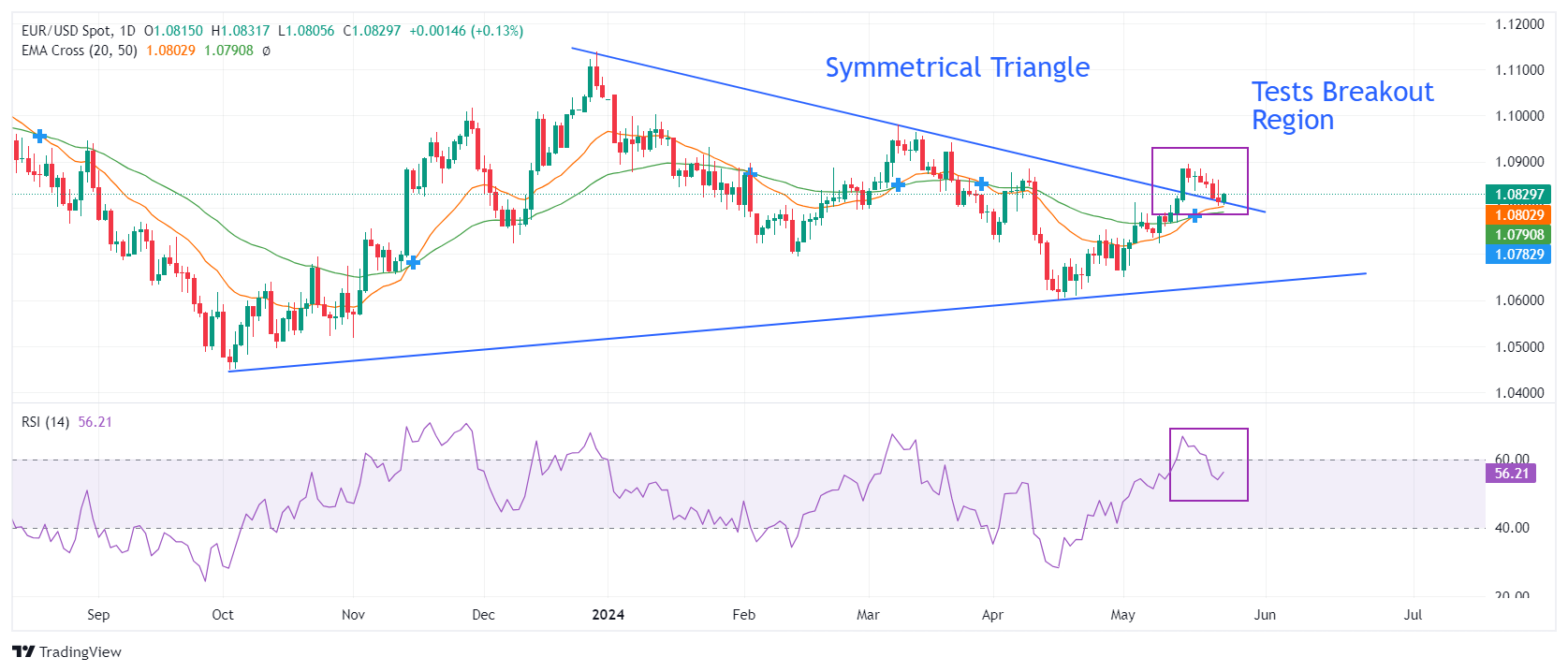
EUR/USD finds buying interest near the breakout region of the Symmetrical Triangle formed on the daily time frame around 1.0800. The near-term outlook of the shared currency pair remains firm as the 20-day and 50-day Exponential Moving Averages (EMAs) have delivered a bullish crossover around 1.0780.
The 14-period Relative Strength Index (RSI) has slipped into the 40.00-60.00, suggesting that the momentum, which was leaned toward the upside has faded for now.
The major currency pair is expected to recapture a two-month high around 1.0900. A decisive break above this level would drive the asset towards March 21 high around 1.0950 and the psychological resistance of 1.1000. However, a downside move below the 200-day EMA at 1.0800 could push it further down.
Euro FAQs
The Euro is the currency for the 20 European Union countries that belong to the Eurozone. It is the second most heavily traded currency in the world behind the US Dollar. In 2022, it accounted for 31% of all foreign exchange transactions, with an average daily turnover of over $2.2 trillion a day. EUR/USD is the most heavily traded currency pair in the world, accounting for an estimated 30% off all transactions, followed by EUR/JPY (4%), EUR/GBP (3%) and EUR/AUD (2%).
The European Central Bank (ECB) in Frankfurt, Germany, is the reserve bank for the Eurozone. The ECB sets interest rates and manages monetary policy. The ECB’s primary mandate is to maintain price stability, which means either controlling inflation or stimulating growth. Its primary tool is the raising or lowering of interest rates. Relatively high interest rates – or the expectation of higher rates – will usually benefit the Euro and vice versa. The ECB Governing Council makes monetary policy decisions at meetings held eight times a year. Decisions are made by heads of the Eurozone national banks and six permanent members, including the President of the ECB, Christine Lagarde.
Eurozone inflation data, measured by the Harmonized Index of Consumer Prices (HICP), is an important econometric for the Euro. If inflation rises more than expected, especially if above the ECB’s 2% target, it obliges the ECB to raise interest rates to bring it back under control. Relatively high interest rates compared to its counterparts will usually benefit the Euro, as it makes the region more attractive as a place for global investors to park their money.
Data releases gauge the health of the economy and can impact on the Euro. Indicators such as GDP, Manufacturing and Services PMIs, employment, and consumer sentiment surveys can all influence the direction of the single currency. A strong economy is good for the Euro. Not only does it attract more foreign investment but it may encourage the ECB to put up interest rates, which will directly strengthen the Euro. Otherwise, if economic data is weak, the Euro is likely to fall. Economic data for the four largest economies in the euro area (Germany, France, Italy and Spain) are especially significant, as they account for 75% of the Eurozone’s economy.
Another significant data release for the Euro is the Trade Balance. This indicator measures the difference between what a country earns from its exports and what it spends on imports over a given period. If a country produces highly sought after exports then its currency will gain in value purely from the extra demand created from foreign buyers seeking to purchase these goods. Therefore, a positive net Trade Balance strengthens a currency and vice versa for a negative balance.
Recommended Articles


