


Four jobs reports in five days: what JOLTS, ADP, claims and the September payrolls mean for the October Fed decision


Mitrade Insights — The Federal Reserve raised rates on September 16 for the first time in three years and immediately put the next move up for debate. This week hands the market four separate readings on the same question — is the US labour market still tight enough to justify another hike on October 28? The answer arrives in stages, beginning Tuesday and ending Friday at 8:30 ET.
1. The week's calendar
| Date | Release | Consensus | Prior |
|---|---|---|---|
| Tue, Sep 29 | JOLTS job openings (Aug) | 7.2 million | 7.3 million |
| Wed, Sep 30 | ADP employment change (Sep) | 70,000 | 38,000 |
| PCE price index (Aug) — see note below | core 3.3% y/y | 3.3% y/y | |
| Thu, Oct 1 | Initial jobless claims | — | 197,000 |
| Fri, Oct 2 | Non-farm payrolls (Sep) | 100,000 | 162,000 |
| Unemployment rate | 4.1% | 4.1% | |
| Average hourly earnings | +0.3% m/m | — |
Why the order matters: JOLTS measures demand for workers, ADP measures private hiring, claims measure separations, and payrolls measure the net result. A weak JOLTS print on Tuesday combined with light claims on Thursday would be a contradictory signal — fewer job openings but no increase in layoffs — and that combination is exactly what would keep the Fed's October decision genuinely open.
2. How we got here
The Fed hiked 25 basis points on September 16 to a 3.75%–4.00% target range. Chair Warsh framed the move in terms of a "dose of accommodation" being withdrawn rather than the start of an aggressive cycle. Then Goldman Sachs and Bank of America both shifted to expect an October follow-up, and October hike odds climbed from roughly 53% to 64%–70% on CME FedWatch. December now carries about a 95% probability of at least one more increase.
The supporting evidence has been the labour data itself. Initial claims have stayed low — the four-week average was 203,600 as of September 18 — and ADP's weekly readings imply roughly 85,000 jobs a month in September. Layoffs are not the problem; the question is whether hiring is slowing enough to cool wage growth.
One technical caution on Wednesday: the BEA has changed its price-index methodology, and both Goldman and JPMorgan estimate the change could shave 0.1–0.2 percentage points off core PCE. A softer core print may therefore reflect methodology rather than genuine disinflation.
3. What the dollar and stocks are already pricing
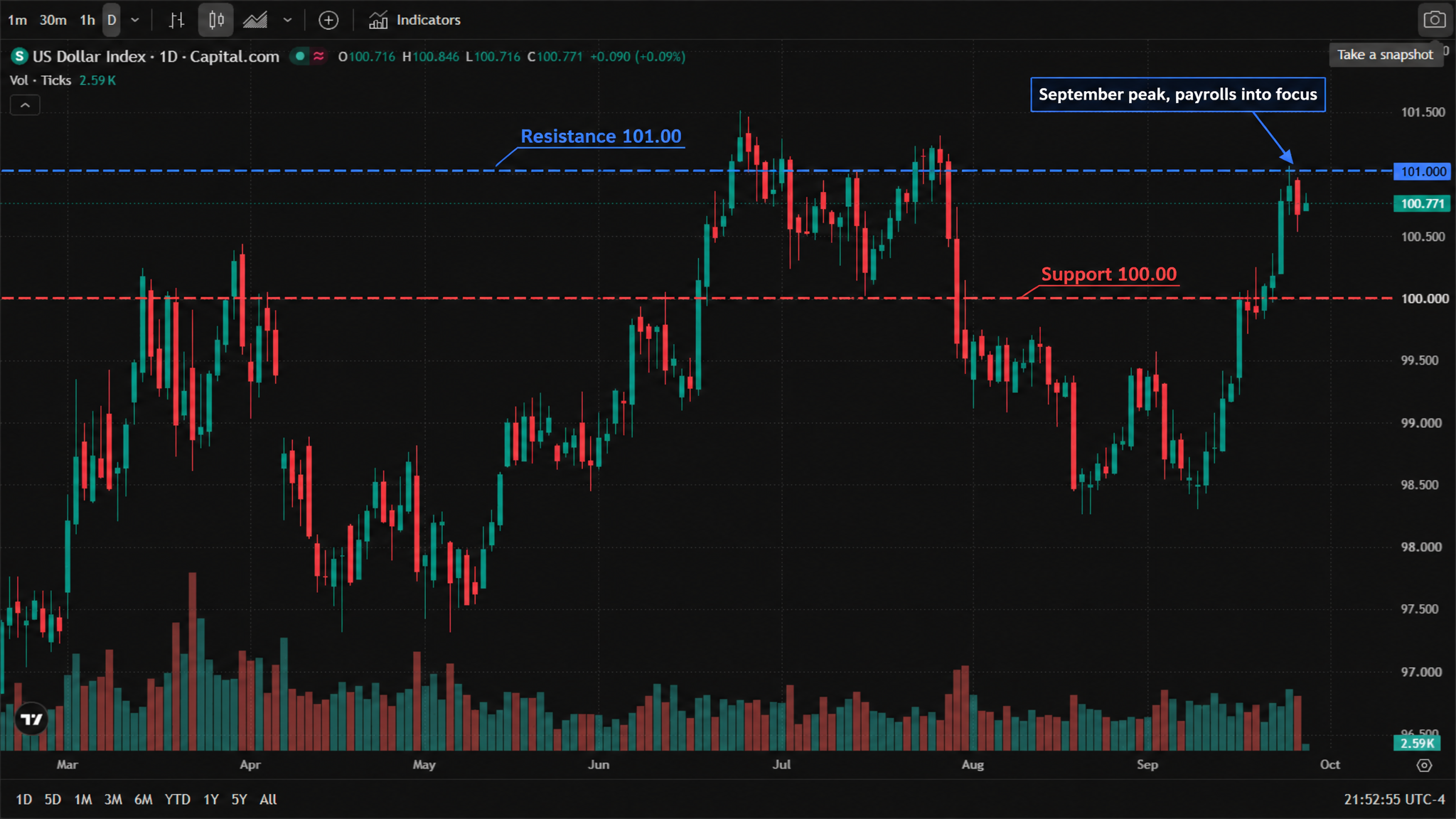
* Chart source: TradingView official chart screenshot (CAPITALCOM:DXY).
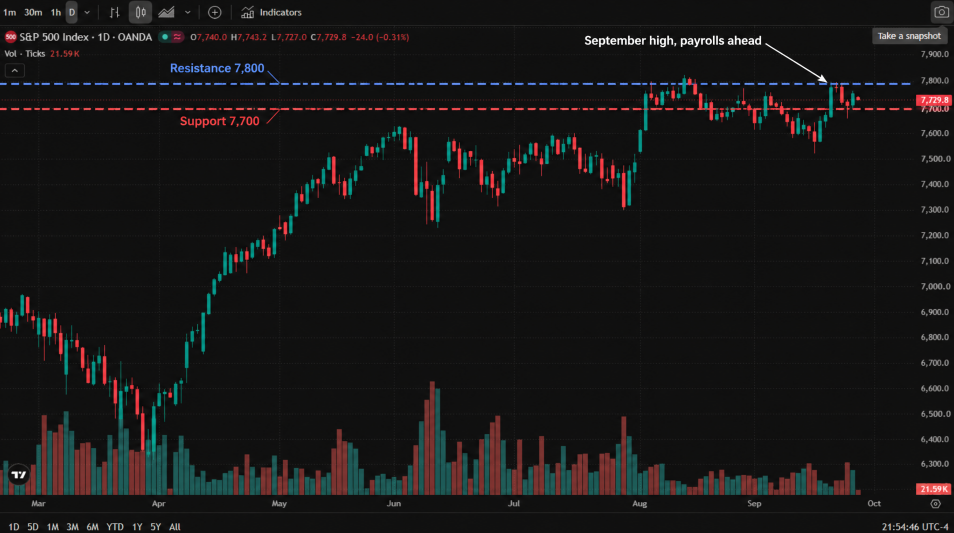
* Chart source: TradingView official chart screenshot (OANDA:SPX500USD).
The dollar is the cleanest read on rate expectations, and it is not positioned for a dovish surprise. DXY closed Friday at 100.97 and trades at 100.771, holding above the 100 line that it reclaimed after the September hike. The S&P 500 at 7,729.8 is a different story — it is within 1% of its August record, but eight of eleven sectors fell in September and the equal-weight index is down about 4%. Underneath a resilient headline index, the average stock is already pricing tighter policy.
4. Two-way scenario
If payrolls beat — say 130,000 or more, with wages at +0.4% m/m: the October hike moves from likely to near-certain, December odds firm further, and the dollar breaks back above 101.00. Gold and rate-sensitive growth stocks take the hit. Watch whether the S&P 500 can hold 7,700; a close below it would suggest the market is finally trading the rate path rather than the AI narrative.
If payrolls miss — 60,000 or fewer, with unemployment ticking up: the "one-and-done" argument returns, and the dollar likely tests 100.00. The immediate reaction would be equity-positive, but only briefly — the reason to cut hiring is usually a weakening economy, and the S&P 500 has already shown it does not like that story either.
The middle case is the most likely and the least tradeable: payrolls near 100,000 with the unemployment rate steady at 4.1%. That keeps October at roughly a coin flip and pushes the decision into the PCE data due October 14 — after the Fed's next meeting, not before it.
5. Key levels and risk
| Asset | Support | Resistance |
|---|---|---|
| US Dollar Index | 100.00 | 101.00 |
| S&P 500 | 7,700 | 7,800 |
| Gold | $4,250 | $4,300 |
The risk in this week is not the number that prints — it is the one the market is not looking at. Wednesday's PCE report carries a methodology change that both Goldman and JPMorgan expect to make core inflation look cooler than it is. If the market treats a technical adjustment as genuine disinflation and then gets a strong payrolls print on Friday, the repricing would be sharper than either release alone would justify.
Read more
* The content presented above, whether from a third party or not, is considered as general advice only. This article should not be construed as containing investment advice, investment recommendations, an offer of or solicitation for any transactions in financial instruments.


