


Pound Sterling jumps as UK inflation accelerates more than expected

 Trending Articles
- Bitcoin Drops to $70,000. U.S. Government Refuses to Bail Out Market, End of Bull Market or Golden Pit?
- Gold rallies further beyond $5,050 amid flight to safety, dovish Fed expectations
- Bitcoin Bottom Debate: $70,000 or $50,000?
- A Crash After a Surge: Why Silver Lost 40% in a Week?
- Bitcoin Slips Below 75,000 Mark. Will Strategy Change Its Mind and Sell?
- Bitcoin Rout. Bridgewater Founder Dalio Publicly Backs Gold.
The Pound Sterling rises sharply after the UK inflation data for October came in hotter than expected.
Hot UK inflation data could diminish the odds of the BoE delivering another interest-rate cut in December.
Several Bank of England policymakers have warned about price pressures remaining persistent.
The Pound Sterling (GBP) gains sharply against its all major peers on Wednesday as data from the United Kingdom (UK) Office for National Statistics (ONS) showed inflation accelerated more than expected in October. The Consumer Price Index (CPI) report showed that the annual headline inflation quickened to 2.3% YoY, higher than estimates of 2.2% and the September reading of 1.7%.
Compared with the previous month, headline inflation rose sharply by 0.6%, higher than expectations of 0.5% and after remaining flat in September.
The core CPI – which excludes volatile items such as food, energy, oil, and tobacco – grew by 3.3%, higher than the former reading of 3.2%. Economists had expected core inflation to fall to 3.1%.
Services inflation, a closely watched indicator by Bank of England (BoE) officials, accelerated to 5% from the prior release of 4.9%. Signs of further acceleration in price pressures could force traders to pare bets supporting interest rate cuts in the BoE December policy meeting.
On Tuesday, traders priced a roughly 80% chance that the BoE will cut interest rates by 25 basis points (bps) in the December meeting, according to Reuters.
Several Bank of England (BoE) policymakers – including Governor Andrew Bailey – also warned about price pressures remaining persistent in the monetary policy hearings before the Treasury Select Committee (TSC) on Tuesday. "Services inflation is still above a level that's compatible with on-target inflation," Andrew Bailey said. BoE external member Catherine Mann, an outspoken hawk, said: "Financial markets' inflation expectations suggest the BoE will not get to sustainable 2% inflation in the forecast
horizon."
Daily digest market movers: Pound Sterling outperforms its all major peers
The Pound Sterling jumps above 1.2700 against the US Dollar (USD) in Wednesday’s London session after the UK CPI report for October showed that inflation came in higher than expected.
The US Dollar Index (DXY), which tracks the Greenback’s value against six major currencies, steadies above the immediate support of 106.10, with investors looking for fresh cues about the Federal Reserve (Fed) interest rate path in 2025.
Given the fact that President-elected Donald Trump’s victory in both United States (US) will allow him to execute his economic agenda smoothly, market participants expect the Fed to follow a more gradual policy-easing cycle. US inflation and economic growth are expected to revamp when Trump takes office as policies such as higher import tariffs and lower taxes are expected to boost demand for domestic products and employment.
Fed officials have refrained from providing projections about the likely impact of Trump’s policies on the economy. Also, they are confident about inflation remaining on a sustainable track towards the bank’s target of 2%.
For the December meeting, the probability for the Fed to reduce interest rates by 25 basis points (bps) to 4.25%-4.50% has diminished to 59% from more than 82% a week ago, according to the CME FedWatch tool. Market expectations for Fed interest rate cuts diminished after Fed Chair Jerome Powell said last Thursday that the economy "is not sending signals that US central bank needs to be in a hurry to lower interest rates.”
Going forward, investors will focus on the flash S&P Global Purchasing Managers’ Index (PMI) data for November, which will be published on Friday. The agency is expected to show that overall private sector activity expanded in the US but remained steady in the UK.
Technical Analysis: Pound Sterling extends recovery to near 1.2700
The Pound Sterling climbs above the round-level resistance of 1.2700 against the US Dollar. The GBP/USD pair gains after a breakout of the three-day trading range of 1.2600-1.2700. The Cable could extend its upside move to 1.2800 if it manages to hold the recovery. On the downside, the six-month low of 1.2600 will act as a major support area.
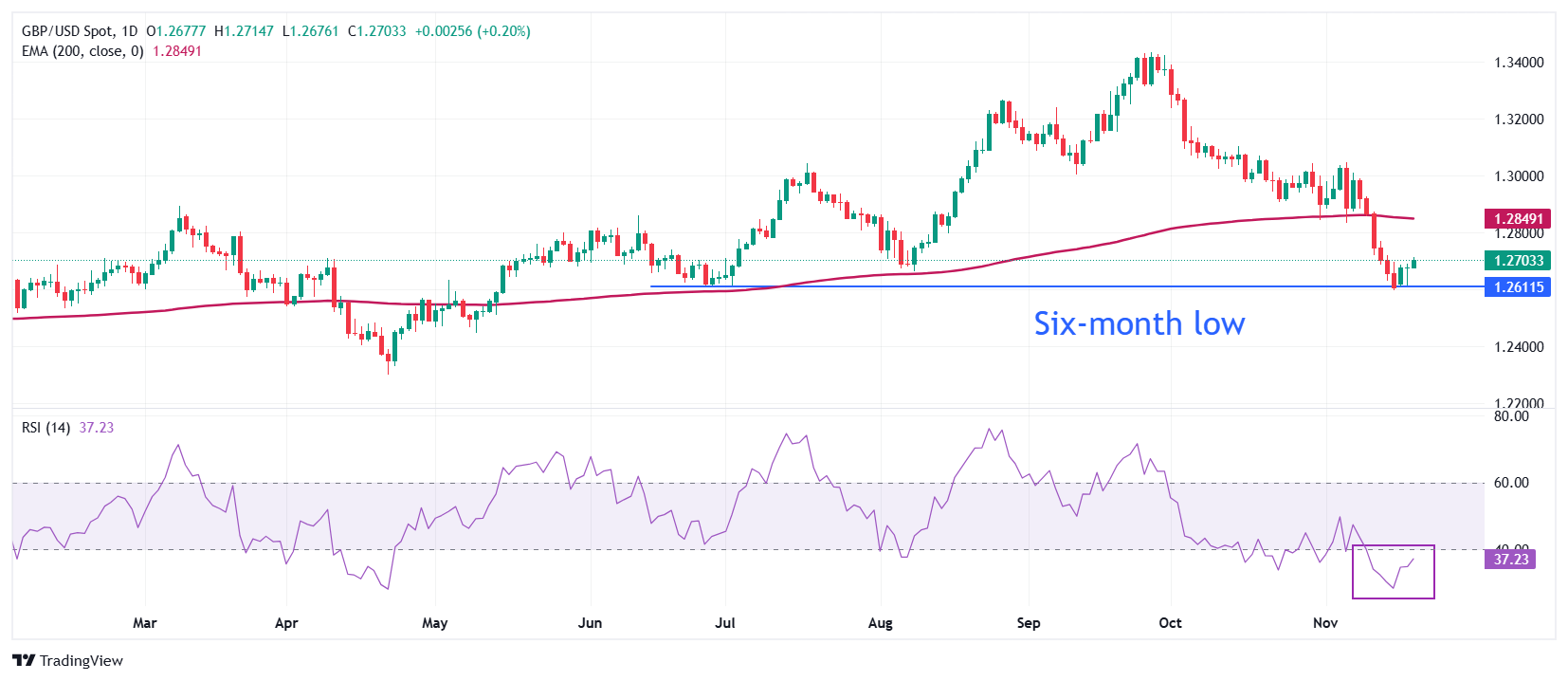
The 14-day Relative Strength Index (RSI) rebounds after turning oversold below 30.00. However, the overall momentum is likely to remain bearish until it breaks above 40.00 decisively.
The overall trend remains negative as the pair trades below the 200-day Exponential Moving Average (EMA), which hovers around 1.2850.
Pound Sterling FAQs
The Pound Sterling (GBP) is the oldest currency in the world (886 AD) and the official currency of the United Kingdom. It is the fourth most traded unit for foreign exchange (FX) in the world, accounting for 12% of all transactions, averaging $630 billion a day, according to 2022 data. Its key trading pairs are GBP/USD, also known as ‘Cable’, which accounts for 11% of FX, GBP/JPY, or the ‘Dragon’ as it is known by traders (3%), and EUR/GBP (2%). The Pound Sterling is issued by the Bank of England (BoE).
The single most important factor influencing the value of the Pound Sterling is monetary policy decided by the Bank of England. The BoE bases its decisions on whether it has achieved its primary goal of “price stability” – a steady inflation rate of around 2%. Its primary tool for achieving this is the adjustment of interest rates. When inflation is too high, the BoE will try to rein it in by raising interest rates, making it more expensive for people and businesses to access credit. This is generally positive for GBP, as higher interest rates make the UK a more attractive place for global investors to park their money. When inflation falls too low it is a sign economic growth is slowing. In this scenario, the BoE will consider lowering interest rates to cheapen credit so businesses will borrow more to invest in growth-generating projects.
Data releases gauge the health of the economy and can impact the value of the Pound Sterling. Indicators such as GDP, Manufacturing and Services PMIs, and employment can all influence the direction of the GBP. A strong economy is good for Sterling. Not only does it attract more foreign investment but it may encourage the BoE to put up interest rates, which will directly strengthen GBP. Otherwise, if economic data is weak, the Pound Sterling is likely to fall.
Another significant data release for the Pound Sterling is the Trade Balance. This indicator measures the difference between what a country earns from its exports and what it spends on imports over a given period. If a country produces highly sought-after exports, its currency will benefit purely from the extra demand created from foreign buyers seeking to purchase these goods. Therefore, a positive net Trade Balance strengthens a currency and vice versa for a negative balance.
Read more
* The content presented above, whether from a third party or not, is considered as general advice only. This article should not be construed as containing investment advice, investment recommendations, an offer of or solicitation for any transactions in financial instruments.


