


Japanese Yen remains on the front foot amid risk-off mood, BoJ’s hawkish outlook

 Trending Articles
- Bitcoin Drops to $70,000. U.S. Government Refuses to Bail Out Market, End of Bull Market or Golden Pit?
- Gold rallies further beyond $5,050 amid flight to safety, dovish Fed expectations
- Bitcoin Bottom Debate: $70,000 or $50,000?
- A Crash After a Surge: Why Silver Lost 40% in a Week?
- Bitcoin Slips Below 75,000 Mark. Will Strategy Change Its Mind and Sell?
- Bitcoin Rout. Bridgewater Founder Dalio Publicly Backs Gold.
The Japanese Yen attracts some haven flows amid renewed trade war fears.
The BoJ’s hawkish rate hike on Friday seems to underpin the JPY further.
The narrowing US-Japan yield differential lends additional support to the JPY.
The Japanese Yen (JPY) kicks off the new week on a positive note amid the global flight to safety, fueled by renewed trade war fears, and the Bank of Japan's (BoJ) hawkish interest rate hike on Friday. Adding to this, hopes that spring wage negotiations will result in strong hikes again this year and allowing the BoJ to tighten its policy further turns out to be another factor underpinning the JPY. This, in turn, dragged the USD/JPY pair back below the mid-155.00s during the Asian session and closer to a one-month low, though a modest US Dollar (USD) uptick could help limit losses.
Meanwhile, bets that the Federal Reserve (Fed) will lower borrowing costs twice this year, bolstered by US President Donald Trump's call for lower interest rates, trigger a fresh leg down in the US Treasury bond yields. The resultant narrowing of the US-Japan yield differential supports prospects for a further appreciating move for the lower-yielding JPY, suggesting that the path of least resistance for the USD/JPY pair remains to the downside. Traders now look forward to the US macro data to grab short-term opportunities later during the early North American session.
Japanese Yen draws support from a combination of factors
US President Donald Trump imposed 25% tariffs on all imports from Colombia after the latter refused to allow two US military planes carrying deported migrants to land in the country.
Trump warned that the tariffs will increase to 50% by next week on further noncompliance, fueling trade war concerns and boosting demand for the traditional safe-haven Japanese Yen.
The anti-risk flow, along with Federal Reserve rate cut bets, drags the US Treasury bond yields lower, narrowing the US-Japan yield differential and lending additional support to the JPY.
The Bank of Japan decided to raise interest rates by 25 basis points, the biggest rate hike since February 2007, from 0.25% to 0.50%, or the highest since the 2008 global financial crisis.
The BoJ reiterated that it would continue to raise the policy rate and adjust the degree of monetary accommodation if the outlook presented at the January policy meeting is realized.
The BoJ does not expect consumer inflation to drop under its 2% target anytime soon and forecast slower growth, though it signaled that rising wages could fuel a ‘virtuous cycle’ of growth.
Data released on Friday showed that Japan's core consumer inflation accelerated to the fastest annual pace in 16 months during December, pointing to broadening inflationary pressure.
Annual spring wage negotiations kicked off in Japan, with the leaders of the top business lobby and labor unions agreeing on the need to maintain the momentum for pay hikes.
Traders now look to Monday's US economic docket – featuring Durable Goods Orders, the Conference Board's Consumer Confidence Index and the Richmond Manufacturing Index.
USD/JPY bears await break below multi-month-old ascending channel support
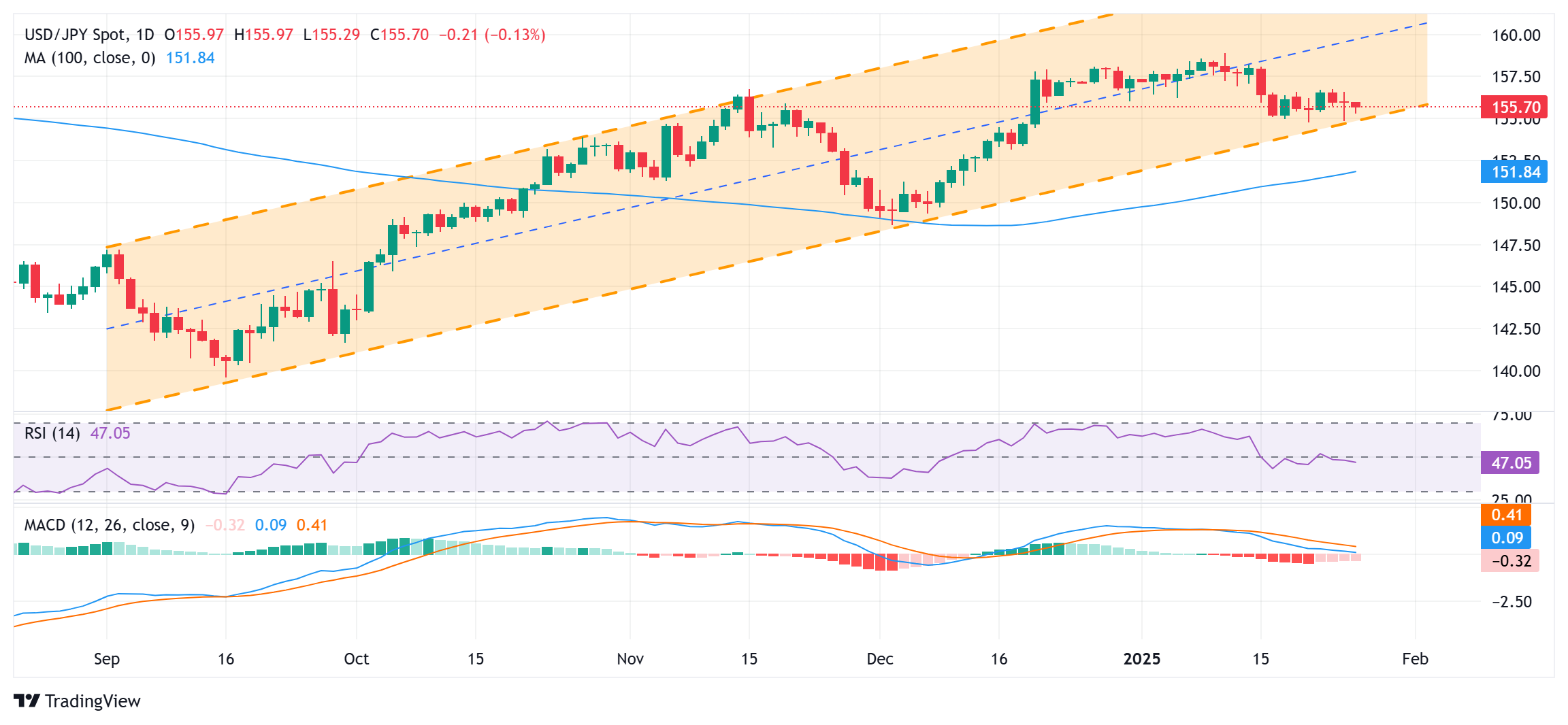
From a technical perspective, any subsequent fall might continue to find support near the lower boundary of a multi-month-old ascending channel, currently pegged near the 155.25 region. This is closely followed by the 155.00 psychological mark and the 154.80-154.75 support, which if broken decisively will be seen as a fresh trigger for bearish traders. Given that oscillators on the daily chart have just started gaining negative traction, the USD/JPY pair might then accelerate the fall towards the 154.00 round figure en route to mid-153.00s and the 153.00 mark.
On the flip side, any attempted recovery might now confront some resistance near the 156.00 mark. The next relevant hurdle is pegged near the 156.75 supply zone. Some follow-through buying, leading to subsequent strength beyond the 157.00 mark, should pave the way for a move towards the 157.55 area en route to the 158.00 mark. The USD/JPY could eventually climb to the 158.35-158.40 region before aiming to retest the multi-month peak, around the 159.00 neighborhood touched on January 10.
Japanese Yen FAQs
The Japanese Yen (JPY) is one of the world’s most traded currencies. Its value is broadly determined by the performance of the Japanese economy, but more specifically by the Bank of Japan’s policy, the differential between Japanese and US bond yields, or risk sentiment among traders, among other factors.
One of the Bank of Japan’s mandates is currency control, so its moves are key for the Yen. The BoJ has directly intervened in currency markets sometimes, generally to lower the value of the Yen, although it refrains from doing it often due to political concerns of its main trading partners. The BoJ ultra-loose monetary policy between 2013 and 2024 caused the Yen to depreciate against its main currency peers due to an increasing policy divergence between the Bank of Japan and other main central banks. More recently, the gradually unwinding of this ultra-loose policy has given some support to the Yen.
Over the last decade, the BoJ’s stance of sticking to ultra-loose monetary policy has led to a widening policy divergence with other central banks, particularly with the US Federal Reserve. This supported a widening of the differential between the 10-year US and Japanese bonds, which favored the US Dollar against the Japanese Yen. The BoJ decision in 2024 to gradually abandon the ultra-loose policy, coupled with interest-rate cuts in other major central banks, is narrowing this differential.
The Japanese Yen is often seen as a safe-haven investment. This means that in times of market stress, investors are more likely to put their money in the Japanese currency due to its supposed reliability and stability. Turbulent times are likely to strengthen the Yen’s value against other currencies seen as more risky to invest in.
Read more
* The content presented above, whether from a third party or not, is considered as general advice only. This article should not be construed as containing investment advice, investment recommendations, an offer of or solicitation for any transactions in financial instruments.


