

Brent swings $105.63 to $102.33 as Gulf risk meets an 'energy ceasefire' — can $100 hold into CPI?


coverImg
Source: DepositPhotos

Mitrade Insights — Brent crude opened the new week with a round trip traders will remember: a spike to $105.63 in early Asian hours on fresh Gulf supply incidents, then a full reversal to $102.33 after the US announced that Russia and Ukraine had agreed to an immediate "energy ceasefire" and that 300,000+ tonnes of Russian diesel would head to global markets. At last look Brent traded near $103.46 (−1.02%) and WTI had slid through $90 to $90.49 (−1.29%) — a session that maps the two forces now fighting over every barrel: war-risk premium up, ceasefire discount down. And it lands three days before a US CPI print in which energy is still the main reason inflation sits above 3%.

The move: one session, two tapes

Friday's settlement had already set the stage: Brent closed at $104.72 (+0.4%) and WTI at $91.85 (+0.4%), with the Middle East supply picture tightening. Monday's Asian session delivered both sides of the trade at once:

Session markerBrentWTI
Friday settle$104.72 (+0.4%)$91.85 (+0.4%)
Monday Asian high$105.63$92.62
Monday Asian low$102.33$89.61
Last (Asian afternoon)$103.46 (−1.02%)$90.49 (−1.29%)

That is a $3.30 range in a single session for Brent — on thin Monday liquidity, with Tokyo markets closed for a holiday and the US bond market shut for Columbus Day, weekend headlines moved prices more than usual.

Why: the weekend delivered two opposite catalysts

Upward force — the Gulf. Over the weekend, missile strikes hit Riyadh's King Khalid International Airport (12 killed, 309 injured on Saturday, with further strikes on Sunday), and shipping incidents spread in the Strait of Hormuz, where one supertanker reportedly hit a mine and at least one more vessel was struck. The US said it was weighing a response. For oil, this is the classic war-risk premium: roughly a fifth of global seaborne crude transits Hormuz, and every incident there re-prices the tail risk of a disruption.

Downward force — the ceasefire and the diesel. On Sunday the US president announced a Russia-Ukraine "energy ceasefire" effective immediately — no further strikes on each other's energy infrastructure. Ukraine's president said the announcement was news to him but added that Kyiv would honour a workable ceasefire; Moscow has not confirmed. More concretely for physical markets, Russia is to ship 300,000+ tonnes of diesel immediately under a deal announced Friday that offers temporary sanctions relief in exchange for fuel supply.

The tape's verdict: the diesel headline and the ceasefire promise carry more near-term weight than the Gulf escalation — for now. Energy equities said the same thing on Monday: Australian oil and gas names (Woodside, Santos, Beach) fell 1–2% even as crude spiked.

The physical market: the Brent-WTI spread tells the story

The Brent-WTI spread sits near $13 ($103.46 vs $90.49) — historically wide, and a signal that the distortion is concentrated in seaborne crude, where the Gulf risk premium applies, rather than in US inland barrels. That's also why the diesel angle matters so much: distillate supply into winter has been the tightest part of the barrel complex, and 300,000 tonnes arriving from Russia is a genuine physical loosening, not just a headline.

Analysts at Commonwealth Bank noted that Friday's rise was a tug-of-war between "the prospect of a wave of Russian diesel hitting global markets" and "mounting supply risks" — a description that fits Monday even better than it fit Friday.
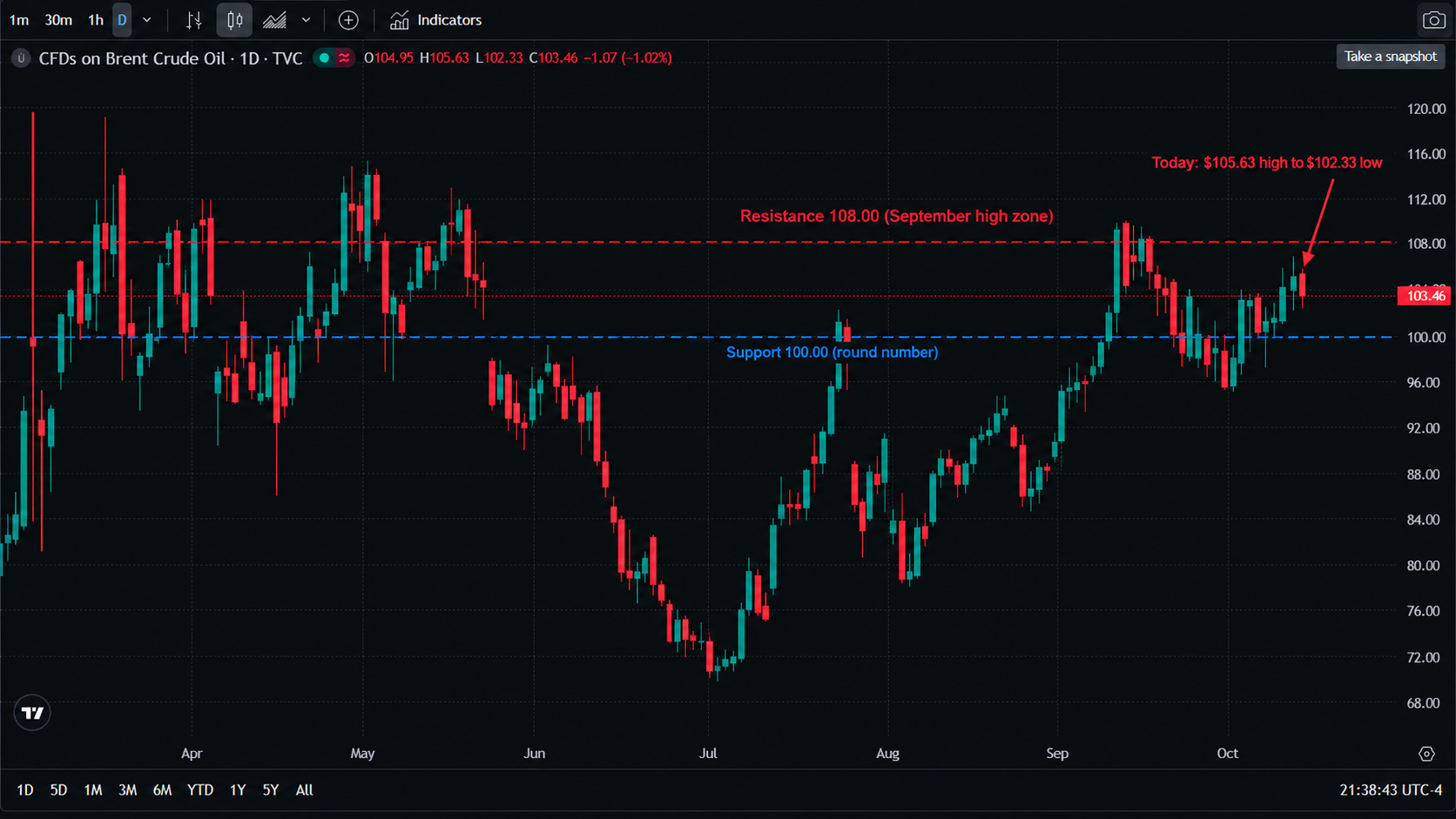
CFDs on Brent Crude Oil (TVC feed) daily candlestick chart, April to October 2026 — a spring slide from above $110 into a July low near $68, an August rebound, a September spike to about $108 and an October pullback into the $100–105 zone; Monday's candle shows the session swinging from a $105.63 high to a $102.33 low, last at $103.46 (−1.02%). The chart marks resistance at 108.00 and support at 100.00, with a red arrow at the rightmost candle pointing out the round trip.

* Chart source: TradingView official chart screenshot, data source TVC (CFDs on Brent Crude Oil).
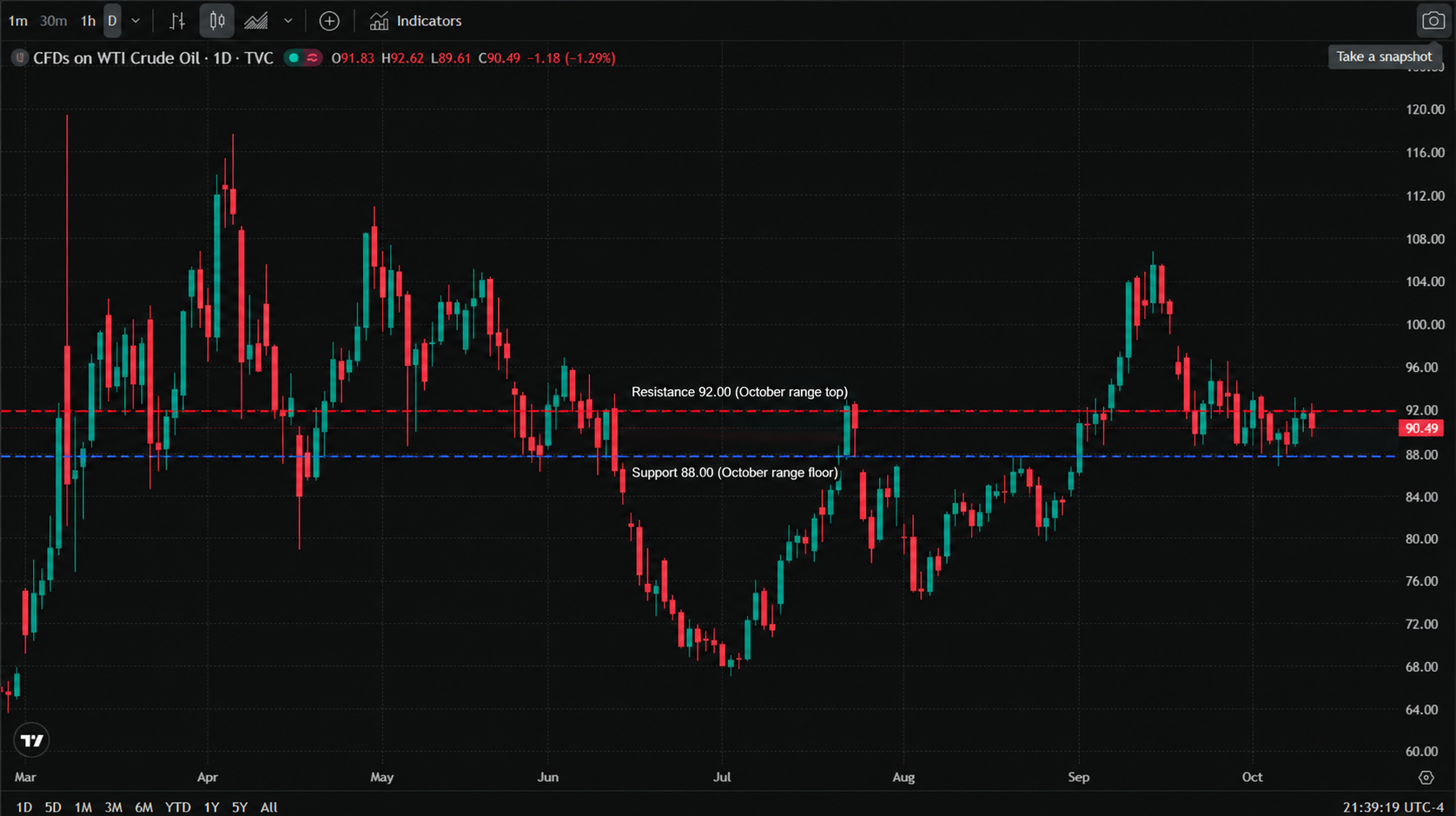

CFDs on WTI Crude Oil (TVC feed) daily candlestick chart, March to October 2026 — a spring slide from above $115 into a July low near $66, a rebound to about $104–106 in September, and an October retreat into the high-$80s; Monday's candle traded from a $92.62 high down to $89.61, last at $90.49 (−1.29%). The chart marks resistance at 92.00 and support at 88.00.

* Chart source: TradingView official chart screenshot, data source TVC (CFDs on WTI Crude Oil).

Levels

Brent key levels. Support: $102.33 (Monday's low — the ceasefire reaction low) / $100 (round number, and the line the market defended through most of early October) / $96 (late-September breakout zone). Resistance: $105.63 (Monday's high) / $108 (September spike zone) / $110 (round number).

WTI key levels. Support: $89.61 (Monday's low) / $88 (October range floor) / $84 (September breakout base). Resistance: $92.62 (Monday's high) / $96 (September shelf) / $100 (round number).

The structure to respect: as long as the ceasefire headline holds the tape, Brent's $100 line is the anchor — a close below it would signal the market is fully pricing a de-escalation discount. A failure of the ceasefire (or a fresh Hormuz incident) flips the tape straight back to $105–108.

What to watch: Wednesday's CPI runs through crude

This is where oil stops being just an oil story. Wednesday's US September CPI (8:30 ET, consensus 3.7% year-over-year) is the last inflation print before the Fed's October 27–28 meeting, and energy has been the single biggest reason headline CPI sits above 3% — energy prices were up roughly 16% year-over-year in August, with gasoline contributing over a third of that month's increase. Every $5 move in crude re-prices that arithmetic.

Scenario A — the ceasefire holds, diesel flows. The war-risk premium bleeds out of Brent; crude drifts toward $100 (WTI toward $88), and energy becomes a disinflationary input for the CPI math and the Fed's December decision. Lower fuel costs would also ease the strain on the consumer sentiment data that has been running at multi-year lows.

Scenario B — the ceasefire fails or the Gulf escalates again. A resumed strike campaign against energy infrastructure — or another Hormuz incident — rebuilds the premium quickly: Brent back through $105.63 toward $108, WTI to $96. That version feeds directly into an upside CPI surprise and puts the Fed's "one more hike" back in play, which would pressure equities and support the dollar.

For traders, the practical point is that this is a two-catalyst week with a single fuse line: Wednesday's CPI. Oil's next $5 and the Fed's next move are now the same trade.

Read more

  • Gold Price Forecast: Gold Tumbles Below $3,900 as Trump Says No Need for Iran Deal; Can October PPI Spur a Rebound?
  • Gold hit a one-year low while central banks bought 321 tonnes — the sellers were never the ones you think
  • Note: If you want to share the article 《Brent swings $105.63 to $102.33 as Gulf risk meets an 'energy ceasefire' — can $100 hold into CPI?》, make sure you retain the original link. For more information, please visit Insights or browse www.mitrade.com.

    * The content presented above, whether from a third party or not, is considered as general advice only.  This article should not be construed as containing investment advice, investment recommendations, an offer of or solicitation for any transactions in financial instruments.

    goTop
    quote
    Related Articles
    placeholder
    Weekly Report: Gold's $4,000 reclaim and Brent's $100 break were right calls — the silver call was wrongLast week this report said gold's $4,000 reclaim was not the trend and that Brent's supply premium was over. Gold fell 4.7% to $3,884.69 and Brent fell 2.52% to $95.84, so both were right. The call that missed was silver: we read a gold-silver ratio of 78.7 as silver being cheap, and the ratio instead broke above 80 to 81.1 as silver fell 5.35%. This report grades the three calls, explains the miss, and sets this week's scorecard around 3,852 gold, 93.73 Brent and 6.00 copper.
    Author  Irene Q.
    58 mins ago
    Last week this report said gold's $4,000 reclaim was not the trend and that Brent's supply premium was over. Gold fell 4.7% to $3,884.69 and Brent fell 2.52% to $95.84, so both were right. The call that missed was silver: we read a gold-silver ratio of 78.7 as silver being cheap, and the ratio instead broke above 80 to 81.1 as silver fell 5.35%. This report grades the three calls, explains the miss, and sets this week's scorecard around 3,852 gold, 93.73 Brent and 6.00 copper.
    placeholder
    Brent rose 3.3% and US crude stocks built 4.66 million barrels in the same weekBrent January settled at 95.82, up 3.3%, and WTI at 88.74, up 2.55%, after the US signalled it would not pursue a deal with Iran and attacks on Gulf shipping continued. In the same week, EIA data showed US crude inventories rising 4.657 million barrels against expectations of a 1.1 million draw, with gasoline up another 1.799 million. OPEC output also rebounded 1.96 million barrels a day to 27.16 million in October, led by Saudi Arabia at 10.56 million. This piece separates the geopolitical premium from the physical balance and lays out where each side of the trade is anchored.
    Author  Irene Q.
    Nov 13, Fri
    Brent January settled at 95.82, up 3.3%, and WTI at 88.74, up 2.55%, after the US signalled it would not pursue a deal with Iran and attacks on Gulf shipping continued. In the same week, EIA data showed US crude inventories rising 4.657 million barrels against expectations of a 1.1 million draw, with gasoline up another 1.799 million. OPEC output also rebounded 1.96 million barrels a day to 27.16 million in October, led by Saudi Arabia at 10.56 million. This piece separates the geopolitical premium from the physical balance and lays out where each side of the trade is anchored.
    placeholder
    US President Donald Trump says military action against Iran doesn't seem to be necessaryUS President Donald Trump said that further strikes on Iran wouldn’t be necessary, but the US remains “locked and loaded,” Bloomberg reported on Monday. Trump added that there is "positive momentum" towards an end to the Iran war.
    Author  FXStreet
    Nov 10, Tue
    US President Donald Trump said that further strikes on Iran wouldn’t be necessary, but the US remains “locked and loaded,” Bloomberg reported on Monday. Trump added that there is "positive momentum" towards an end to the Iran war.
    placeholder
    Weekly Report: Gold up 4.5%, Brent down 16.4% — three commodity regimes just resetGold rose 4.51% to $4,074.90 while Brent fell 16.42% to $98.32 in the same five sessions — two inflation hedges, opposite answers. Around them, the gold-silver ratio sits at 78.7 and copper fell 3.72%. Three regime signals, two of them close to flipping, define what commodity traders must re-price before Tuesday's CPI.
    Author  Irene Q.
    Nov 09, Mon
    Gold rose 4.51% to $4,074.90 while Brent fell 16.42% to $98.32 in the same five sessions — two inflation hedges, opposite answers. Around them, the gold-silver ratio sits at 78.7 and copper fell 3.72%. Three regime signals, two of them close to flipping, define what commodity traders must re-price before Tuesday's CPI.
    placeholder
    WTI struggles below $87.50 as Democrats seek end to Iran war after midterm sweepWest Texas Intermediate (WTI) – the benchmark US Crude Oil price – remains depressed for the second straight day on Thursday, trading just below mid-$87.00s during the Asian session and close to a near one-month low touched the previous day.
    Author  FXStreet
    Nov 05, Thu
    West Texas Intermediate (WTI) – the benchmark US Crude Oil price – remains depressed for the second straight day on Thursday, trading just below mid-$87.00s during the Asian session and close to a near one-month low touched the previous day.
    Live Quotes
    Name / SymbolChart% Change / Price
    UKOIL
    UKOIL
    0.00%0.00
    USOIL
    USOIL
    0.00%0.00

    Oil Related Articles

    • Best Oil Trading Platforms in 2026: A Complete Guide for Retail Traders
    • Should I Invest in Oil Right Now? The 2026 Oil Price Forecast
    • Crude Oil Trading: How To Invest In WTI/Brent Oil?
    • WTI Moves Upward Near $75.50 on Dovish Fed Outlook, Maersk, CMA CGM Return to Red Sea

    Click to view more