


Did Amazon Just Say "Checkmate" to Nvidia?
It's been a busy week for semiconductor darling Nvidia (NASDAQ: NVDA). The company hosted its annual GTC summit, showcasing to investors the latest and greatest in product innovation, customer testimonials, and more.
In the middle of all the hoopla, e-commerce and cloud computing behemoth Amazon (NASDAQ: AMZN) attempted to take a jab at Nvidia.
Where to invest $1,000 right now? Our analyst team just revealed what they believe are the 10 best stocks to buy right now. Learn More »
Below, I'll detail some interesting developments out of Amazon and explore whether the "Magnificent Seven" member just made its checkmate move against Nvidia.
What did Amazon just do?
Amazon's cloud division -- Amazon Web Services (AWS) -- is a pretty sophisticated operation. AWS develops a multitude of different platforms and even has a large infrastructure component to the business, including data centers and custom chipsets.
For much of the last two years, Nvidia hasn't faced much of a competitive threat when it comes to data center graphics processing units (GPU). This dynamic has provided Nvidia with unparalleled pricing power.
But according to a new report from The Information, AWS is looking to make a splash in the chip realm by competing with Nvidia on price. Per the report, AWS claims that its Trainium chipsets perform on par with Nvidia's H100 (called Hopper) but is looking to sell them for 25% of what Nvidia sells its GPUs for.
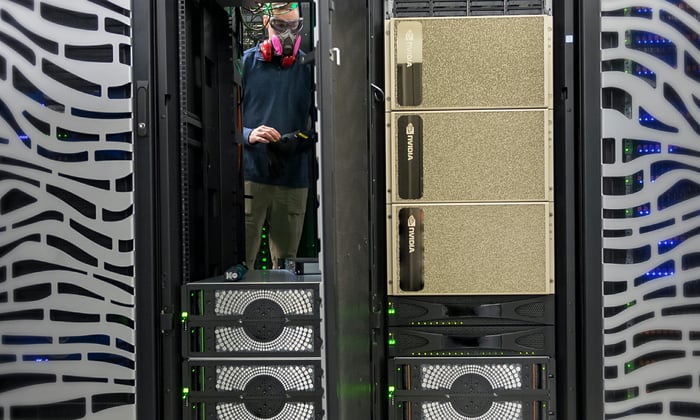
Image source: Nvidia.
Pricing pressure was going to be a factor at some point
On the surface, selling a product that is as good as the mainstream but at a significantly reduced rate looks like an unwanted headwind for Nvidia. However, there are a couple of finer details I'd like to explore further.
One of the downsides of experiencing unprecedented demand can be found in the supply chain. Over the last two years, Nvidia has had to invest significant effort and capital into supply chain logistics to try to mitigate any bottlenecks in its backlog. Considering demand for the company's chips doesn't appear to fading, many of its own customers including Microsoft, Meta Platforms, and Alphabet have all made it clear that they are developing their own custom silicon solutions in an effort to reduce such heavy reliance on Nvidia.
On top of that, Advanced Micro Devices has quietly emerged as a fast-growing alternative to Nvidia's data center GPUs over the last year. The company has attracted the likes of Microsoft, Meta, and Oracle as customers, complementing their Nvidia infrastructure with AMD's new MI300 accelerators.
Broadly speaking, when new products begin to enter the marketplace, legacy providers tend to be forced to alter their pricing strategies in an effort to remain competitive. With custom silicon solutions from cloud hyperscalers, as well as alternative chipsets from AMD on the rise, I think it was only a matter of time before Nvidia was going to face some pricing pressure.
Even with rising competition, I think Nvidia may have a workaround to Amazon's pricing strategy. During the GTC conference, Nvidia CEO Jensen Huang jokingly called himself the "chief revenue destroyer" when talking about the Hopper chip.
Why would he do that? Well, Huang went on to say that "there are circumstances where Hopper is fine. That's the best thing I could say about Hopper. There are circumstances where you're fine. Not many."
In essence, Huang is more or less saying that AI development is moving at such a rapid pace that the chipsets that were once considered the industry-standard are already going out of style. Luckily for Nvidia, that's not a problem. The company's next-generation architecture, dubbed Blackwell, generated $11 billion in sales during the fourth quarter and demand for the new chips remains sky high.
My final take
In a way, I view Huang talking down the Hopper GPUs as a clever way to sell Blackwell chips and market just how powerful these new products are. Taking this a step further, Huang spent quite a bit of time at GTC to talk to investors about Blackwell's successor product, the Rubin architecture.
The idea I really want to drive home here is that Nvidia is innovating at a staggering pace, so I don't see Amazon's Trainium chips as much of a headwind for Nvidia. While it's likely some businesses will settle for less sophisticated architecture at a more efficient price point, I do not see Amazon's pricing strategy as a checkmate move against Nvidia in the long-run.
Don’t miss this second chance at a potentially lucrative opportunity
Ever feel like you missed the boat in buying the most successful stocks? Then you’ll want to hear this.
On rare occasions, our expert team of analysts issues a “Double Down” stock recommendation for companies that they think are about to pop. If you’re worried you’ve already missed your chance to invest, now is the best time to buy before it’s too late. And the numbers speak for themselves:
- Nvidia: if you invested $1,000 when we doubled down in 2009, you’d have $314,847!*
- Apple: if you invested $1,000 when we doubled down in 2008, you’d have $41,848!*
- Netflix: if you invested $1,000 when we doubled down in 2004, you’d have $524,186!*
Right now, we’re issuing “Double Down” alerts for three incredible companies, and there may not be another chance like this anytime soon.
Continue »
*Stock Advisor returns as of March 24, 2025
John Mackey, former CEO of Whole Foods Market, an Amazon subsidiary, is a member of The Motley Fool’s board of directors. Suzanne Frey, an executive at Alphabet, is a member of The Motley Fool’s board of directors. Randi Zuckerberg, a former director of market development and spokeswoman for Facebook and sister to Meta Platforms CEO Mark Zuckerberg, is a member of The Motley Fool's board of directors. Adam Spatacco has positions in Alphabet, Amazon, Meta Platforms, Microsoft, and Nvidia. The Motley Fool has positions in and recommends Advanced Micro Devices, Alphabet, Amazon, Meta Platforms, Microsoft, Nvidia, and Oracle. The Motley Fool recommends the following options: long January 2026 $395 calls on Microsoft and short January 2026 $405 calls on Microsoft. The Motley Fool has a disclosure policy.
Recommended Articles


