


The Supreme Court's Ruling on President Donald Trump's Tariffs Could Have Unintended Consequences for the Stock Market
Key Points
Prediction market operator Kalshi currently places a low likelihood of the Supreme Court upholding Trump's tariffs.
While many have perceived the tariffs as negative for the market, there are other factors investors must consider.
If the Supreme Court strikes down tariffs, the stock market's reaction may not be positive, at least initially.
- These 10 stocks could mint the next wave of millionaires ›
The Supreme Court is currently arguing a critical case that will determine the fate of many of President Donald Trump's highly controversial tariffs. While some of those following the case might assume that a conservative-leaning court would uphold Trump's tariffs, users of the prediction market platform Kalshi currently (as of Nov. 7) only place a 21% chance of such an outcome occurring.
Considering the market's brutal sell-off in April when Trump first announced the tariffs, it's understandable that investors might think the stock market will react positively if the Supreme Court rules Trump's tariff actions unconstitutional. However, like most things in the stock market, the answer is not so simple, and there is more than meets the eye with this particular case.
Where to invest $1,000 right now? Our analyst team just revealed what they believe are the 10 best stocks to buy right now. Continue »
Here's why the Supreme Court's ruling on Trump's tariffs could have unintended consequences for the stock market.
Official White House photo by Tia Dufour.
The economic impact of tariffs is still largely unknown
Tariffs are taxes on imports. The purpose is to make the cost of goods produced abroad (which can often be made cheaper) higher, so they are less competitive with domestically made goods. Trump wants to bring back more manufacturing jobs to the U.S. One way to do this is for more companies to make their products in the U.S. However, unwinding globalization doesn't happen overnight, and at the end of the day, market forces might simply be too strong.
There is widespread debate on the overall impact of tariffs on the economy, and we likely won't know the truth until things play out further.
To start with the cons, if the tariffs remain, think tanks like the Conference Board and Yale Budget Lab believe tariffs will prove to be a drag on gross domestic product (GDP). Other economists believe tariffs will reignite inflation because companies will likely pass the higher costs onto consumers through price hikes. Many companies have announced charges or higher costs due to tariffs, and whether caused by tariffs or not, inflation has edged up for most of the time that tariffs have been in place, although perhaps not to the degree that some might have initially thought.
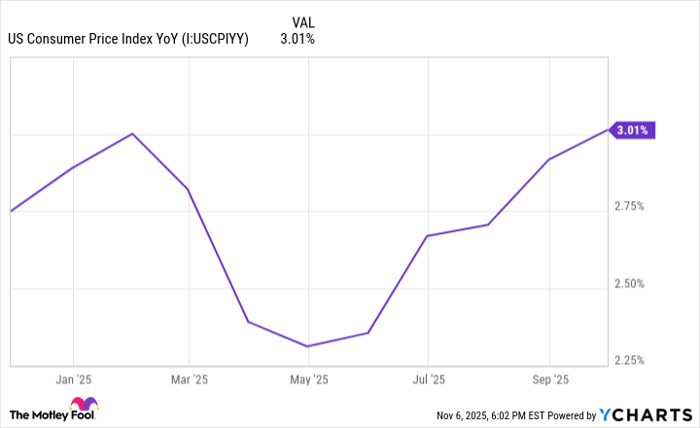
Data by YCharts.
Tariffs are now intertwined with Trump's tax cuts
The big upside of tariffs is that they are expected to generate significant revenue for the U.S. government. In fact, as recently as August, the nonpartisan Congressional Budget Office (CBO) estimated that tariffs could bring in up to $4 trillion in revenue over the next decade.
That would be very helpful for the U.S. government, as it's currently running some $38 trillion in total debt, which requires the government to make significant interest payments from its budget each year. In fact, the government allocated 14% of its budget in the 2025 fiscal year to these interest payments. Given the cons mentioned, if the Supreme Court were to rule the tariffs illegal and the U.S. government had to refund the duties they've already collected, one might think it would benefit the stock market because it removes a potential threat to inflation, and many companies would not incur higher costs.
But remember, the Republican-controlled Congress earlier this year passed a sweeping spending package that made significant tax cuts imposed in Trump's first term permanent, and also implemented many new temporary tax cuts as well. The CBO in July estimates that the spending bill would increase federal deficits by about $3.4 trillion over the next year.
Increasing bond yields may hurt the market
The Trump administration's playbook has seemingly been to offset the impact of its spending bill on the country's deteriorating fiscal situation with revenue from tariffs. But if the tariffs are struck down, the government's total debt and fiscal deficits are going up, which may bring a return of the bond vigilantes.
Bond vigilantes, a term coined by prolific Wall Street strategist Ed Yardeni in the 1980s, are buyers of U.S. debt through U.S. Treasury bonds that essentially sell these bonds, particularly longer-dated ones, when they don't think the government is prudently managing its finances. Selling bonds sends bond yields higher.
As the government has run up higher and higher debts and had to spend more each year on interest expense, the bond vigilantes have started to be a lot more visible, driving up longer-dated Treasury yields to alarming levels, as seen earlier this year. This is also partly the reason that the price of gold has surged as well.
Investors only want to see higher long-term yields if the economy is expanding, not because of the bond vigilantes. Otherwise, higher yields can result in inflation and lead to a risk-off appetite in the market. If longer-term yields start to creep higher, especially as the Federal Reserve is lowering its overnight benchmark lending rate, that could begin to spook the market. This factor may have contributed to the stock market sell-off in the early days of the Supreme Court case, when it became apparent on Kalshi that the tariffs might not survive.
So, while many economists do view tariffs negatively, whether due to the risk of higher inflation or slower GDP growth, they are somewhat intertwined with Trump's spending bill, which can't really be undone.
So what about the stock market?
Ultimately, if the Supreme Court rules Trump's tariff actions unconstitutional, bond yields could rise, hurting the stock market. Whether investors will eventually be able to determine if zero or smaller tariff levels are better for the stock market long term, it's hard to say. But I do think investors should be prepared for a negative market reaction or some volatility if the Supreme Court determines that the tariffs were illegal.
Where to invest $1,000 right now
When our analyst team has a stock tip, it can pay to listen. After all, Stock Advisor’s total average return is 1,064%* — a market-crushing outperformance compared to 194% for the S&P 500.
They just revealed what they believe are the 10 best stocks for investors to buy right now, available when you join Stock Advisor.
See the stocks »
*Stock Advisor returns as of November 10, 2025
The Motley Fool has a disclosure policy.
Recommended Articles


