


Pound Sterling consolidates against US Dollar as Trump’s reciprocal tariffs take centre stage
- The Pound Sterling trades sideways near 1.2940 against the US Dollar as investors await US President Trump to unveil reciprocal tariffs on Wednesday.
- Goldman Sachs sees higher risks of a US recession amid Trump tariff jitters.
- The BoE is expected to follow a moderate monetary expansion cycle this year.
The Pound Sterling (GBP) flattens against the US Dollar (USD) around 1.2940 in Monday’s European session. The GBP/USD pair trades flat as investors turn cautious ahead of the so-called “Liberation Day” on Wednesday, when United States (US) President Donald Trump will announce reciprocal tariffs on his trading allies.
The imposition of reciprocal levies by US President Trump will significantly impact global economic growth. Goods attracting higher duties will become less competitive globally, and their respective firms will be forced to lower their prices significantly. Such a scenario will force them to dump their products in other nations.
Analysts at Barclays said, "We expect the countries with the largest trade deficits in goods with the US and with the highest tariffs and non-tariff trade barriers could potentially be the target of the reciprocal tariffs.” As to their theory, the European Union (EU), China, Canada, India, and Japan will face higher tariffs from the US.
Financial market participants believe that the US economy will also face economic risks in the near term due to Trump’s tariffs. Analysts at Goldman Sachs have revised the chances of a recession in the US to 35% from their prior expectations of 20%. Their upward revision for recession risks has been based on a sharp “deterioration in household and business confidence”, and statements from the White House officials indicating “greater willingness to tolerate near-term economic weakness” in pursuit of their policies.
Daily digest market movers: Pound Sterling remains broadly firm
- The Pound Sterling trades higher against its major peers on Monday, except the Japanese Yen (JPY), whose safe-haven appeal has increased amid fears of Trump’s tariffs. The British currency gains as investors expect Trump’s reciprocal tariffs to have a nominal impact on the United Kingdom’s (UK) economic outlook.
- On Thursday, UK Chancellor of the Exchequer Rachel Reeves said in an interview with Bloomberg Television that they are working intensely these next few days to try and secure a “good deal for Britain”. The optimism that the impact of Trump’s tariffs will be very limited on the UK is also driven by Trump’s comments in late February that he is not sure about imposing tariffs on the UK. Trump also sounded confident that a deal could be made as UK Prime Minister Keir Starmer was "very nice".
- Meanwhile, upbeat UK Retail Sales data for February has also strengthened the Pound Sterling. The Office for National Statistics (ONS) reported on Friday that Retail Sales, a key measure of consumer spending, surprisingly rose by 1% month-on-month compared to an expected 0.3% decline.
- Additionally, hopes of a moderate policy-easing cycle by the Bank of England (BoE) has also kept the Pound Sterling on the frontfoot. Market participants expect the BoE to cut interest rates only two times more this year. The BoE has already reduced borrowing rates once in 2025.
Technical Analysis: Pound Sterling stays around 61.8% Fibonacci retracement at 1.2930
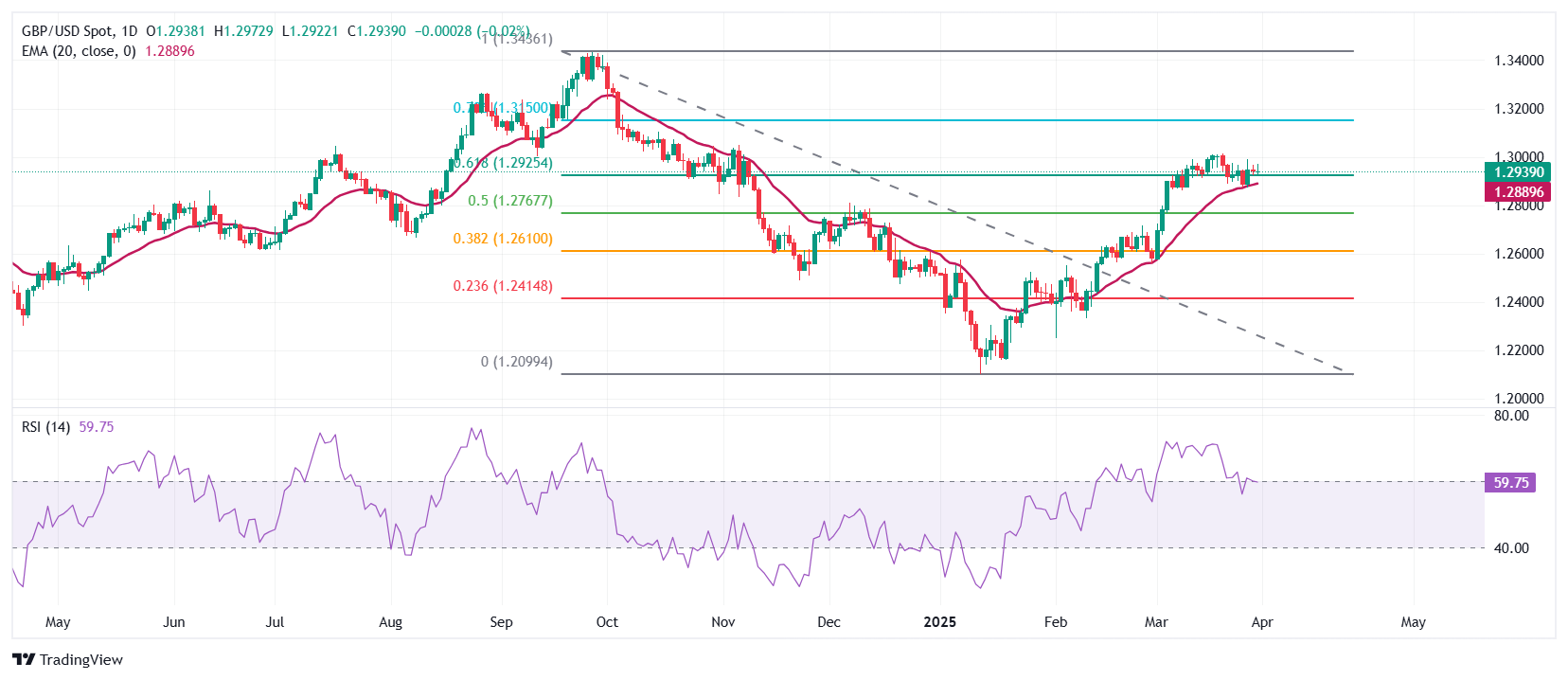
The Pound Sterling continues to wobble around the 61.8% Fibonacci retracement, plotted from late-September high to mid-January low, near 1.2930 against the US Dollar. Additionally, the 20-day Exponential Moving Average (EMA) continues to provide support to the pair around 1.2890.
The 14-day Relative Strength Index (RSI) cools down to near 60.00 after turning overbought above 70.00. Should a fresh bullish momentum come into action if the RSI resumes the upside journey after holding above the 60.00 level
Looking down, the 50% Fibonacci retracement near 1.2770 and the 38.2% Fibonacci retracement at 1.2610 will act as key support zones for the pair. On the upside, the October 15 high of 1.3100 will act as a key resistance zone.
Pound Sterling FAQs
The Pound Sterling (GBP) is the oldest currency in the world (886 AD) and the official currency of the United Kingdom. It is the fourth most traded unit for foreign exchange (FX) in the world, accounting for 12% of all transactions, averaging $630 billion a day, according to 2022 data. Its key trading pairs are GBP/USD, also known as ‘Cable’, which accounts for 11% of FX, GBP/JPY, or the ‘Dragon’ as it is known by traders (3%), and EUR/GBP (2%). The Pound Sterling is issued by the Bank of England (BoE).
The single most important factor influencing the value of the Pound Sterling is monetary policy decided by the Bank of England. The BoE bases its decisions on whether it has achieved its primary goal of “price stability” – a steady inflation rate of around 2%. Its primary tool for achieving this is the adjustment of interest rates. When inflation is too high, the BoE will try to rein it in by raising interest rates, making it more expensive for people and businesses to access credit. This is generally positive for GBP, as higher interest rates make the UK a more attractive place for global investors to park their money. When inflation falls too low it is a sign economic growth is slowing. In this scenario, the BoE will consider lowering interest rates to cheapen credit so businesses will borrow more to invest in growth-generating projects.
Data releases gauge the health of the economy and can impact the value of the Pound Sterling. Indicators such as GDP, Manufacturing and Services PMIs, and employment can all influence the direction of the GBP. A strong economy is good for Sterling. Not only does it attract more foreign investment but it may encourage the BoE to put up interest rates, which will directly strengthen GBP. Otherwise, if economic data is weak, the Pound Sterling is likely to fall.
Another significant data release for the Pound Sterling is the Trade Balance. This indicator measures the difference between what a country earns from its exports and what it spends on imports over a given period. If a country produces highly sought-after exports, its currency will benefit purely from the extra demand created from foreign buyers seeking to purchase these goods. Therefore, a positive net Trade Balance strengthens a currency and vice versa for a negative balance.
Recommended Articles


